
Solder Joint Inspection
Solder joint inspection is the process of examining solder connections on a printed circuit board to ensure they meet quality and reliability standards. It is a critical step in Montering av kretskort, especially in SMT-montering, where precise and reliable solder joints are essential for proper electrical and mechanical performance.
This inspection ensures that every connection between components and the PCB is correctly formed, free of defects, and capable of long-term operation.
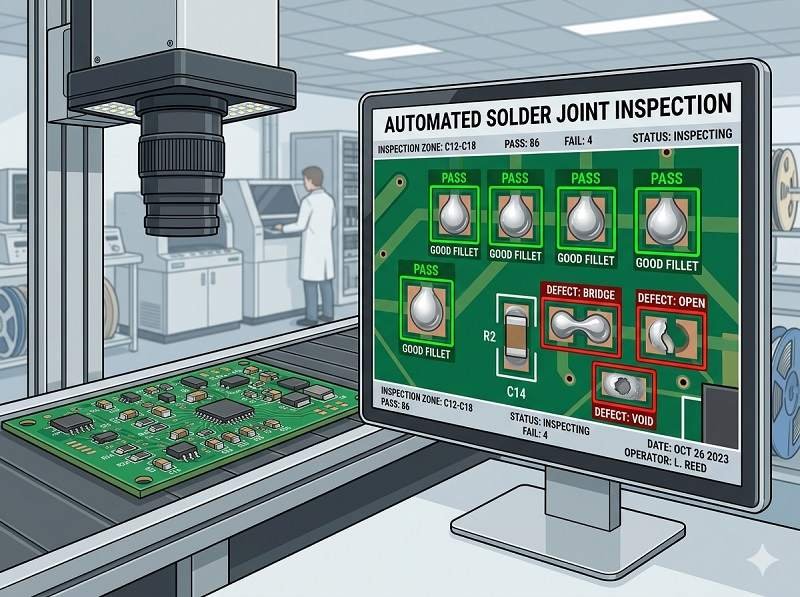
Why Solder Joint Inspection Is Important
Solder joints are the foundation of all electronic connections.
Defective joints can lead to electrical failure, intermittent signals, or complete product malfunction. In high-reliability applications, poor soldering can cause serious safety and performance issues.
I Tillverkning av kretskort och Nyckelfärdig PCB-montering, solder joint inspection helps detect problems early, reducing rework costs and improving product quality.
Common Solder Joint Defects
During inspection, several types of defects are typically identified.
- Cold solder joints (dull, weak connections)
- Solder bridges (short circuits between pads)
- Insufficient or excessive solder
- Voids within solder joints
- Tombstoning of small components
- Cracks or mechanical damage
Identifying these defects is essential in SMT-montering processer.
Methods of Solder Joint Inspection
Different inspection methods are used depending on the complexity of the PCB and component types.
Visual Inspection (Manual Inspection)
Operators visually check solder joints using magnification tools.
It is suitable for simple boards but depends on operator skill.
AOI (automatiserad optisk inspektion)
AOI systems use cameras to scan PCBs and detect defects automatically.
Det används ofta i Montering av kretskort for high-speed and consistent inspection.
Röntgeninspektion
X-ray systems are used to inspect hidden solder joints, such as BGAs and QFNs.
This method is essential for advanced SMT-montering where joints are not visible.
Microscopic Inspection
High-magnification microscopes are used for detailed analysis of critical areas.
Inspection Standards
Solder joint inspection is typically performed according to industry standards such as IPC-A-610.
These standards define acceptable and unacceptable solder joint conditions, ensuring consistency in Tillverkning av kretskort and assembly processes.
Role in SMT Assembly
I SMT-montering, solder joint inspection is performed after reflow soldering.
It verifies that components are correctly soldered and that no defects were introduced during the process.
Inspection results may trigger rework or process adjustments.
Role in Turnkey PCB Assembly
I Nyckelfärdig PCB-montering, solder joint inspection is integrated throughout the production process.
From initial assembly to final quality control, inspection ensures that all boards meet customer requirements and industry standards.
This improves overall product reliability and reduces failure rates.
Best Practices for Solder Joint Inspection
To achieve effective inspection, manufacturers should:
Use a combination of inspection methods (AOI, X-ray, manual).
Train operators according to IPC standards.
Implement inline inspection systems for real-time feedback.
Regularly calibrate inspection equipment.
Maintain proper documentation and traceability.
Slutsats
Solder joint inspection is a vital quality control step in electronics manufacturing. It ensures that all solder connections are reliable, defect-free, and compliant with industry standards.
I Montering av kretskort, SMT-montering, och Nyckelfärdig PCB-montering, effective solder joint inspection plays a key role in delivering high-quality, durable, and reliable electronic products.
Ladda upp dina filer och få en detaljerad offert. Klicka nedan för att börja.
Vi erbjuder professionella tjänster för PCB-montering, inklusive SMT, DIP och kompletta nyckelfärdiga lösningar.
✔ NDA tillgängligt ✔ Snabb offert inom 24 timmar ✔ ISO-certifierad fabrik ✔ One-stop PCB & PCBA Service


 Svenska
  English
  Deutsch
  Français
  Português do Brasil
  Español
  日本語
日本語  Nederlands
  Italiano
  Русский
  한국어
한국어  العربية
  Polski
  Türkçe
  繁體中文
繁體中文