
IPC-2581 file format
IPC-2581 is an open, intelligent data exchange format used in electronics manufacturing to transfer complete PCB design information in a single file. It is designed to replace traditional Gerber files by providing a more comprehensive and error-free solution for PCB 組裝, PCB 製造, 以及 SMT 組裝 流程。.
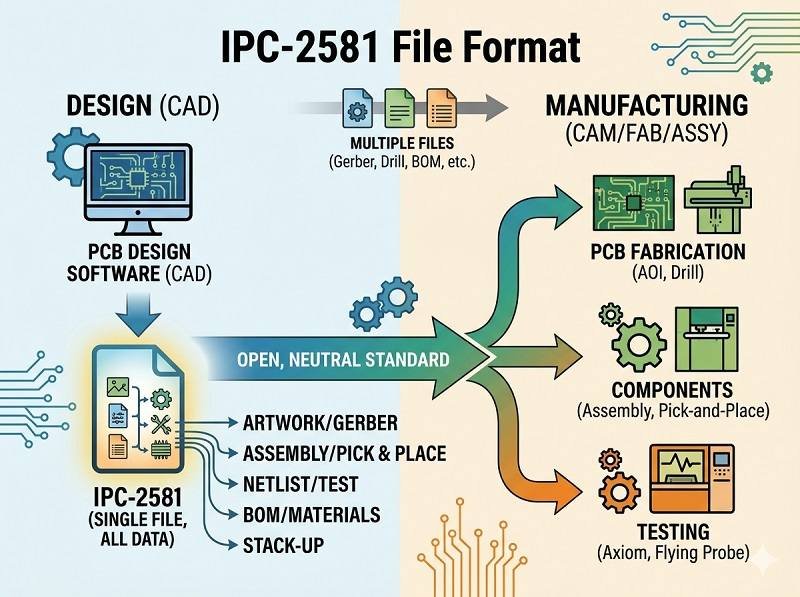
Overview of IPC-2581
The IPC-2581 format is developed and maintained by the IPC, a global association that sets standards for the electronics industry.
Unlike Gerber, which requires multiple files for different layers and processes, IPC-2581 consolidates all manufacturing data into one unified file. This includes PCB layout, layer stack-up, drill data, netlist, BOM, and assembly information.
This makes IPC-2581 especially valuable for modern PCB 組裝 workflows where accuracy and automation are critical.
What data does IPC-2581 include
One of the biggest advantages of IPC-2581 is that it contains all necessary data for both fabrication and assembly.
Typical information included:
- PCB layer data (copper, solder mask, silkscreen)
- Drill and via information
- Netlist (electrical connectivity)
- Stack-up details
- Component placement (X/Y coordinates)
- 物料清單 (BOM)
- Assembly drawings and instructions
This eliminates the need to send separate Gerber files, pick-and-place files, and BOM documents for SMT 組裝.
IPC-2581 vs Gerber files
Traditional Gerber files are widely used in PCB 製造, but they have limitations.
Gerber is a graphical format that describes shapes and layers but does not include intelligent data such as netlist or component information. As a result, manufacturers must rely on additional files and manual interpretation, which increases the risk of errors.
IPC-2581, on the other hand, is a fully intelligent format. It provides machine-readable data for both fabrication and PCB 組裝, enabling higher automation and fewer misunderstandings.
Benefits of IPC-2581
Using IPC-2581 offers several advantages in PCB 組裝 和生產。.
First, it reduces errors by eliminating manual data interpretation. Since all information is included in one file, there is less chance of mismatch between Gerber, BOM, and pick-and-place data.
Second, it improves efficiency. Manufacturers can directly import IPC-2581 data into their systems, speeding up CAM processing and SMT 組裝 setup.
Third, it enhances communication between designers and manufacturers. A single standardized file simplifies data exchange and reduces back-and-forth clarification.
Finally, it supports advanced manufacturing requirements such as high-density designs and complex multilayer boards.
Limitations and adoption
Despite its advantages, IPC-2581 adoption is still growing.
Some manufacturers continue to rely on Gerber because it is widely supported and familiar. Not all PCB design tools and factories fully support IPC-2581 yet, although this is rapidly changing.
適用於 原型 PCB 組裝, many suppliers still request Gerber files due to compatibility reasons. However, more advanced manufacturers are beginning to accept IPC-2581 as a preferred format.
When to use IPC-2581
IPC-2581 is particularly useful for complex designs, high-reliability products, and automated production environments.
If your project involves advanced SMT 組裝, tight tolerances, or requires high accuracy, IPC-2581 can significantly improve data integrity and production efficiency.
It is also ideal when working with modern PCB 製造 partners that support digital workflows.
總結
IPC-2581 is a next-generation file format that simplifies and improves data exchange in electronics manufacturing. By combining all necessary information into a single intelligent file, it enhances efficiency, reduces errors, and supports advanced PCB 組裝 流程。.
While Gerber remains widely used, IPC-2581 is becoming increasingly important for companies looking to optimize 原型 PCB 組裝 和大型 SMT 組裝 生產。.
需要快速準確的 PCB 裝配報價?在幾秒鐘內提交您的請求。.
我們提供專業的 PCB 裝配服務,包括 SMT、DIP 及完整的統包解決方案。.
✔ 提供 NDA ✔ 24 小時內快速報價 ✔ ISO 認證工廠 ✔ 一站式 PCB & PCBA 服務

 繁體中文
繁體中文  English
  Deutsch
  Français
  Português do Brasil
  Español
  日本語
日本語  Nederlands
  Italiano
  Русский
  한국어
한국어  العربية
  Svenska
  Polski
  Türkçe