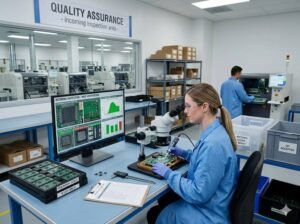
Conformal coating rework process
The conformal coating rework process refers to the controlled removal, repair, and reapplication of 保形塗層 on a PCB when defects, design changes, or component replacements are required. It is an important step in PCB 組裝 和 SMT 組裝, ensuring that boards can be corrected without compromising reliability.

Why rework is needed
Rework may be required in 交鑰匙 PCB 組裝 for several reasons:
- Coating defects (bubbles, voids, uneven thickness)
- Contamination trapped under the coating
- Incorrect masking or overcoating of connectors
- Component repair or replacement
- Engineering changes or design updates
Without proper rework, these issues could lead to functional failure or reduced lifespan.
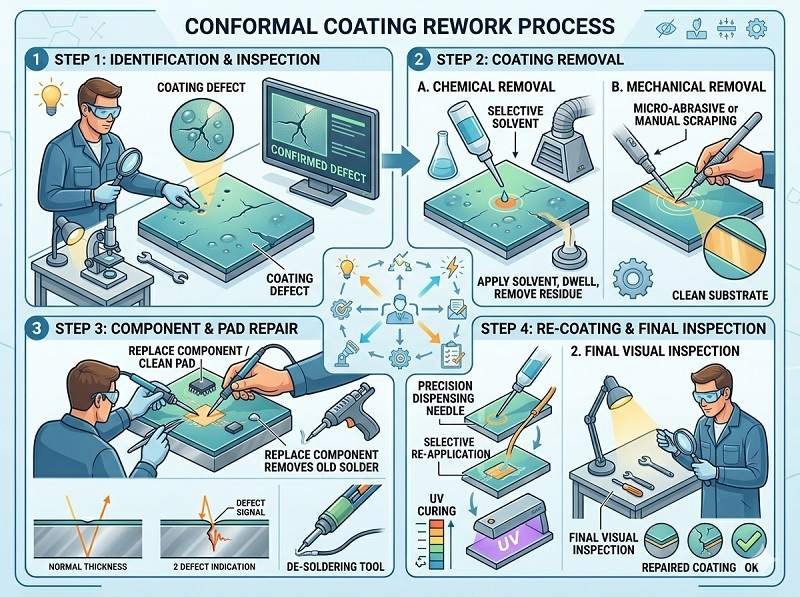
Steps in conformal coating rework
Coating identification
First, identify the type of 保形塗層 used (acrylic, silicone, urethane, epoxy, or parylene), as each requires a different removal method.
Coating removal
Common removal techniques include:
- Solvent removal → dissolves acrylic coatings
- Mechanical removal → scraping or micro-abrasion
- Thermal methods → softening coating with heat
- Chemical stripping → used for tougher coatings like epoxy
The method must be chosen carefully to avoid damaging components or traces during PCB 組裝 repair.
Cleaning the PCB
After removal:
- Clean residues using appropriate solvents
- Ensure the surface is free of contaminants
- Dry the board completely before further processing
Proper cleaning is critical before re-coating in SMT 組裝.
Repair or replacement
Perform necessary actions such as:
- Replacing faulty components
- Fixing solder joints
- Modifying circuit areas
This step follows standard repair procedures in 交鑰匙 PCB 組裝.
Reapplication of coating
Once repairs are complete:
- Reapply 保形塗層 using brush, spray, or selective coating
- Ensure proper masking of no-coat areas
- Maintain correct thickness and coverage
Curing and final inspection
Finally:
- Cure the coating (air dry, heat, or UV depending on material)
- Inspect using UV or AOI methods
- Verify coverage, adhesion, and thickness
Challenges in rework
- Risk of damaging sensitive components
- Difficulty removing certain coatings (e.g., epoxy or parylene)
- Maintaining consistent coating quality after rework
- Time and labor costs
Because of these challenges, rework should be minimized through proper process control in PCB 組裝.
Best practices
- Use rework-friendly coatings (e.g., acrylic) when possible
- Design for accessibility in PCB layout
- Apply proper masking during initial coating
- Train technicians on safe removal techniques
總結
The conformal coating rework process is essential for correcting defects and enabling repairs in PCB 組裝, SMT 組裝, 以及 交鑰匙 PCB 組裝. By carefully removing, repairing, and reapplying the coating, manufacturers can maintain product quality while reducing waste and cost.
取得保形塗層報價
使用專業的保形塗層降低 PCB 故障風險。立即索取報價。.
將您的需求傳送給我們,並獲得我們工程團隊的快速回應。.
24 小時回應 ✔ 工程支援 ✔ 小型與大量生產
深圳市騰欣杰電子有限公司