Difference between acrylic and silicone HumiSeal coatings
壓克力 和 silicone HumiSeal coatings are two of the most commonly used 保形塗層 types in PCB 組裝, 原型 PCB 組裝, 以及 SMT 組裝. While both provide protection against moisture, dust, and contaminants, they differ significantly in performance, flexibility, cost, and application scenarios.

Key difference: material properties
The main distinction lies in their chemical nature:
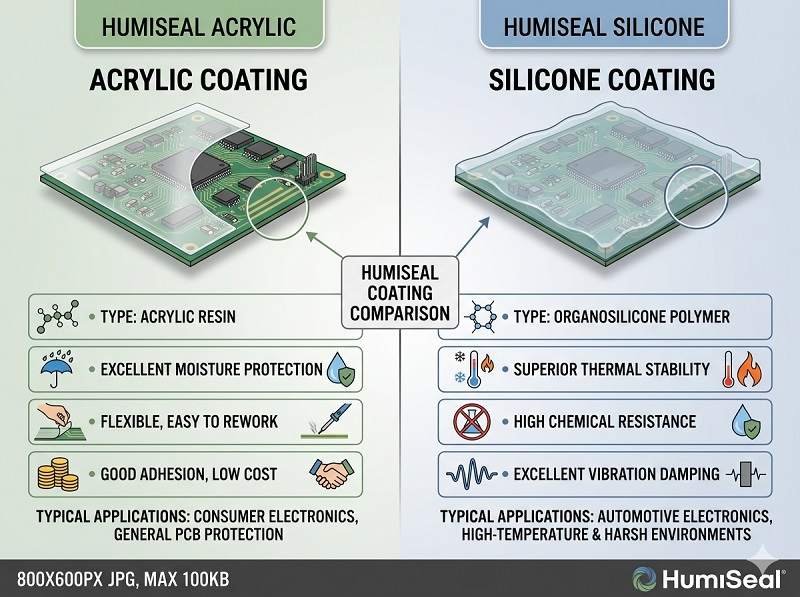
- Acrylic coatings (AR) → hard, transparent, fast-drying polymers
- Silicone coatings (SR) → soft, rubber-like, highly flexible materials
Acrylic coatings cure into a rigid protective layer, while silicone coatings remain elastic and flexible.
Drying speed and process efficiency
Acrylic coatings are known for their fast drying and easy processing, making them ideal for high-speed SMT 組裝 production lines. They can dry within minutes and are simple to apply.
Silicone coatings typically require longer curing time, especially if moisture curing is involved, which can slow down production throughput.
Flexibility and vibration resistance
This is one of the most important differences:
- Acrylic → relatively rigid, may crack under vibration or thermal cycling
- Silicone → highly flexible, absorbs stress and resists cracking
Silicone coatings are better suited for environments with mechanical stress, vibration, or thermal expansion.
耐溫性
Acrylic coatings perform well in moderate temperature ranges (typically up to ~120°C).
Silicone coatings offer excellent high and low temperature resistance, often operating from -55°C 至 200°C 或更高, making them ideal for extreme environments.
Chemical and environmental resistance
- Acrylic → good moisture protection, but limited resistance to harsh chemicals
- Silicone → strong resistance to chemicals, humidity, and harsh environments
Silicone coatings are preferred for automotive, aerospace, and outdoor electronics where long-term durability is critical.
返修和維修
在 PCB 組裝, rework capability is very important:
- Acrylic → easy to remove and repair using common solvents
- Silicone → 更難移除, requires special processes
This makes acrylic coatings highly suitable for 原型 PCB 組裝, where frequent modifications are needed.
Cost and production considerations
- Acrylic → lower cost + faster processing
- Silicone → higher cost + better performance
For high-volume SMT 組裝, acrylic is often chosen for cost efficiency, while silicone is used when performance requirements justify the higher cost.
典型應用
Acrylic HumiSeal coatings (e.g., 1B31):
- 消費性電子產品
- LED drivers and power supplies
- General-purpose PCB 組裝
- 原型 PCB 組裝 (easy rework)
Silicone HumiSeal coatings:
- 汽車電子
- Aerospace systems
- Outdoor and high-humidity environments
- High-temperature applications
Summary comparison
| 特點 | Acrylic Coating | Silicone Coating |
|---|---|---|
| Drying speed | Very fast | Slower |
| 彈性 | Low to moderate | 非常高 |
| 耐溫性 | 中度 | 極佳 |
| 耐化學性 | 中度 | 高 |
| 可重複加工性 | Easy | Difficult |
| 成本 | 較低 | Higher |
| Best use | Standard electronics | Harsh environments |
最終見解
There is no “one-size-fits-all” choice between acrylic and silicone HumiSeal coatings.
- 選擇 壓克力塗料 為 cost-effective, fast, and rework-friendly solutions in PCB 組裝 和 SMT 組裝
- 選擇 silicone coatings 為 extreme environments, high reliability, and long-term durability
In practice, many manufacturers validate both options during 原型 PCB 組裝 before selecting the most suitable coating for mass production.
取得保形塗層報價
不確定哪一種保形塗料適合您的產品?立即聯絡我們的專家。.
將您的需求傳送給我們,並獲得我們工程團隊的快速回應。.
24 小時回應 ✔ 工程支援 ✔ 小型與大量生產
深圳市騰欣杰電子有限公司