
Difference between acrylic and silicone HumiSeal coatings
Acrylic and silicone HumiSeal coatings are two of the most commonly used Conformal Coating types in PCB Assembly, Prototype PCB Assembly, and SMT Assembly. While both provide protection against moisture, dust, and contaminants, they differ significantly in performance, flexibility, cost, and application scenarios.
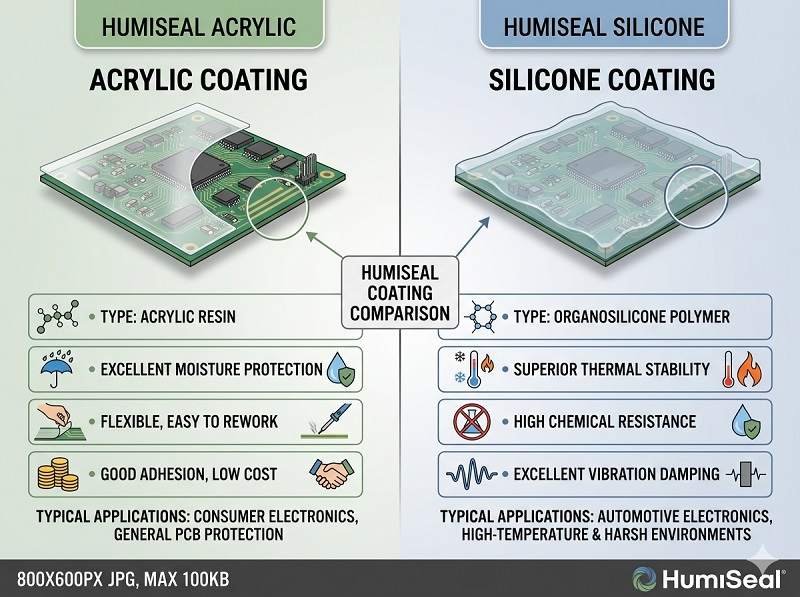
Key difference: material properties
The main distinction lies in their chemical nature:
- Acrylic coatings (AR) → hard, transparent, fast-drying polymers
- Silicone coatings (SR) → soft, rubber-like, highly flexible materials
Acrylic coatings cure into a rigid protective layer, while silicone coatings remain elastic and flexible.
Drying speed and process efficiency
Acrylic coatings are known for their fast drying and easy processing, making them ideal for high-speed SMT Assembly production lines. They can dry within minutes and are simple to apply.
Silicone coatings typically require longer curing time, especially if moisture curing is involved, which can slow down production throughput.
Flexibility and vibration resistance
This is one of the most important differences:
- Acrylic → relatively rigid, may crack under vibration or thermal cycling
- Silicone → highly flexible, absorbs stress and resists cracking
Silicone coatings are better suited for environments with mechanical stress, vibration, or thermal expansion.
Temperature resistance
Acrylic coatings perform well in moderate temperature ranges (typically up to ~120°C).
Silicone coatings offer excellent high and low temperature resistance, often operating from -55°C to 200°C or higher, making them ideal for extreme environments.
Chemical and environmental resistance
- Acrylic → good moisture protection, but limited resistance to harsh chemicals
- Silicone → strong resistance to chemicals, humidity, and harsh environments
Silicone coatings are preferred for automotive, aerospace, and outdoor electronics where long-term durability is critical.
Rework and repair
In PCB Assembly, rework capability is very important:
- Acrylic → easy to remove and repair using common solvents
- Silicone → more difficult to remove, requires special processes
This makes acrylic coatings highly suitable for Prototype PCB Assembly, where frequent modifications are needed.
Cost and production considerations
- Acrylic → lower cost + faster processing
- Silicone → higher cost + better performance
For high-volume SMT Assembly, acrylic is often chosen for cost efficiency, while silicone is used when performance requirements justify the higher cost.
Typical applications
Acrylic HumiSeal coatings (e.g., 1B31):
- Consumer electronics
- LED drivers and power supplies
- General-purpose PCB Assembly
- Prototype PCB Assembly (easy rework)
Silicone HumiSeal coatings:
- Automotive electronics
- Aerospace systems
- Outdoor and high-humidity environments
- High-temperature applications
Summary comparison
| Feature | Acrylic Coating | Silicone Coating |
|---|---|---|
| Drying speed | Very fast | Slower |
| Flexibility | Low to moderate | Very high |
| Temperature resistance | Moderate | Excellent |
| Chemical resistance | Moderate | High |
| Reworkability | Easy | Difficult |
| Cost | Lower | Higher |
| Best use | Standard electronics | Harsh environments |
Final insight
There is no “one-size-fits-all” choice between acrylic and silicone HumiSeal coatings.
- Choose acrylic coatings for cost-effective, fast, and rework-friendly solutions in PCB Assembly and SMT Assembly
- Choose silicone coatings for extreme environments, high reliability, and long-term durability
In practice, many manufacturers validate both options during Prototype PCB Assembly before selecting the most suitable coating for mass production.
Get a Conformal Coating Quote
Not sure which conformal coating is right for your product? Contact our experts today.
Send us your requirements and get a fast response from our engineering team.
✔ 24-hour response ✔ Engineering support ✔ Small & Mass Production
Shenzhen Tengxinjie Electronics Co., Ltd.
 English
  Deutsch
  Français
  Português do Brasil
  Español
  日本語
日本語  Nederlands
  Italiano
  Русский
  한국어
한국어  العربية
  Svenska
  Polski
  Türkçe
  繁體中文
繁體中文