
Process Control in PCBA
Process control in PCBA (Printed Circuit Board Assembly) refers to the systematic monitoring, management, and adjustment of manufacturing processes to ensure consistent quality and stable production results. It is a core part of quality management in PCB 組裝, SMT 組裝, 以及 PCB 製造, ensuring that every step of production stays within defined standards.
In simple terms, process control makes sure that the production line does not “drift” away from the correct settings, so every board produced is consistent, reliable, and defect-free.
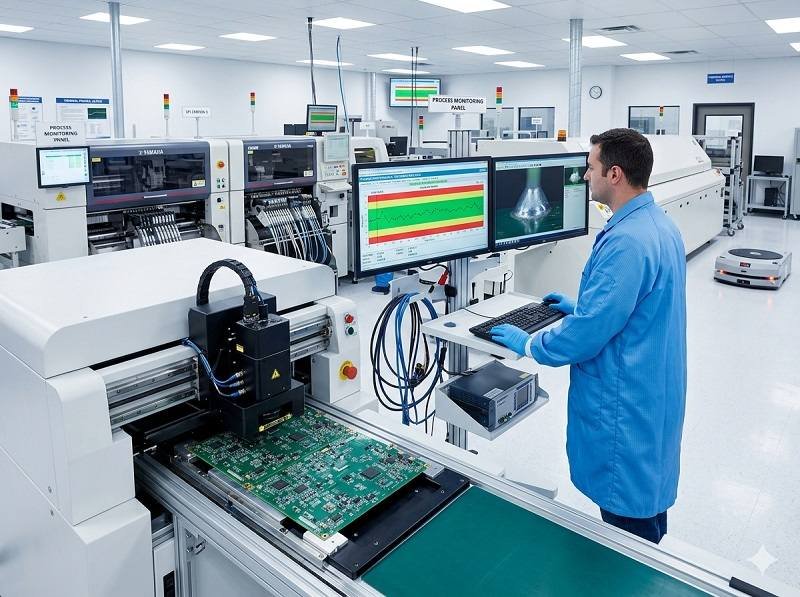
Why Process Control is Important in PCBA
In electronics manufacturing, even small variations in process parameters can lead to serious defects. That is why process control is essential in maintaining stability.
在 PCB 組裝, process control helps ensure that soldering quality, component placement, and electrical performance remain consistent across all units.
Key benefits include:
- Reducing production defects and rework
- Ensuring consistent product quality
- Improving yield rate in mass production
- Stabilizing SMT 組裝 performance
- Enhancing reliability in final electronic products
適用於 原型 PCB 組裝, process control is also important because it helps identify and stabilize manufacturing conditions before scaling to mass production.
Key Elements of Process Control in PCB Assembly
Process control in PCB 製造 and assembly involves several critical elements that work together to maintain quality.
These include:
- Standard operating procedures (SOPs)
- Real-time monitoring of production parameters
- Equipment calibration and maintenance
- Operator training and qualification
- Statistical process control (SPC)
- Quality inspection checkpoints
Each of these ensures that the production process remains stable and repeatable.
Process Control in SMT Assembly
在 SMT 組裝, process control is especially important because the process involves high-speed, high-precision equipment.
Key controlled parameters include:
- Solder paste printing thickness and alignment
- Pick-and-place machine accuracy
- Reflow oven temperature profile
- Component placement accuracy
- AOI inspection feedback
Any deviation in these parameters can result in defects such as tombstoning, solder bridging, or open circuits.
Process Control Workflow
A typical process control system in PCBA follows a structured workflow:
First, production parameters are defined based on engineering requirements and product specifications.
Next, the production line is set up and calibrated according to these parameters.
During production, real-time monitoring is performed to detect any deviations.
If issues are detected, corrective actions are immediately applied to prevent defect propagation.
Finally, data is recorded and analyzed to improve future production efficiency and quality.
Tools Used in Process Control
現代 PCB 組裝 factories use advanced tools and systems to maintain tight process control.
Common tools include:
- Statistical Process Control (SPC) software
- Automated Optical Inspection (AOI) systems
- X-ray inspection systems
- Reflow oven profiling systems
- Manufacturing Execution Systems (MES)
- Real-time data monitoring dashboards
These tools help engineers quickly identify trends and prevent potential quality issues.
Common Problems Without Process Control
Without proper process control, PCBA production can experience serious quality issues, such as:
- Inconsistent solder quality
- Misaligned components in SMT 組裝
- High defect rates in mass production
- Frequent rework and production delays
- Unstable product performance
These issues not only increase cost but also reduce customer trust and product reliability.
Process Control in Prototype vs Mass Production
在 原型 PCB 組裝, process control focuses on testing and stabilizing production parameters. The goal is to identify optimal settings for future scaling.
In mass production, process control focuses on maintaining consistency and preventing deviations across large production volumes.
Both stages are essential for ensuring long-term manufacturing stability.
總結
Process control in PCBA is a critical system that ensures consistency, reliability, and efficiency in electronics manufacturing. It connects every stage of production—from design setup to final inspection—into a controlled and measurable system.
From PCB 製造 至 SMT 組裝 和 原型 PCB 組裝, strong process control guarantees stable quality, higher yield, and improved product performance.
正在尋找完整的 PCB 組裝服務?點選下方開始。.
我們提供專業的 PCB 裝配服務,包括 SMT、DIP 及完整的統包解決方案。.
✔ 提供 NDA ✔ 24 小時內快速報價 ✔ ISO 認證工廠 ✔ 一站式 PCB & PCBA 服務
 繁體中文
繁體中文  English
  Deutsch
  Français
  Português do Brasil
  Español
  日本語
日本語  Nederlands
  Italiano
  Русский
  한국어
한국어  العربية
  Svenska
  Polski
  Türkçe