
機能テスト(FCT)
機能テスト(FCT) is a critical testing method in PCBアセンブリ that verifies whether a fully assembled circuit board operates according to its intended real-world function. Unlike electrical tests that check individual components, FCT evaluates the overall performance of the entire system after SMTアセンブリ is completed.
It is typically the final step before shipment, ensuring that the product works exactly as designed.
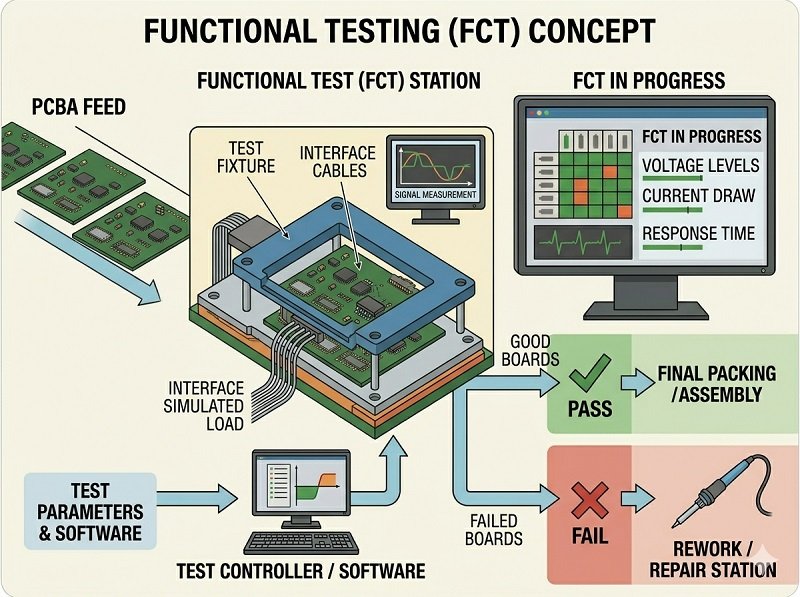
What Does Functional Testing Do?
FCT simulates the real operating environment of the PCB and checks:
- Power-up behavior
- Signal input/output performance
- Communication interfaces (UART, USB, CAN, etc.)
- Firmware functionality
- Overall system response
👉 It ensures the complete PCB Assembly functions correctly in real conditions.
How Functional Testing Works
The FCT process generally includes:
- Connecting the PCB to a test fixture
- Powering the board under controlled conditions
- Sending input signals or commands
- Measuring output signals and responses
- Comparing results with expected behavior
Test systems may include:
- Custom test fixtures
- Software test programs
- Measurement instruments (oscilloscope, multimeter, etc.)
Key Features of FCT
- Tests the entire circuit functionality
- Mimics actual product usage
- Detects system-level defects
- Often customized for each product
Unlike ICT, FCT is not standardized and must be designed specifically for each PCB.
Types of Functional Testing
Manual Functional Testing
- Performed by operators
- Suitable for low-volume production
- Flexible but slower
Automated Functional Testing
- Uses automated test systems
- Faster and more consistent
- Ideal for mass production
👉 Most modern SMTアセンブリ lines use automated FCT for efficiency.
What Defects Can FCT Detect?
FCT can identify:
- Functional failures
- Firmware issues
- Incorrect component behavior
- Signal timing problems
- Integration issues between components
These are defects that ICT or AOI may not detect.
FCT vs ICT Testing
| 特徴 | FCT | ICT |
|---|---|---|
| Focus | System-level function | Component-level electrical test |
| Test method | Simulated operation | Probe-based measurement |
| スピード | 遅い | Faster |
| 柔軟性 | 高い | 限定 |
| Setup | Custom for each product | Fixture-based |
👉 Both are complementary in PCBアセンブリ 品質管理。.
When is FCT Used?
Functional testing is essential for:
- 家電製品
- 自動車システム
- 産業用制御盤
- IoTデバイス
- Medical electronics
Any product that must operate reliably in real conditions benefits from FCT.
Advantages of Functional Testing
- Verifies real-world performance
- Detects complex system-level issues
- Ensures product reliability
- Reduces field failures and returns
Limitations of FCT
- Requires custom test development
- Higher setup time and cost
- Slower compared to ICT
- May not isolate the exact faulty component
Best Practices for FCT
- Design PCBs with testability in mind (DFT)
- Develop clear test procedures and criteria
- Automate testing for large volumes
- Combine FCT with ICT and AOI for full coverage
- Maintain and calibrate test equipment regularly
Role of FCT in PCB Assembly
In a typical PCBアセンブリ process:
- Performed after SMT Assembly and inspection
- Acts as the final quality gate
- Ensures only fully functional products are shipped
結論
Functional Testing (FCT) is an essential step in PCBアセンブリ that ensures the final product works as intended in real-world conditions. By verifying system-level performance after SMTアセンブリ, FCT helps manufacturers deliver reliable, high-quality electronic products and minimize failures in the field.
PCBアセンブリソリューションはここから始まります。お見積もり依頼は下記をクリックしてください。.
SMT、DIP、フルターンキーソリューションを含むプロフェッショナルなPCBアセンブリサービスを提供します。.
利用できる NDA ✔ 24 時間以内の速い引用語句 ✔ ISO によって証明される工場 ✔ ワンストップ PCB 及び PCBA サービス
 日本語
日本語  English
  Deutsch
  Français
  Português do Brasil
  Español
  Nederlands
  Italiano
  Русский
  한국어
한국어  العربية
  Svenska
  Polski
  Türkçe
  繁體中文
繁體中文