
Conformal Coating Process
について コンフォーマルコーティングプロセス is a protective step in PCBアセンブリ where a thin, non-conductive polymer layer is applied to a completed circuit board. This coating “conforms” to the contours of the PCB, covering components, solder joints, and exposed traces to protect them from environmental hazards.
It is commonly used after SMTアセンブリ and testing to enhance reliability, especially in harsh operating conditions.
Why Conformal Coating is Important
Electronic assemblies are often exposed to:
- 水分と湿度
- 埃と汚染物質
- 化学薬品と溶剤
- Temperature fluctuations
- 腐食と酸化
👉 Conformal coating acts as a barrier, significantly improving the durability of the PCBアセンブリ.
Conformal Coating Process Steps
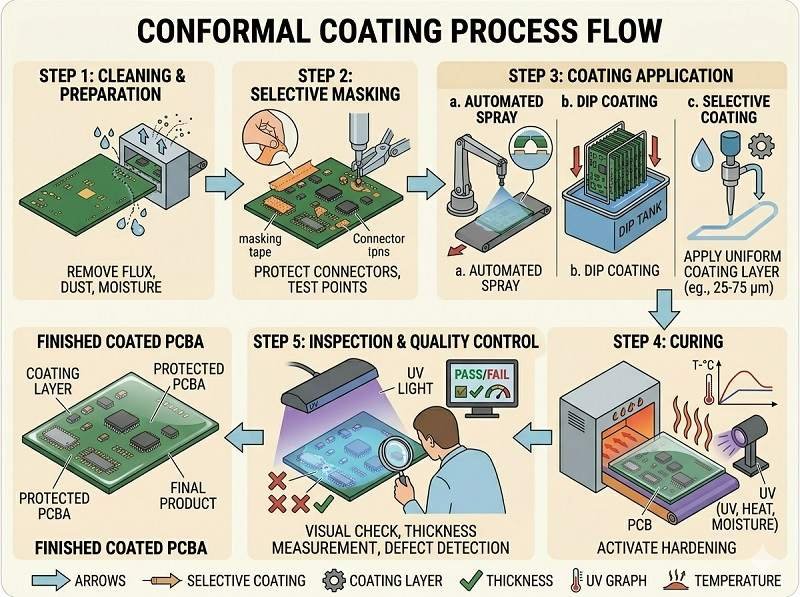
について コンフォーマル・コーティング process typically includes the following stages:
Surface Cleaning
Before coating, the PCB must be thoroughly cleaned to remove:
- Flux residues
- 埃と粒子
- Oils or contaminants
Common cleaning methods include:
- Aqueous cleaning
- 溶剤洗浄
- Plasma cleaning
👉 Proper cleaning ensures strong adhesion of the coating.
マスキング
Certain areas must not be coated, such as:
- Connectors
- テストポイント
- Switches
Masking methods include:
- Tape masking
- Rubber boots
- Custom fixtures
Coating Application
The coating material is applied using one of several methods:
Spray Coating
- Most common method
- Suitable for automated production
- Even coverage
Dip Coating
- PCBをコーティング液に浸す
- Good for full coverage
- Less selective
Brush Coating
- Manual method
- Ideal for prototypes or rework
セレクティブ・コーティング
- Automated, precise application
- Coats only required areas
- Widely used in modern SMTアセンブリ 行
養生
After application, the coating must cure (dry and harden):
- Air curing (room temperature)
- Heat/oven curing
- UV curing (fast and efficient)
👉 Curing time depends on the coating material used.
検査
Final inspection ensures:
- Proper coverage
- Correct thickness
- No bubbles or defects
Inspection methods include:
- Visual inspection (UV light)
- 厚さ測定
Types of Conformal Coating Materials
Different materials are used depending on application needs:
- アクリル(AR) – Easy to apply and repair
- シリコーン (SR) – High temperature resistance
- ポリウレタン(UR) – Strong chemical resistance
- エポキシ(ER) – Excellent durability but difficult to rework
- パリレン(XY) – High-performance vacuum deposition coating
Advantages of Conformal Coating
- Protects against moisture and corrosion
- Extends product lifespan
- Improves reliability in harsh environments
- Reduces failure rates
- Lightweight and thin protection
Limitations of Conformal Coating
- Adds extra process cost
- Requires masking and process control
- Rework and repair can be difficult
- Not a substitute for full encapsulation
Applications of Conformal Coating
Conformal coating is widely used in:
- カーエレクトロニクス
- 航空宇宙システム
- 産業機器
- 医療機器
- Outdoor and IoT electronics
Best Practices for Conformal Coating
- Ensure thorough PCB cleaning before coating
- Choose the right coating material for the environment
- Use selective coating for precision
- Control coating thickness (typically 25–75 microns)
- Combine with proper inspection methods
Role in PCB Assembly
In the overall PCBアセンブリ workflow:
- Applied after SMT Assembly and testing (ICT/FCT)
- Acts as a final protection layer
- Enhances long-term product reliability
結論
The conformal coating process is a vital step in PCBアセンブリ そして SMTアセンブリ, providing essential protection against environmental damage. By selecting the right materials and applying proper process control, manufacturers can significantly improve the performance and lifespan of electronic products.
信頼性の高いPCBアセンブリソリューションをお探しですか?今すぐお見積もりをご依頼ください。.
SMT、DIP、フルターンキーソリューションを含むプロフェッショナルなPCBアセンブリサービスを提供します。.
利用できる NDA ✔ 24 時間以内の速い引用語句 ✔ ISO によって証明される工場 ✔ ワンストップ PCB 及び PCBA サービス
 日本語
日本語  English
  Deutsch
  Français
  Português do Brasil
  Español
  Nederlands
  Italiano
  Русский
  한국어
한국어  العربية
  Svenska
  Polski
  Türkçe
  繁體中文
繁體中文