
You Prevent Defects
Defect prevention in electronics manufacturing is achieved through a combination of strict process control, quality inspections, and continuous improvement systems. In تجميع ثنائي الفينيل متعدد الكلور, تجميع SMT, تجميع النموذج الأولي لثنائي الفينيل متعدد الكلور, و تصنيع ثنائي الفينيل متعدد الكلور, preventing defects is always more cost-effective than detecting them after production.
A reliable manufacturing system focuses on controlling every stage of production to ensure that errors are eliminated at the source rather than corrected later.
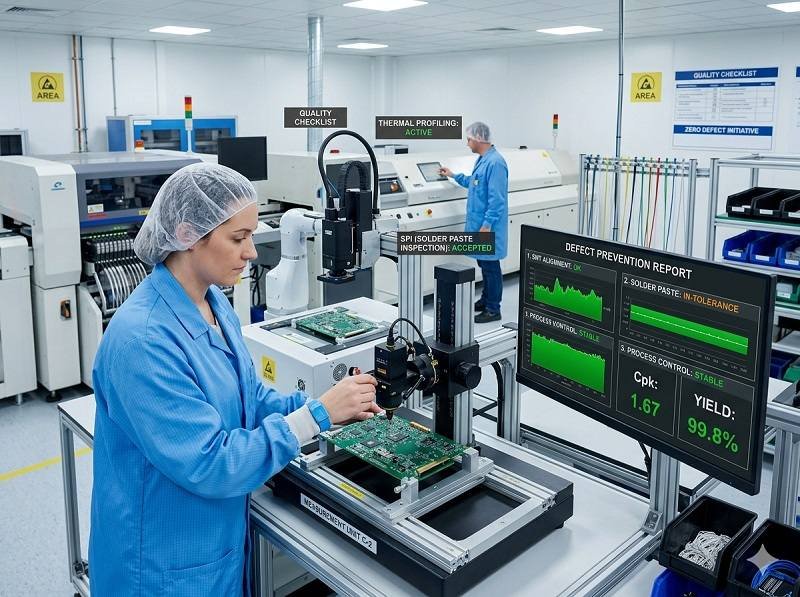
Design and Engineering Review
Defect prevention starts before production even begins.
During the engineering stage, design files such as Gerber data, BOM (Bill of Materials), and assembly drawings are carefully reviewed. This helps identify potential issues such as incorrect footprints, spacing problems, or component mismatches.
في تجميع ثنائي الفينيل متعدد الكلور, Design for Manufacturability (DFM) checks are especially important to ensure the design can be built efficiently without risk of defects during تجميع SMT.
Incoming Material Control
A major source of defects comes from poor-quality or incorrect components. That is why incoming inspection is essential.
Before materials enter production, they are checked for:
- Correct part numbers and specifications
- Physical damage or contamination
- Authenticity of electronic components
- Storage conditions and moisture sensitivity
في تصنيع ثنائي الفينيل متعدد الكلور, raw boards are also inspected for defects such as scratches, warping, or copper issues.
Process Control During SMT Assembly
Strong process control is one of the most effective ways to prevent defects in تجميع SMT.
Key controls include:
- Solder paste printing accuracy
- Pick-and-place machine calibration
- Reflow oven temperature profiling
- Component placement verification
- Real-time process monitoring systems
Even small deviations in these parameters can cause defects such as bridging, tombstoning, or cold solder joints.
Automated Inspection Systems
Modern factories use advanced inspection technologies to detect and prevent defects early.
Common systems include:
- الفحص البصري الآلي (AOI)
- X-ray inspection for hidden solder joints
- SPI (Solder Paste Inspection) systems
- Functional testing (FCT)
- In-circuit testing (ICT)
These tools are widely used in تجميع ثنائي الفينيل متعدد الكلور to ensure defects are caught immediately after each process stage.
Quality Control Checkpoints
Defect prevention also depends on structured inspection points throughout production.
These include:
- مراقبة الجودة الواردة (IQC)
- In-Process Quality Control (IPQC)
- فحص المادة الأولى (FAI)
- Outgoing Quality Control (OQC)
Each checkpoint ensures that problems are identified early and do not continue to the next stage of production.
Operator Training and Standardization
Human factors also play a role in defect prevention. Proper training ensures that operators follow standardized procedures consistently.
في تجميع النموذج الأولي لثنائي الفينيل متعدد الكلور, skilled technicians are especially important because small mistakes can affect product validation and testing results.
Standard operating procedures (SOPs) help reduce variation and improve consistency across all production shifts.
Equipment Maintenance and Calibration
Unstable equipment is a common cause of defects. Regular maintenance ensures machines operate within required tolerances.
For example, in تصنيع ثنائي الفينيل متعدد الكلور and SMT lines:
- Printers must maintain consistent solder paste thickness
- Placement machines must stay precisely calibrated
- Reflow ovens must maintain accurate temperature profiles
Preventive maintenance reduces unexpected failures and improves long-term stability.
Data Monitoring and Continuous Improvement
Modern production systems use real-time data to detect trends and prevent future defects.
Statistical Process Control (SPC) helps engineers identify small variations before they become serious problems.
This feedback loop allows continuous improvement in تجميع ثنائي الفينيل متعدد الكلور processes and helps maintain high production yield.
الخاتمة
Defect prevention in electronics manufacturing is achieved through a complete system of design review, material control, process monitoring, inspection, and continuous improvement.
From تصنيع ثنائي الفينيل متعدد الكلور إلى تجميع SMT و تجميع النموذج الأولي لثنائي الفينيل متعدد الكلور, every stage plays a role in ensuring high-quality output. By focusing on prevention rather than correction, manufacturers can deliver more reliable products, reduce costs, and improve customer satisfaction.
أرسل ملفات ثنائي الفينيل متعدد الكلور واحصل على عرض أسعار سريع اليوم. اطلب الآن.
نحن نوفر خدمات تجميع ثنائي الفينيل متعدد الكلور الاحترافية بما في ذلك SMT وDIP وحلول تسليم المفتاح الكاملة.
✔ إتاحة اتفاقية عدم الإفشاء ✔ عرض أسعار سريع في غضون 24 ساعة ✔ مصنع معتمد من ISO ✔ خدمة PCB و PCBA الشاملة
 العربية
  English
  Deutsch
  Français
  Português do Brasil
  Español
  日本語
日本語  Nederlands
  Italiano
  Русский
  한국어
한국어  Svenska
  Polski
  Türkçe
  繁體中文
繁體中文