Is Wave Soldering
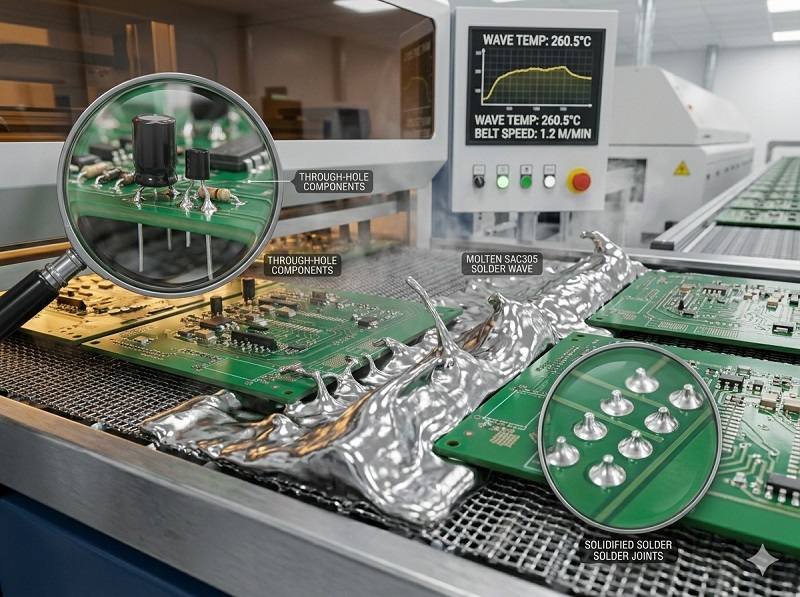
Wave soldering is a bulk soldering process used in PCB 組裝 to attach electronic components—primarily through-hole components—to a printed circuit board. In this method, the bottom side of the PCB passes over a wave of molten solder, which forms strong and reliable connections between component leads and PCB pads.
Wave soldering is widely used in traditional electronics manufacturing and is often combined with SMT 組裝 in mixed-technology boards that include both surface-mount and through-hole components.

How Wave Soldering Works
The wave soldering process follows several key steps.
First, components are inserted into the PCB, either manually or by automated insertion machines. These are typically through-hole components with leads passing through the board.
Next, the PCB is cleaned and flux is applied to the underside. The flux removes oxidation and prepares the metal surfaces for proper soldering.
The board then enters a preheating stage, where it is gradually heated to activate the flux and reduce thermal shock.
After preheating, the PCB passes over a wave of molten solder. As the board moves across the wave, the solder adheres to exposed metal areas, forming joints between the component leads and PCB pads.
Finally, the board is cooled, allowing the solder to solidify and create durable electrical connections.
Types of Wave Soldering
There are different wave configurations used in PCB Assembly.
Single-wave soldering uses one wave of solder and is suitable for simpler designs.
Dual-wave soldering uses two waves—a turbulent wave followed by a smooth laminar wave. This approach improves solder penetration and reduces defects, making it ideal for more complex boards.
Role of Wave Soldering in PCB Assembly
Wave soldering is essential for through-hole PCB Assembly, where components require strong mechanical bonds in addition to electrical connections.
雖然 SMT 組裝 dominates modern electronics, wave soldering remains important for connectors, transformers, and other components that cannot be surface-mounted.
In many cases, manufacturers use a combination of reflow soldering for SMT components and wave soldering for through-hole components, especially in mixed PCB Assembly processes.
Wave Soldering in PCB Manufacturing Workflow
Wave soldering typically occurs after SMT Assembly if both technologies are used on the same board. SMT components are first placed and soldered using reflow, and then through-hole components are added and soldered using the wave process.
This integration ensures that the final product benefits from both compact design and mechanical strength.
在 交鑰匙 PCB 組裝, the manufacturer manages both SMT Assembly and wave soldering processes to ensure compatibility and efficiency throughout production.
Advantages of Wave Soldering
Wave soldering offers several benefits.
It allows simultaneous soldering of multiple joints, making it highly efficient for bulk production.
It provides strong and reliable connections, especially for through-hole components that require mechanical durability.
It is cost-effective for medium to high-volume production and ensures consistent quality when properly controlled.
Challenges of Wave Soldering
Despite its advantages, wave soldering also presents challenges.
Design constraints are important, as PCB layout must accommodate the solder wave and prevent defects such as bridging or shadowing.
Thermal stress can affect sensitive components if the process is not carefully controlled.
Flux residue and cleaning requirements must also be managed to maintain product quality.
Best Practices for Wave Soldering
To achieve optimal results, manufacturers should follow best practices.
Ensure proper PCB design with adequate spacing and orientation of components.
Use the correct type and amount of flux to improve solder quality.
Optimize preheating and solder temperature to avoid defects.
Maintain equipment regularly to ensure consistent solder wave performance.
Work with experienced PCB Assembly providers who understand both SMT Assembly and through-hole processes.
總結
Wave soldering is a vital process in PCB Assembly, particularly for through-hole components and mixed-technology boards. It complements SMT Assembly and plays an important role in delivering durable and reliable electronic products.
When integrated into PCB Manufacturing and Turnkey PCB Assembly services, wave soldering helps ensure efficient production, consistent quality, and strong mechanical connections across a wide range of applications.
From design review to delivery — we support every step. Request your PCB assembly quote.
我們提供專業的 PCB 裝配服務,包括 SMT、DIP 及完整的統包解決方案。.
✔ 提供 NDA ✔ 24 小時內快速報價 ✔ ISO 認證工廠 ✔ 一站式 PCB & PCBA 服務