Batch coating process
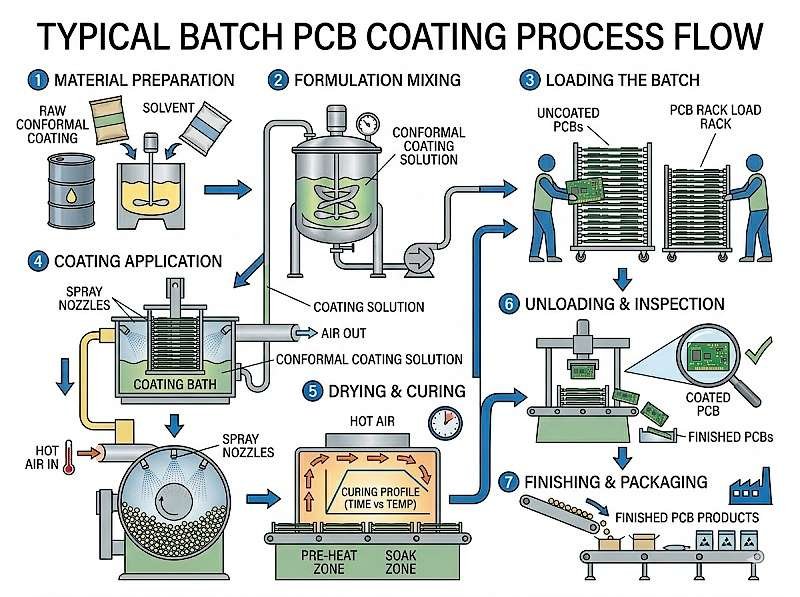
的 batch coating process 於 保形塗層 refers to applying coating to multiple PCBs at the same time in grouped cycles rather than continuously. This method is widely used in PCB 組裝, 原型 PCB 組裝, and small-to-medium scale SMT 組裝, where flexibility and cost control are important.

How batch coating works
In a batch process, a group of assembled PCBs is prepared, masked, and coated together using methods such as dipping, spraying, or brushing. After coating, all boards in the batch go through a shared drying or curing cycle. Once completed, the next batch is processed.
Common batch coating methods
浸塗
PCBs are submerged into a tank of 保形塗層 material and then withdrawn at a controlled speed. This ensures full coverage but requires proper masking in PCB 組裝.
Manual or spray coating
Operators or semi-automatic spray systems apply coating to multiple boards placed in racks or fixtures. This is common in 原型 PCB 組裝 due to its flexibility.
刷塗
Used mainly for rework or small batches, where precision is needed but production volume is low.
Key features of batch coating
Grouped processing
Multiple boards are coated and cured together, improving efficiency compared to single-board handling.
Flexible setup
Ideal for different PCB designs or low-volume orders, especially in 原型 PCB 組裝.
Lower equipment cost
Compared to fully automated inline systems used in high-speed SMT 組裝, batch processes require less investment.
Advantages of batch coating
- Cost-effective for small and medium production runs
- Easy to switch between different products
- Suitable for complex or irregular PCB designs
- Simplified process control for prototyping
Limitations of batch coating
Lower consistency
Compared to automated inline coating in SMT 組裝, batch processes may have more variation in thickness and coverage.
Labor-intensive
Manual handling increases labor costs and the risk of human error in PCB 組裝.
Slower throughput
Processing is done in cycles rather than continuously, which can limit production speed.
Risk of defects
Improper handling, uneven dipping, or inconsistent spraying can lead to bubbles, drips, or uneven coating.
Batch vs inline coating
- Batch coating: Flexible, lower cost, ideal for 原型 PCB 組裝 and small volumes
- Inline coating: Automated, high consistency, best for large-scale SMT 組裝
Best practices for batch coating
- Use consistent fixturing to hold PCBs in place
- Control withdrawal speed in dip coating
- Maintain stable coating viscosity and temperature
- Ensure proper cleaning and masking before coating
- Standardize curing conditions for each batch
In conclusion, the batch coating process is a practical and cost-effective approach for applying 保形塗層 於 PCB 組裝, especially for prototyping and medium-volume production. While it may not match the speed and precision of inline systems, it offers flexibility and adaptability for a wide range of applications.
取得保形塗層報價
需要用於惡劣環境應用的保形塗層嗎?請在下方提交您的詢問。.
將您的需求傳送給我們,並獲得我們工程團隊的快速回應。.
24 小時回應 ✔ 工程支援 ✔ 小型與大量生產
深圳市騰欣杰電子有限公司