
Comply with IPC standards
Yes, compliance with IPC standards is a fundamental requirement in professional PCB 組裝, SMT 組裝, 以及 交鑰匙 PCB 組裝 services. IPC standards are globally recognized guidelines that define quality, workmanship, and acceptance criteria for electronic manufacturing.
A qualified PCB 製造 partner strictly follows these standards to ensure consistent quality, reliability, and compatibility with international requirements.
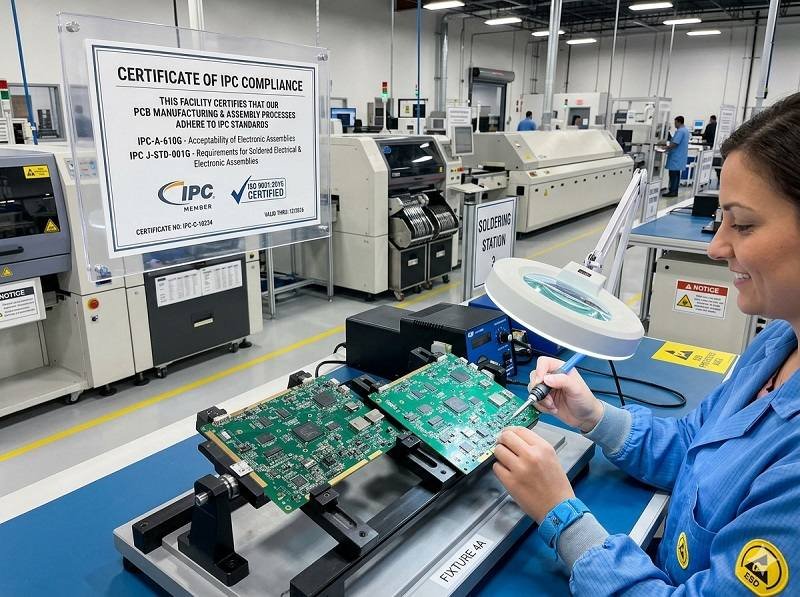
What are IPC standards?
IPC (Association Connecting Electronics Industries) develops widely accepted standards for electronics manufacturing.
These standards cover:
- PCB design and layout
- Material selection
- Assembly processes
- Inspection and acceptance criteria
- Testing and rework procedures
遵循 IPC 標準可確保 PCB 組裝 processes meet industry best practices.
Key IPC standards used in PCB assembly
Several IPC standards are commonly applied in SMT 組裝 和 交鑰匙 PCB 組裝:
IPC-A-610 (電子組裝的可接受性)
Defines visual inspection criteria for solder joints, component placement, and overall workmanship.
IPC-J-STD-001 (Requirements for Soldered Electrical and Electronic Assemblies)
Specifies soldering materials, processes, and quality requirements.
IPC-7711/7721 (Rework, Modification, and Repair)
Provides guidelines for repairing defective boards in PCB 組裝.
IPC-A-600 (Acceptability of Printed Boards)
Focuses on bare PCB quality before assembly.
IPC-6012 (Qualification and Performance Specification for Rigid PCBs)
Defines performance requirements for rigid boards used in PCB 製造.
IPC classes and quality levels
IPC standards define different product classes based on reliability requirements:
- 第一級: General electronics (consumer products)
- 第二級: Dedicated service electronics (industrial, communication)
- 第三級: High-reliability electronics (medical, aerospace, automotive)
在 交鑰匙 PCB 組裝, the required IPC class is determined by the application and customer specifications.
How IPC compliance is implemented
A professional PCB 製造 provider ensures IPC compliance through:
- Standardized operating procedures
- Certified and trained operators
- Controlled soldering processes
- Defined inspection criteria
- Documented quality control systems
These practices ensure consistent results across all SMT 組裝 項目。.
IPC training and certification
To maintain high standards, technicians and engineers often receive IPC certification.
This includes:
- IPC-A-610 certified inspectors
- IPC-J-STD-001 certified soldering specialists
- Continuous training and recertification
Skilled personnel are essential for achieving high-quality PCB 組裝 outcomes.
Benefits of IPC compliance
Following IPC standards provides several advantages:
Consistent Quality
Standardized processes reduce variability and defects.
Global Acceptance
Products meet international manufacturing expectations.
Improved Reliability
Higher-quality soldering and assembly increase product lifespan.
Better Communication
Clear standards help align expectations between customers and manufacturers.
IPC compliance in turnkey PCB assembly
在 交鑰匙 PCB 組裝, IPC standards apply across the entire process:
- Component sourcing quality
- PCB fabrication standards
- SMT 組裝 workmanship
- Inspection and testing criteria
This ensures that every stage of PCB 製造 meets defined quality benchmarks.
Can customers specify IPC class?
Yes, customers can specify the required IPC class based on their application.
Manufacturers can then:
- Adjust process controls accordingly
- Apply stricter inspection criteria
- Ensure compliance with specific industry requirements
This flexibility is essential for customized PCB 組裝 項目。.
總結
Yes, we fully comply with IPC standards as part of our PCB 組裝, SMT 組裝, 以及 交鑰匙 PCB 組裝 services. These standards ensure consistent quality, reliable performance, and global compliance.
Choosing an IPC-compliant PCB 製造 partner guarantees that your products meet industry-recognized quality levels and perform reliably in their intended applications.
一步到位,獲得專家建議和精確定價。立即索取報價。.
我們提供專業的 PCB 裝配服務,包括 SMT、DIP 及完整的統包解決方案。.
✔ 提供 NDA ✔ 24 小時內快速報價 ✔ ISO 認證工廠 ✔ 一站式 PCB & PCBA 服務
 繁體中文
繁體中文  English
  Deutsch
  Français
  Português do Brasil
  Español
  日本語
日本語  Nederlands
  Italiano
  Русский
  한국어
한국어  العربية
  Svenska
  Polski
  Türkçe