
Is Environmental testing
Environmental testing is a key quality assurance process in PCB 組裝, SMT 組裝, 以及 交鑰匙 PCB 組裝 that evaluates how electronic products perform under various environmental conditions.
It is designed to simulate real-world operating environments—such as extreme temperatures, humidity, vibration, and corrosion—to ensure that the final product remains stable, reliable, and functional throughout its lifecycle. This makes it an essential part of advanced PCB 製造.
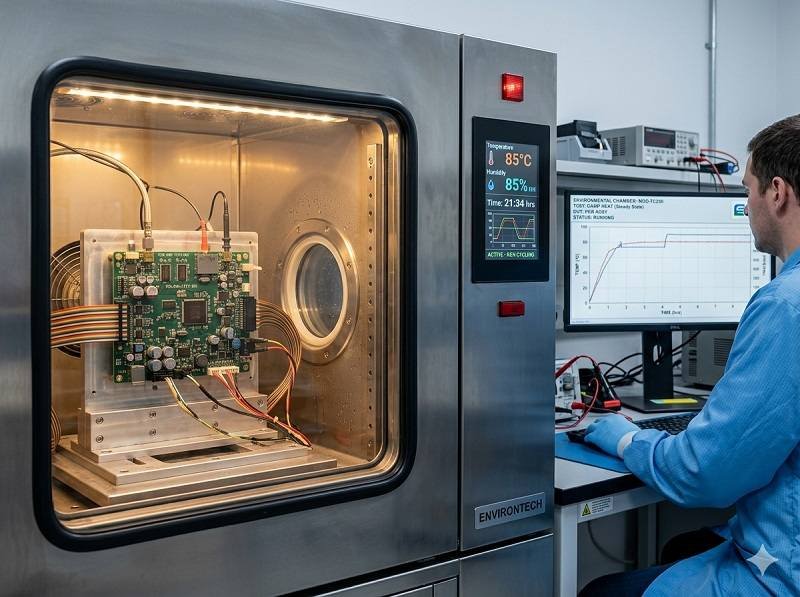
Why environmental testing matters
Electronic devices are often exposed to challenging conditions during transportation, storage, and operation.
Environmental testing helps:
- Verify product durability in harsh conditions
- Identify potential failure mechanisms early
- Improve long-term reliability
- Ensure compliance with industry standards
For high-reliability 交鑰匙 PCB 組裝, environmental testing is crucial to prevent field failures and costly recalls.
Common types of environmental testing
Different tests are used depending on the application and environment requirements.
Temperature Cycling Test
The PCB is exposed to repeated high and low temperature changes to simulate expansion and contraction, which can stress solder joints in SMT 組裝.
High and Low Temperature Storage
Boards are stored at extreme temperatures to evaluate material stability and component tolerance.
Humidity Testing
High humidity conditions are used to test resistance to moisture, corrosion, and insulation breakdown in PCB 組裝.
Thermal Shock Test
Rapid transitions between extreme temperatures test the PCB’s ability to withstand sudden environmental changes.
Vibration Testing
Simulates transportation and operational vibration to ensure mechanical stability.
Mechanical Shock Test
Applies sudden physical impacts to evaluate structural integrity.
Salt Spray (Corrosion) Test
Used for products exposed to marine or industrial environments to assess corrosion resistance.
Environmental testing vs reliability testing
These two are closely related but slightly different:
- Environmental Testing focuses on external conditions (temperature, humidity, vibration, etc.)
- Reliability Testing focuses on long-term performance over time
Environmental testing is often part of a broader reliability validation strategy in PCB 製造.
When is environmental testing required?
Environmental testing is especially important for:
- 汽車電子
- Outdoor and industrial equipment
- Marine and aerospace applications
- 醫療器材
- Power and energy systems
In these industries, SMT 組裝 quality must be validated under real-world conditions.
Integration with turnkey PCB assembly
在 交鑰匙 PCB 組裝, environmental testing can be incorporated into the full workflow:
- Design for environment (DFE) review
- Selection of suitable materials and components
- Controlled PCB 組裝 流程
- Post-assembly environmental validation
- Data recording and reporting
This ensures that products are not only functional but also durable under expected conditions.
Benefits for customers
Environmental testing provides significant value:
Improved Product Reliability
Ensures stable performance in real-world environments.
Reduced Field Failures
Identifies weaknesses before products are shipped.
Compliance with Standards
Meets requirements for global markets.
Enhanced Product Quality
Strengthens overall PCB 製造 性能。.
Challenges and considerations
Environmental testing may involve:
- Additional time in the production cycle
- Specialized testing equipment
- Increased cost depending on test complexity
However, for many applications, it is a necessary investment to ensure product success.
總結
Environmental testing is an essential process in PCB 組裝, SMT 組裝, 以及 交鑰匙 PCB 組裝 that validates product performance under real-world environmental conditions.
By simulating temperature, humidity, vibration, and other stresses, it ensures that products manufactured through PCB 製造 processes are durable, reliable, and ready for demanding applications.
從設計審查到交付 - 我們為每個步驟提供支援。索取您的 PCB 裝配報價。.
我們提供專業的 PCB 裝配服務,包括 SMT、DIP 及完整的統包解決方案。.
✔ 提供 NDA ✔ 24 小時內快速報價 ✔ ISO 認證工廠 ✔ 一站式 PCB & PCBA 服務
 繁體中文
繁體中文  English
  Deutsch
  Français
  Português do Brasil
  Español
  日本語
日本語  Nederlands
  Italiano
  Русский
  한국어
한국어  العربية
  Svenska
  Polski
  Türkçe