
First article inspection (FAI)
Eerste artikelinspectie (FAI) is a critical quality control process used in manufacturing to verify that a product meets all specified requirements before full-scale production begins. In industries such as electronics, aerospace, and automotive, FAI ensures that every component, dimension, and process aligns with design specifications, reducing the risk of defects and costly rework.
In the context of PCB-assemblage, FAI plays an especially important role because even minor deviations in component placement, soldering quality, or materials can lead to functional failures. Whether it is Prototype PCB-assemblage or mass production, FAI acts as the first checkpoint to validate manufacturing readiness.
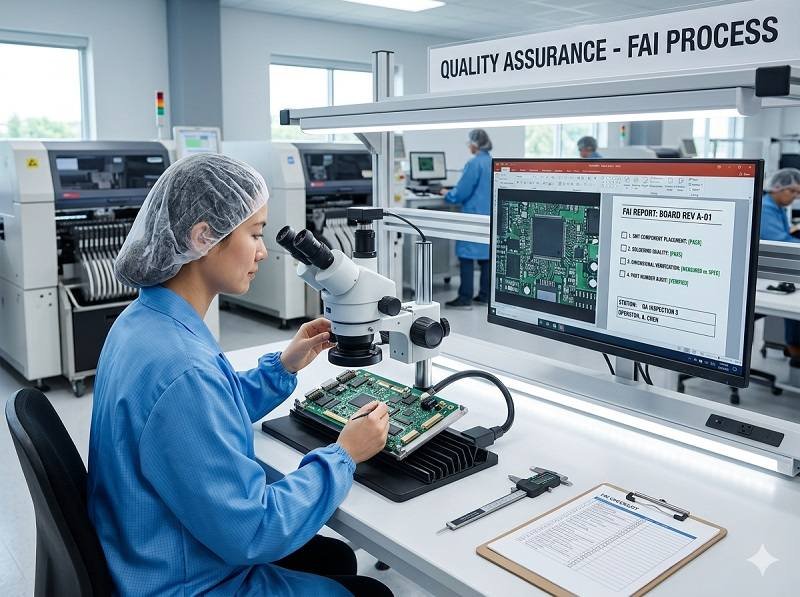
Why First Article Inspection Matters
FAI is essential because it helps manufacturers detect issues early in the production cycle. During PCB Productie en SMT-assemblage, errors can arise from incorrect components, misaligned placement, or process inconsistencies. If these problems go unnoticed, they can multiply across hundreds or thousands of units.
By performing FAI, manufacturers can:
- Verify design accuracy against engineering drawings
- Ensure correct components and materials are used
- Validate manufacturing processes and equipment settings
- Reduce scrap rates and production delays
- Improve overall product reliability
For customers, especially those requiring Prototype PCB-assemblage, FAI provides confidence that the final product will meet performance expectations before scaling up production.
FAI Process in PCB Assembly
The FAI process in PCB-assemblage typically follows a structured workflow to ensure all aspects of the product are verified.
First, documentation review is conducted. Engineers examine Gerber files, BOM (Bill of Materials), assembly drawings, and specifications. This ensures that the production team fully understands the design requirements before starting.
Next, the first unit is manufactured under standard production conditions. This step is crucial because the goal of FAI is to validate the actual process—not a special or adjusted version of it.
After production, a detailed inspection is performed. This includes:
- Visual inspection of solder joints and component placement
- Measurement of critical dimensions
- Verification of component values and orientations
- Electrical testing for functionality
In SMT-assemblage, automated optical inspection (AOI) and X-ray inspection are often used to detect hidden defects such as solder bridging or voids.
Finally, the results are documented in an FAI report. This report serves as a reference for quality assurance and may be required by customers as part of compliance or certification processes.
Key Elements of an FAI Report
An FAI report is a comprehensive document that records the results of the inspection. It typically includes:
- Part number and revision level
- Drawing references and specifications
- Measurement results for each feature
- Inspection methods used
- Deviations or non-conformities
- Approval signatures
In Prototype PCB-assemblage, the FAI report is particularly valuable because it provides feedback for design optimization. Engineers can use this data to refine layouts, improve manufacturability, and address potential reliability issues.
FAI vs. In-Process Inspection
While FAI focuses on the first produced unit, in-process inspection occurs continuously during production. Both are important, but they serve different purposes.
FAI ensures that production starts correctly, while in-process inspection ensures it stays consistent. In PCB Productie, combining both approaches creates a robust quality control system that minimizes defects throughout the entire production lifecycle.
Common Challenges in FAI
Despite its importance, FAI can present several challenges, especially in complex electronic assemblies.
One common issue is incomplete or unclear documentation. If design files or specifications are ambiguous, it becomes difficult to perform accurate inspections.
Another challenge is component variability. In global supply chains, slight differences between component batches can affect performance, making verification more complicated.
Process stability is also critical. If the SMT-assemblage line is not properly calibrated, the first article may not accurately represent future production runs.
To overcome these challenges, manufacturers often invest in advanced inspection equipment, standardized procedures, and experienced quality engineers.
FAI in Prototype vs. Mass Production
FAI is used in both prototype and mass production, but its role differs slightly.
In Prototype PCB-assemblage, FAI is more exploratory. The goal is to identify design flaws, test manufacturability, and refine the product before scaling up.
In mass production, FAI is more about validation and consistency. It ensures that the production line is correctly set up and capable of delivering high-quality products at scale.
Both applications are essential, and skipping FAI in either stage can lead to significant risks.
Best Practices for Effective FAI
To maximize the effectiveness of FAI in PCB-assemblage, manufacturers should follow several best practices.
Ensure clear and complete documentation. All design files, specifications, and requirements should be accurate and up to date.
Use advanced inspection technologies. Tools such as AOI, X-ray, and functional testing improve detection accuracy.
Train skilled personnel. Experienced engineers and inspectors are crucial for interpreting results and identifying subtle issues.
Maintain traceability. Every component and process step should be traceable to ensure accountability and facilitate troubleshooting.
Collaborate with customers. Sharing FAI reports and feedback helps build trust and ensures alignment with customer expectations.
Conclusie
First Article Inspection (FAI) is a foundational step in ensuring product quality and manufacturing reliability. In industries like electronics, where precision is critical, FAI plays a vital role in validating both design and production processes.
From Prototype PCB-assemblage to full-scale PCB Productie, FAI helps identify issues early, reduce risks, and improve overall efficiency. When combined with robust SMT-assemblage practices and continuous quality control, it ensures that every product meets the highest standards.
For businesses seeking reliable PCB-assemblage services, a strong FAI process is not just an advantage—it is a necessity.
Klaar om uw PCB assemblage project te starten? Klik hieronder voor een snelle offerte.
We bieden professionele assemblagediensten voor printplaten, waaronder SMT, DIP en kant-en-klare oplossingen.
✔ NDA beschikbaar ✔ Snel offerte binnen 24 uur ✔ ISO-gecertificeerde fabriek ✔ One-stop PCB & PCBA Service
 Nederlands
  English
  Deutsch
  Français
  Português do Brasil
  Español
  日本語
日本語  Italiano
  Русский
  한국어
한국어  العربية
  Svenska
  Polski
  Türkçe
  繁體中文
繁體中文