
AOI vs ICT testing
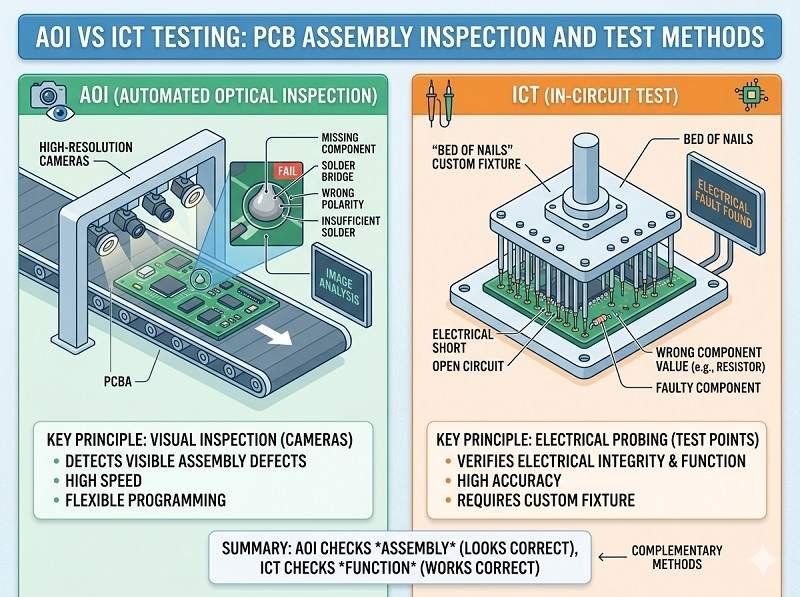
Automated Optical Inspection (AOI) is a visual inspection method used in PCBアセンブリ to detect surface-level defects. It relies on high-resolution cameras and image processing software to scan the board and compare it against a reference design.
AOI is widely used in SMT Assembly both before and after reflow soldering to ensure components are placed correctly and solder joints meet quality standards.
AOI can detect:
- Missing or wrong components
- Polarity errors
- Misalignment or skewed parts
- Solder bridges and insufficient solder
Because it is fast and non-contact, AOI is ideal for high-speed SMT Assembly production lines.
What is ICT testing
In-Circuit Testing (ICT) is an electrical testing method used after PCB Assembly is completed. It verifies the performance of individual components and the integrity of the circuit.
ICT uses a test fixture with multiple probes (bed-of-nails) that contact specific test points on the PCB.
ICT can detect:
- Short circuits and open circuits
- Incorrect component values
- Faulty or damaged components
- Connectivity issues
Unlike AOI, ICT does not rely on visual inspection. Instead, it directly measures electrical behavior, making it highly accurate for functional validation at the component level.
Key differences between AOI and ICT
AOI and ICT serve different purposes in PCB Assembly and are often used together for comprehensive quality control.
The main differences include:
- Inspection type
AOI is a visual inspection method, while ICT is an electrical testing method. - Testing stage
AOI is typically used during SMT Assembly (before and after reflow), while ICT is used after full PCB Assembly is completed. - Defect detection
AOI identifies visible defects such as placement and soldering issues, while ICT detects electrical faults such as shorts, opens, and incorrect values. - Equipment requirement
AOI uses cameras and software, whereas ICT requires dedicated fixtures and physical contact with the PCB. - Speed and flexibility
AOI is faster and easier to set up, while ICT requires more preparation but provides deeper verification.
When to use AOI in SMT Assembly
AOI is essential during SMTアセンブリ because it allows manufacturers to detect defects early in the process.
It is commonly used:
- After solder paste printing (to check alignment)
- After component placement
- After reflow soldering
By catching issues early, AOI reduces rework costs and prevents defective boards from moving further down the PCB Assembly line.
When to use ICT in PCB Assembly
ICT is used when electrical accuracy and circuit integrity must be verified.
It is ideal for:
- Mass production with stable designs
- High-reliability products
- Complex circuits requiring detailed validation
Although ICT setup takes time and cost, it provides deep insight into PCB Assembly quality and ensures each component functions correctly.
Advantages of AOI
AOI offers several benefits in SMT Assembly:
- High-speed inspection suitable for large volumes
- Non-contact testing with no risk of damage
- Early defect detection
- Easy integration into automated production lines
However, AOI cannot detect hidden solder joints or electrical performance issues.
Advantages of ICT
ICT provides strong electrical validation in PCB Assembly:
- Accurate detection of electrical faults
- Verification of component values
- High reliability for finished boards
The main limitation is that ICT requires test points and custom fixtures, which may increase cost and design complexity.
Why AOI and ICT are used together
In professional PCB Assembly, AOI and ICT are not alternatives—they are complementary.
AOI ensures that the board is assembled correctly from a visual perspective, while ICT confirms that it works correctly from an electrical standpoint.
By combining both methods, manufacturers can:
- Detect defects at multiple stages
- Improve product reliability
- Reduce failure rates
- Ensure consistent SMT Assembly quality
結論
AOI and ICT are two essential testing methods in PCB Assembly and SMT Assembly, each serving a unique purpose.
AOI focuses on visual inspection and early defect detection, while ICT verifies electrical performance and circuit integrity. Using both methods together creates a comprehensive quality control system that ensures reliable and high-performance electronic products.
プロトタイプから大量生産まで-お任せください。今すぐPCBアセンブリのお見積もりをご依頼ください。.
SMT、DIP、フルターンキーソリューションを含むプロフェッショナルなPCBアセンブリサービスを提供します。.
利用できる NDA ✔ 24 時間以内の速い引用語句 ✔ ISO によって証明される工場 ✔ ワンストップ PCB 及び PCBA サービス
 日本語
日本語  English
  Deutsch
  Français
  Português do Brasil
  Español
  Nederlands
  Italiano
  Русский
  한국어
한국어  العربية
  Svenska
  Polski
  Türkçe
  繁體中文
繁體中文