
PCB Cleaning Process
について PCB洗浄工程 is a critical step in PCBアセンブリ that removes contaminants such as flux residues, dust, oils, and ionic impurities from the surface of a printed circuit board. Proper cleaning is essential after SMTアセンブリ and soldering to ensure long-term reliability, electrical performance, and compatibility with processes like conformal coating.
Even when using “no-clean” flux, residues can still affect sensitive electronics, especially in high-reliability applications.
Why PCB Cleaning is Important
期間中 PCBアセンブリ, several contaminants can remain on the board:
- はんだ付け時のフラックス残渣
- Solder paste residues
- 粉塵と浮遊粒子
- Fingerprints and oils
- イオン汚染
If not removed, these can cause:
- 腐食
- 漏電または短絡
- Poor adhesion of conformal coating
- 製品寿命の低下
👉 Cleaning ensures the PCB meets reliability and quality standards.
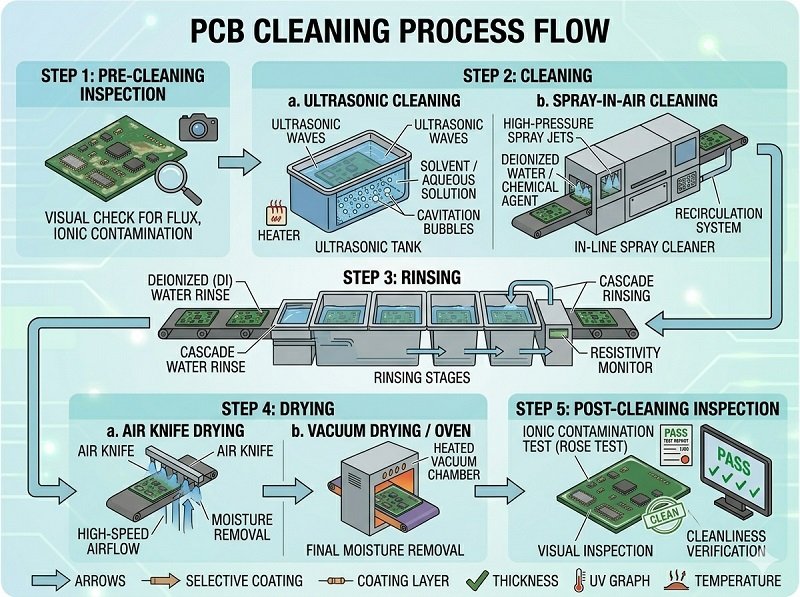
PCB Cleaning Process Steps
Pre-Clean Inspection
- Identify contamination level
- Determine cleaning method
- Check sensitive components
Cleaning Stage
The PCB is cleaned using appropriate methods (see below).
Rinsing
- Removes cleaning agents and dissolved residues
- Prevents chemical contamination
乾燥
- Ensures no moisture remains
- Uses hot air or vacuum drying
最終検査
- Verifies cleanliness
- May include ionic contamination testing
Common PCB Cleaning Methods
Aqueous Cleaning (Water-Based)
- Uses deionized (DI) water and cleaning agents
- 環境にやさしい
- ほとんどに適している SMTアセンブリ プロセス
Solvent Cleaning
- Uses chemical solvents to dissolve residues
- Effective for stubborn contaminants
- 適切な取り扱いと換気が必要
Semi-Aqueous Cleaning
- Combines solvent and water cleaning
- High efficiency for complex residues
Ultrasonic Cleaning
- Uses high-frequency sound waves
- 届きにくい場所の汚染物質を除去
- Not suitable for all components
Manual Cleaning
- Brush + solvent method
- Used for rework or small batches
Cleaning Equipment Used
- Inline cleaning machines
- Batch cleaning systems
- Spray-in-air cleaners
- Ultrasonic cleaning tanks
Modern factories integrate cleaning into automated PCBアセンブリ 線。.
Standards for PCB Cleanliness
Cleanliness is often measured by:
- Ionic contamination testing (ROSE test)
- 拡大下での目視検査
- IPC standards (e.g., IPC-TM-650)
👉 These ensure the PCB meets industry quality requirements.
Advantages of Proper PCB Cleaning
- 電気的信頼性の向上
- Prevents corrosion and leakage
- Enhances conformal coating adhesion
- Reduces field failures
- Extends product lifespan
When is PCB Cleaning Required?
Cleaning is especially important for:
- High-reliability electronics (medical, aerospace)
- Fine-pitch or high-density boards
- Boards requiring conformal coating
- 過酷な環境での使用
Limitations and Considerations
- Adds extra cost and process time
- Incorrect cleaning can damage components
- Must match cleaning method with materials used
- Requires proper drying to avoid moisture issues
Best Practices for PCB Cleaning
- Choose the right flux and cleaning method
- Use DI water for rinsing
- Control cleaning temperature and time
- Ensure complete drying
- Test cleanliness regularly
Role in PCB Assembly Process
In a typical PCBアセンブリ workflow:
- Performed after soldering (SMT or through-hole)
- Before conformal coating or final testing
- Ensures the board is free from harmful residues
結論
The PCB cleaning process is an essential part of SMTアセンブリ, ensuring that circuit boards are free from contaminants that could compromise performance and reliability. With proper cleaning methods and quality control, manufacturers can significantly improve product durability and reduce long-term failures.
迅速で正確なPCBアセンブリの見積りが必要ですか?数秒でリクエストを送信します。.
SMT、DIP、フルターンキーソリューションを含むプロフェッショナルなPCBアセンブリサービスを提供します。.
利用できる NDA ✔ 24 時間以内の速い引用語句 ✔ ISO によって証明される工場 ✔ ワンストップ PCB 及び PCBA サービス
 日本語
日本語  English
  Deutsch
  Français
  Português do Brasil
  Español
  Nederlands
  Italiano
  Русский
  한국어
한국어  العربية
  Svenska
  Polski
  Türkçe
  繁體中文
繁體中文