
Coating thickness measurement method
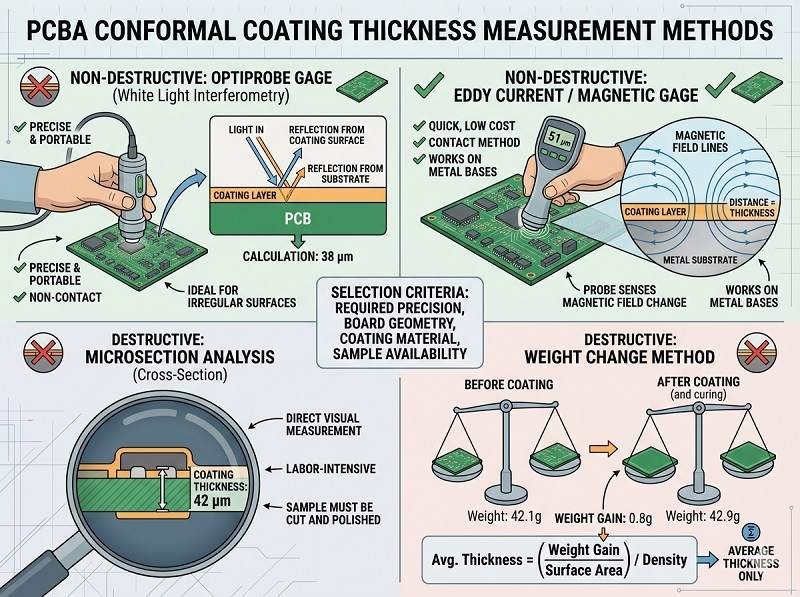
Coating thickness measurement is the process of determining the thickness of Conformal Coating applied on a PCB in PCB Assembly and SMT Assembly. Proper thickness is critical to ensure effective protection without interfering with electrical performance or component functionality.
Why thickness measurement is important
The thickness of Conformal Coating directly affects its performance.
If too thin:
- Insufficient protection against moisture and contaminants
- Reduced insulation performance
If too thick:
- Risk of cracking or delamination
- Potential interference with connectors or moving parts
Accurate measurement ensures optimal coating quality in PCB Assembly.
Common coating thickness measurement methods
Wet film thickness measurement
This method is used immediately after coating application before curing.
How it works:
- A wet film gauge is placed on the coated surface
- The thickness is determined based on contact points
Advantages:
- Quick and simple
- Helps adjust process parameters in real time
Limitations:
- Only applicable before curing
- Less precise than dry measurement
Dry film thickness measurement
Performed after the coating has cured, this is the most widely used method in SMT Assembly.
Methods include:
Micrometer measurement
- Measures total thickness before and after coating
- Calculates coating thickness by difference
Ultrasonic thickness measurement
- Uses sound waves to measure coating thickness
- Non-destructive and accurate
Eddy current method
- Used for conductive substrates
- Measures thickness based on electromagnetic response
Cross-section measurement
How it works:
- PCB is cut to expose a cross-section
- Thickness is measured under a microscope
Advantages:
- Very accurate
- Useful for process validation
Disadvantages:
- Destructive method
- Not suitable for routine inspection
Optical measurement methods
Advanced PCB Assembly processes may use optical systems:
- Laser measurement
- Digital microscopy
- Automated inspection systems
These provide high precision and are suitable for automated SMT Assembly lines.
Typical coating thickness ranges
Depending on the coating type:
- Acrylic: 25–75 microns
- Silicone: 50–200 microns
- Polyurethane: 25–100 microns
- Epoxy: 25–100 microns
Maintaining the correct range ensures reliable Conformal Coating performance.
Factors affecting thickness
- Coating method (spray, dip, brush, selective)
- Viscosity of coating material
- Application speed and pressure
- Environmental conditions
These must be controlled in SMT Assembly processes.
Final conclusion
Coating thickness measurement is a vital quality control step in PCB Assembly and SMT Assembly. By using appropriate methods such as wet film gauges, ultrasonic testing, and cross-section analysis, manufacturers can ensure that Conformal Coating meets performance and reliability requirements.
Get a Conformal Coating Quote
Have special coating requirements? Send us your PCB files for evaluation.
Send us your requirements and get a fast response from our engineering team.
✔ 24-hour response ✔ Engineering support ✔ Small & Mass Production
Shenzhen Tengxinjie Electronics Co., Ltd.

 English
  Deutsch
  Français
  Português do Brasil
  Español
  日本語
日本語  Nederlands
  Italiano
  Русский
  한국어
한국어  العربية
  Svenska
  Polski
  Türkçe
  繁體中文
繁體中文