
DIP vs spray coating process
In PCB Assembly and SMT Assembly, both dip coating and spray coating are widely used methods for applying Conformal Coating. Each process has its own advantages, limitations, and suitable applications depending on production requirements.
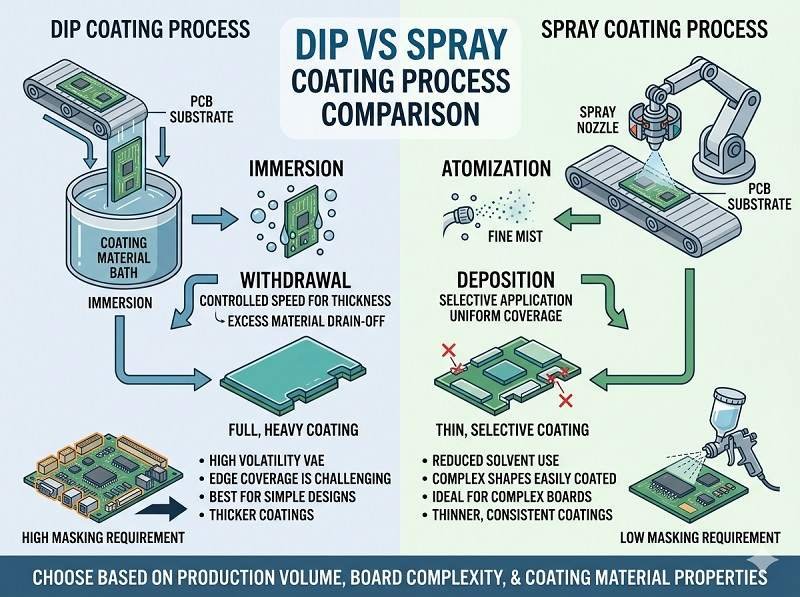
What is dip coating process
Dip coating involves immersing the entire PCB into a tank filled with Conformal Coating material and then withdrawing it at a controlled speed.
Process steps:
- PCB is cleaned and masked
- Board is fully submerged in coating liquid
- PCB is slowly withdrawn
- Excess coating drains off
- Coating is cured
Advantages:
- Excellent coverage, including hard-to-reach areas
- Simple process with minimal equipment
- Suitable for high-volume PCB Assembly
Disadvantages:
- Coating applied to entire board (including unwanted areas)
- Requires extensive masking
- Higher material consumption
- Risk of thick coating or pooling
Dip coating is often used when full coverage is required and design allows it.
What is spray coating process
Spray coating applies Conformal Coating using a spray nozzle, either manually or through automated systems.
Process steps:
- PCB is prepared and masked
- Coating is sprayed onto the board surface
- Multiple passes may be applied for uniform thickness
- Coating is cured
Advantages:
- More controlled and uniform thickness
- Reduced material waste
- Can be automated for inline SMT Assembly
- Less masking compared to dip coating
Disadvantages:
- May require multiple passes
- Overspray needs to be controlled
- Slightly more complex equipment
Spray coating is commonly used in modern PCB Assembly for better precision and efficiency.
Key differences between dip and spray coating
Coverage
- Dip coating: full coverage, including hidden areas
- Spray coating: controlled, targeted coverage
Material usage
- Dip coating: higher consumption
- Spray coating: more efficient
Masking requirement
- Dip coating: extensive masking needed
- Spray coating: less masking required
Thickness control
- Dip coating: less precise
- Spray coating: better thickness control
Automation
- Dip coating: semi-automatic or manual
- Spray coating: easily integrated into automated SMT Assembly lines
Which is better
- Choose dip coating for simple designs requiring full protection
- Choose spray coating for complex PCBs, selective coverage, and high-quality control
In most modern SMT Assembly environments, spray or selective coating is preferred due to precision and efficiency.
Final conclusion
Dip coating and spray coating are both effective methods for applying Conformal Coating in PCB Assembly. Dip coating offers complete coverage and simplicity, while spray coating provides better control, efficiency, and suitability for automated SMT Assembly. The best choice depends on PCB design, production volume, and quality requirements.
Get a Conformal Coating Quote
Looking for a trusted PCBA partner with conformal coating capability? Let’s talk.
Send us your requirements and get a fast response from our engineering team.
✔ 24-hour response ✔ Engineering support ✔ Small & Mass Production
Shenzhen Tengxinjie Electronics Co., Ltd.
 English
  Deutsch
  Français
  Português do Brasil
  Español
  日本語
日本語  Nederlands
  Italiano
  Русский
  한국어
한국어  العربية
  Svenska
  Polski
  Türkçe
  繁體中文
繁體中文