
Multilayer PCB Assembly
Multilayer PCB Assembly refers to the process of assembling electronic components onto a printed circuit board that contains three or more conductive layers. Unlike single-sided or double-sided boards, multilayer PCBs stack multiple copper layers separated by insulating materials, enabling highly complex and compact circuit designs. This type of assembly is widely used in advanced PCB 組裝 和 SMT 組裝 for high-performance electronic products.
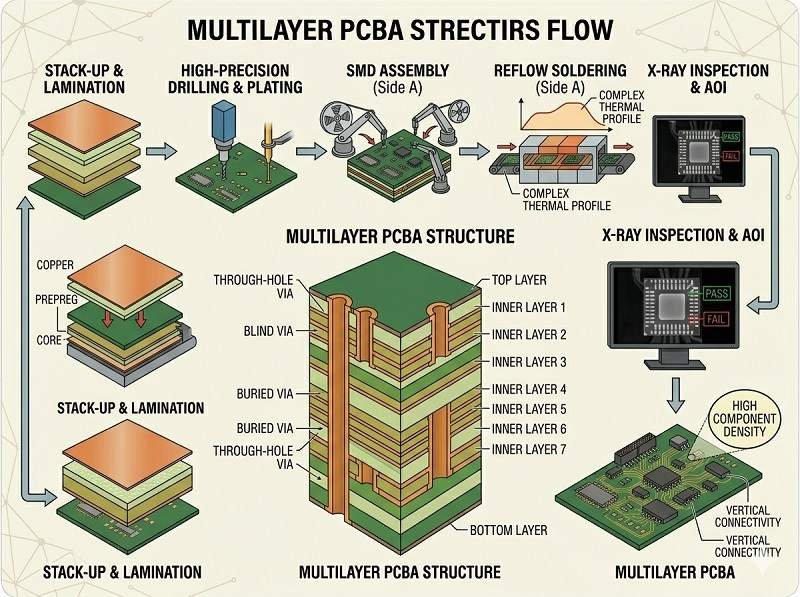
What is a Multilayer PCB?
A multilayer PCB typically includes:
- Multiple copper layers (4, 6, 8, or more)
- Insulating layers (prepreg and core materials)
- Vias (through-hole, blind, and buried vias)
- Internal routing for signals, power, and ground
👉 These layers are laminated together to form a single compact board used in modern PCB 組裝.
Why Use Multilayer PCB Assembly?
Multilayer designs are essential for:
- High-density circuits
- Complex signal routing
- High-speed and high-frequency applications
- Miniaturized electronic devices
👉 They allow more functionality in a smaller footprint compared to traditional PCBs.
Multilayer PCB Assembly Process
The assembly process is similar to standard SMT 組裝, but with tighter control requirements:
焊膏印刷
- Precise application on surface pads
- Critical for fine-pitch components
元件安置
- High-speed, high-accuracy pick-and-place machines
- Handles dense layouts and small components
回流焊接
- Controlled temperature profile
- Ensures reliable solder joints without damaging inner layers
檢查
- AOI for surface defects
- X-ray inspection for hidden joints and internal connections
測試
- ICT (In-Circuit Testing) for electrical validation
- Functional testing (FCT) for system performance
Key Features of Multilayer PCB Assembly
- High component density
- Complex routing capability
- Improved signal integrity
- Reduced electromagnetic interference (EMI)
👉 These features make multilayer boards essential in advanced electronics.
Challenges in Multilayer PCB Assembly
- More complex design and manufacturing
- Higher cost compared to simpler PCBs
- Difficult inspection of internal layers
- Thermal management issues
- Increased risk of defects if not properly controlled
Advantages of Multilayer PCB Assembly
- Compact and lightweight design
- High reliability and durability
- Better electrical performance
- Supports high-speed signal transmission
- Reduced noise and interference
Applications of Multilayer PCB Assembly
Multilayer PCB Assembly is widely used in:
- Smartphones and consumer electronics
- Computers and servers
- 汽車電子
- 航太系統
- 醫療器材
- 電信設備
Design Considerations
To ensure successful PCB 組裝:
- Optimize layer stack-up design
- Control impedance for high-speed signals
- Ensure proper via design (blind/buried vias)
- Plan thermal management (heat dissipation)
- Follow DFM, DFA, and DFT guidelines
Multilayer vs Double-Sided PCB Assembly
| 特點 | Multilayer PCB | Double-Sided PCB |
|---|---|---|
| 層數 | 3 or more | 2 |
| 複雜性 | 高 | 中度 |
| 成本 | 更高 | 較低 |
| 效能 | 進階 | Basic to moderate |
👉 Multilayer PCBs are used when higher performance and density are required.
Role in Modern SMT Assembly
In today’s SMT 組裝, multilayer PCB Assembly is essential for:
- Miniaturized devices
- High-speed communication systems
- Advanced computing hardware
It represents the standard for modern electronics manufacturing.
總結
Multilayer PCB Assembly is a key technology in advanced PCB 組裝 和 SMT 組裝, enabling complex, high-performance, and compact electronic designs. While it involves higher cost and complexity, its benefits in performance, reliability, and miniaturization make it indispensable in modern electronic products.
想知道您的 PCB 裝配成本嗎?立即索取詳細報價。.
我們提供專業的 PCB 裝配服務,包括 SMT、DIP 及完整的統包解決方案。.
✔ 提供 NDA ✔ 24 小時內快速報價 ✔ ISO 認證工廠 ✔ 一站式 PCB & PCBA 服務

 繁體中文
繁體中文  English
  Deutsch
  Français
  Português do Brasil
  Español
  日本語
日本語  Nederlands
  Italiano
  Русский
  한국어
한국어  العربية
  Svenska
  Polski
  Türkçe