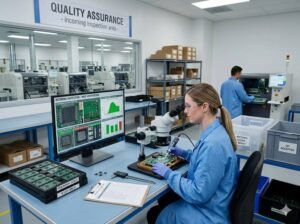
Cleanroom requirement for coating
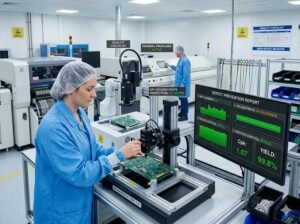
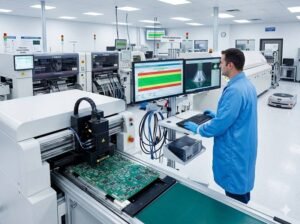
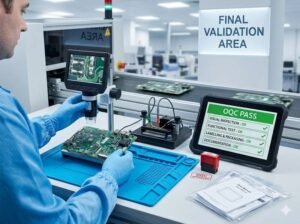
Cleanroom requirements for 保形塗層 refer to the environmental controls needed to prevent contamination during the coating process. In PCB 組裝, 原型 PCB 組裝, 以及 SMT 組裝, maintaining a clean and controlled environment is essential to ensure coating quality, adhesion, and long-term reliability.
Unlike semiconductor manufacturing, conformal coating does not always require ultra-high cleanroom levels, but a controlled clean environment is still critical to avoid defects such as dust inclusion, pinholes, bubbles, and poor surface finish.

Typical cleanroom levels
For most PCB 組裝 coating processes, the following standards are commonly used:
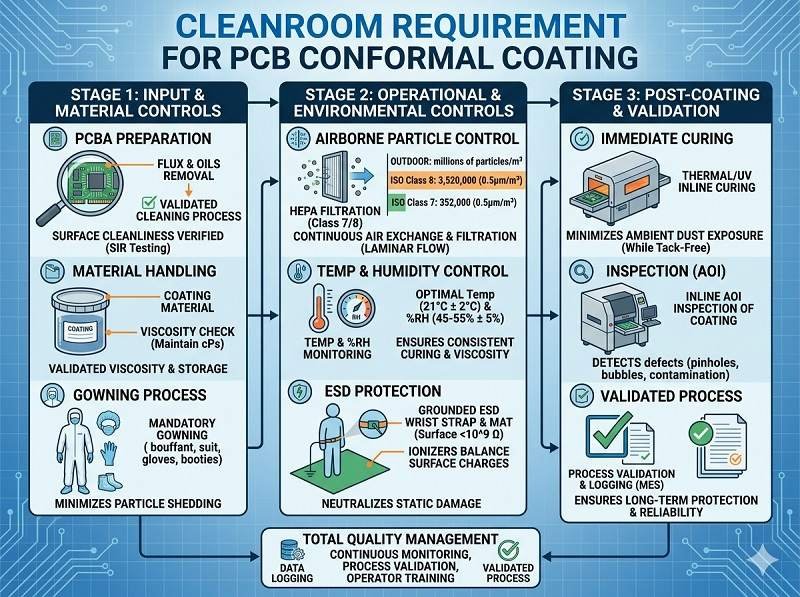
- ISO Class 7–8 cleanroom (Class 10,000–100,000) for high-reliability applications
- Controlled production areas with filtration for general industrial use
在 原型 PCB 組裝, a full cleanroom may not be necessary, but a clean, dust-free workspace is still required.
Key environmental requirements
Air cleanliness and filtration
High-efficiency particulate air (HEPA) filters are used to remove airborne particles. Clean airflow reduces the risk of dust settling on wet 保形塗層 surfaces.
Temperature control
Stable temperature (typically 20–25°C) ensures consistent coating viscosity and curing behavior in SMT 組裝 流程。.
Humidity control
Relative humidity is usually maintained at 40–60% to prevent static buildup and avoid moisture-related defects during PCB 組裝.
Airflow management
Laminar or controlled airflow helps direct particles away from coated surfaces. Positive pressure environments prevent external contaminants from entering the coating area.
Why cleanroom control is important
- Prevents dust and particles from contaminating the coating
- Ensures smooth and uniform coating finish
- Improves adhesion and electrical insulation performance
- Reduces defects and rework in SMT 組裝
- Enhances product reliability, especially in harsh environments
Cleanroom vs controlled environment
Not all coating processes require a full cleanroom. Many manufacturers use a controlled coating zone instead, which includes:
- Enclosed coating area
- Air filtration systems
- Anti-static flooring and surfaces
- Restricted access to minimize contamination
This approach balances cost and performance, especially in standard PCB 組裝 operations.
Additional requirements for coating areas
ESD control
Cleanroom environments should also include ESD protection measures to prevent electrostatic damage during 保形塗層.
Material and equipment cleanliness
All tools, fixtures, and coating equipment must be regularly cleaned to avoid introducing contaminants.
Operator discipline
Personnel should wear clean garments, gloves, and follow strict handling procedures, particularly in 原型 PCB 組裝 where manual processes are common.
Inspection and monitoring
Regular monitoring of particle levels, humidity, and temperature ensures that the environment remains within acceptable limits.
Best practices
- Use HEPA-filtered air systems
- Maintain stable temperature and humidity
- Isolate coating areas from dust-generating processes
- Implement strict cleaning and maintenance schedules
- Train staff on cleanroom protocols
In conclusion, while 保形塗層 does not always require a full semiconductor-grade cleanroom, a controlled, clean environment is essential in PCB 組裝, SMT 組裝, 以及 原型 PCB 組裝. Proper environmental control minimizes contamination, reduces defects, and ensures high-quality coating performance.
取得保形塗層報價
準備好開始您的保形塗層專案了嗎?請填寫以下表格開始。.
將您的需求傳送給我們,並獲得我們工程團隊的快速回應。.
24 小時回應 ✔ 工程支援 ✔ 小型與大量生產
深圳市騰欣杰電子有限公司