
Coating removal process
The coating removal process refers to the controlled stripping of Conformal Coating from a PCB to allow inspection, repair, modification, or rework. It is a critical operation in PCB Assembly and SMT Assembly, especially when defects must be corrected or components need replacement.
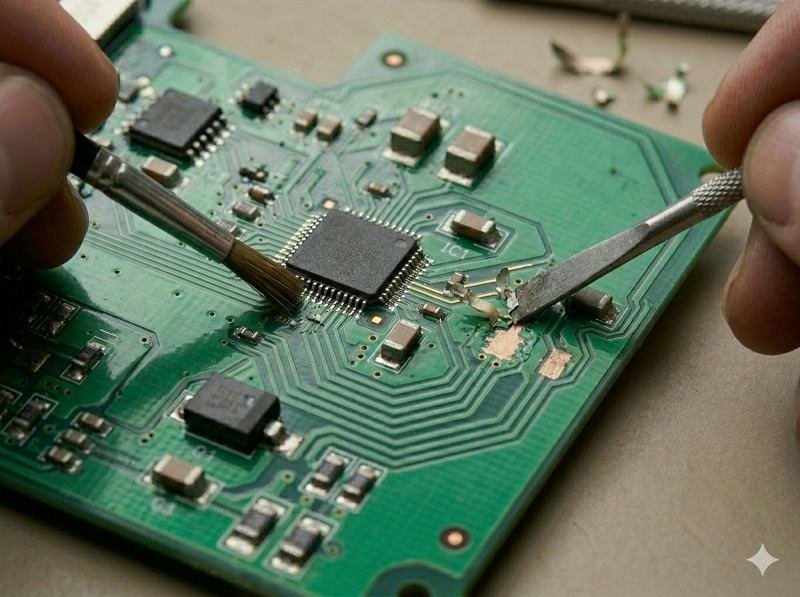
Why coating removal is necessary
In Turnkey PCB Assembly, coating removal is typically required for:
- Repairing or replacing faulty components
- Fixing coating defects (bubbles, cracks, delamination)
- Removing contamination trapped under the coating
- Implementing design or engineering changes
- Performing detailed inspection or testing
Without proper removal, accessing the PCB circuitry would be difficult and risky.
Types of conformal coatings and removal difficulty
Different coatings require different removal methods:
- Acrylic coatings → easiest to remove
- Silicone coatings → flexible, moderate difficulty
- Urethane coatings → more chemical-resistant
- Epoxy coatings → very hard, difficult to remove
- Parylene coatings → require specialized techniques
Understanding the coating type is essential in PCB Assembly before starting removal.
Common coating removal methods
Solvent removal
- Uses chemical solvents to dissolve the coating
- Most effective for acrylic coatings
- Simple and widely used in SMT Assembly rework
Mechanical removal
- Involves scraping, brushing, or micro-abrasion
- Suitable for localized removal
- Requires precision to avoid PCB damage
Chemical stripping
- Uses stronger chemicals for tough coatings (urethane, epoxy)
- Effective but must be carefully controlled
- Requires proper safety measures
Thermal removal
- Applies heat to soften the coating
- Makes mechanical removal easier
- Must avoid overheating sensitive components
Plasma or laser removal (advanced)
- Used for high-precision or complex boards
- Ideal for selective removal in high-end Turnkey PCB Assembly
Steps in coating removal process
- Identify coating type
- Select appropriate removal method
- Protect surrounding components (masking if needed)
- Remove coating from targeted area
- Clean residues thoroughly
- Inspect PCB for damage or remaining coating
Each step must be carefully controlled to maintain board integrity.
Challenges in coating removal
- Risk of damaging components or PCB traces
- Residue left behind affecting re-coating
- Time-consuming for hard coatings
- Safety concerns when using chemicals
These challenges highlight the importance of proper process control in PCB Assembly.
Best practices
- Use coatings that allow easier rework when possible
- Limit removal to only necessary areas
- Use proper tools and trained technicians
- Follow safety and environmental guidelines
- Ensure complete cleaning before recoating
Conclusion
The coating removal process is an essential part of rework in PCB Assembly, SMT Assembly, and Turnkey PCB Assembly. By selecting the correct method and following controlled procedures, manufacturers can safely remove Conformal Coating, perform repairs, and restore PCB functionality without compromising reliability.
Get a Conformal Coating Quote
Working on automotive, industrial, or outdoor electronics? We can help with conformal coating.
Send us your requirements and get a fast response from our engineering team.
✔ 24-hour response ✔ Engineering support ✔ Small & Mass Production
Shenzhen Tengxinjie Electronics Co., Ltd.
 English
  Deutsch
  Français
  Português do Brasil
  Español
  日本語
日本語  Nederlands
  Italiano
  Русский
  한국어
한국어  العربية
  Svenska
  Polski
  Türkçe
  繁體中文
繁體中文