
Coating be reapplied
Yes, Conformal Coating can be reapplied on a PCB, and this is a standard practice in PCB Assembly and SMT Assembly when repairs, rework, or coating defects occur. However, successful reapplication depends on proper surface preparation and compatibility with the original coating.
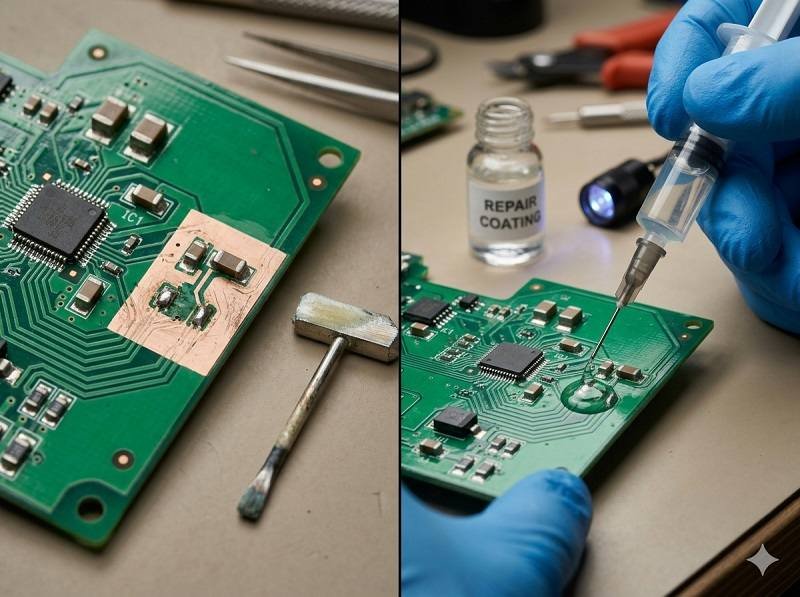
When reapplication is needed
Reapplying coating is common in Turnkey PCB Assembly under the following conditions:
- After repairing or replacing components
- When the original coating is damaged (cracks, peeling, scratches)
- If there are coating defects such as bubbles or uneven coverage
- Following engineering changes or modifications
Key requirement before reapplying
The most critical step is surface preparation:
- Remove the damaged or old Conformal Coating in the affected area
- Clean the surface to eliminate residues, dust, and contaminants
- Ensure the PCB is completely dry
Without proper cleaning, the new coating may not adhere well, leading to future failures.
Compatibility considerations
- Ideally, reapply the same type of coating (acrylic, silicone, urethane, etc.)
- Some coatings bond well to themselves (e.g., acrylics)
- Others may require full removal before recoating (e.g., epoxy or parylene)
In SMT Assembly, using compatible materials ensures strong adhesion and uniform protection.
Reapplication methods
Common methods include:
- Brush coating → suitable for small repair areas
- Spray coating → provides more uniform coverage
- Selective coating → automated and precise for production environments
The method should match the original process used in PCB Assembly as closely as possible.
Curing after reapplication
After applying the new coating:
- Allow proper curing (air dry, heat, or UV depending on material)
- Follow manufacturer specifications for time and temperature
- Avoid handling before full cure
Proper curing ensures durability and performance.
Inspection after recoating
Once cured, inspect the PCB:
- Use UV inspection to verify coverage
- Check for bubbles, gaps, or overcoating
- Confirm proper thickness and adhesion
Inspection is essential in Turnkey PCB Assembly to maintain quality standards.
Limitations and risks
- Poor adhesion if surface is not properly cleaned
- Incompatibility between old and new coatings
- Uneven thickness if recoating is not controlled
- Difficulty with multiple rework cycles
To minimize risks, reapplication should follow strict process controls.
Conclusion
Yes, Conformal Coating can be reapplied effectively, provided the surface is properly prepared and compatible materials are used. In PCB Assembly, SMT Assembly, and Turnkey PCB Assembly, careful recoating helps restore protection, extend product life, and maintain high reliability.
Get a Conformal Coating Quote
Want to optimize coating cost without compromising quality? Contact us now.
Send us your requirements and get a fast response from our engineering team.
✔ 24-hour response ✔ Engineering support ✔ Small & Mass Production
Shenzhen Tengxinjie Electronics Co., Ltd.
 English
  Deutsch
  Français
  Português do Brasil
  Español
  日本語
日本語  Nederlands
  Italiano
  Русский
  한국어
한국어  العربية
  Svenska
  Polski
  Türkçe
  繁體中文
繁體中文