
Chemicals remove Conformal Coating
In PCB Assembly and SMT Assembly, removing Conformal Coating is often necessary for repair, rework, or inspection. The type of chemical used depends on the coating material (acrylic, silicone, polyurethane, epoxy, or parylene), as each has different resistance properties.
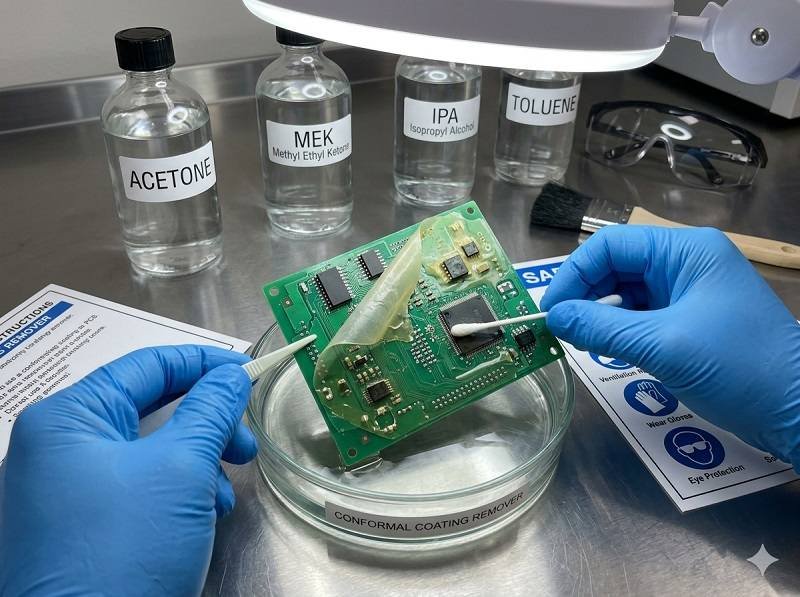
Common chemicals for removing Conformal Coating
Solvent removers (for acrylic coatings)
Acrylic Conformal Coating is the easiest to remove.
Common chemicals:
- Acetone
- Isopropyl alcohol (IPA)
- Specialized acrylic removers
Features:
- Fast and effective
- Minimal damage to PCB when used properly
- Widely used in PCB Assembly rework
Solvent blends (for polyurethane coatings)
Polyurethane coatings require stronger chemicals.
Common chemicals:
- Dedicated urethane removers
- Solvent blends (e.g., glycol ethers, esters)
Features:
- Good effectiveness with controlled exposure
- May require brushing or soaking
- Common in industrial SMT Assembly repair
Silicone removers
Silicone Conformal Coating is more resistant and harder to remove.
Common chemicals:
- Silicone stripping agents
- Swelling solvents (to soften coating before removal)
Features:
- Usually requires mechanical assistance (scraping)
- Slower process compared to acrylic
Epoxy removers
Epoxy coatings are very difficult to remove chemically.
Common chemicals:
- Strong industrial epoxy strippers
- Often combined with heat or mechanical removal
Features:
- Time-consuming and aggressive
- Risk of damaging components or PCB
- Used only when necessary in PCB Assembly
Parylene removal chemicals
Parylene Conformal Coating is highly resistant to most chemicals.
Removal methods:
- Specialized chemical stripping agents
- Plasma etching (more common than chemicals)
Features:
- Complex and expensive process
- Typically used in high-end SMT Assembly applications
Important safety considerations
When using chemicals to remove Conformal Coating:
- Work in well-ventilated areas
- Use proper PPE (gloves, goggles)
- Avoid prolonged exposure to solvents
- Test on a small area first to prevent PCB damage
Alternative removal methods
In addition to chemicals, other methods may be used:
- Mechanical removal (scraping, micro-tools)
- Thermal removal (heat softening)
- Laser or plasma removal (high precision)
These are often combined with chemical methods in PCB Assembly rework.
Final conclusion
Different Conformal Coating materials require different removal chemicals. Acrylic coatings are the easiest to remove with common solvents, while silicone, polyurethane, epoxy, and parylene require stronger or specialized methods. In PCB Assembly and SMT Assembly, selecting the correct removal approach ensures safe and effective rework without damaging the PCB.
Get a Conformal Coating Quote
Ensure long-term reliability for your PCBs with our coating solutions. Start here.
Send us your requirements and get a fast response from our engineering team.
✔ 24-hour response ✔ Engineering support ✔ Small & Mass Production
Shenzhen Tengxinjie Electronics Co., Ltd.
 English
  Deutsch
  Français
  Português do Brasil
  Español
  日本語
日本語  Nederlands
  Italiano
  Русский
  한국어
한국어  العربية
  Svenska
  Polski
  Türkçe
  繁體中文
繁體中文