
Methode voor laagdiktemeting
Coatingdiktemeting is het proces van het bepalen van de dikte van Conforme coating aangebracht op een printplaat in PCB-assemblage en SMT-assemblage. De juiste dikte is essentieel voor een effectieve bescherming zonder de elektrische prestaties of de functionaliteit van de onderdelen te beïnvloeden.
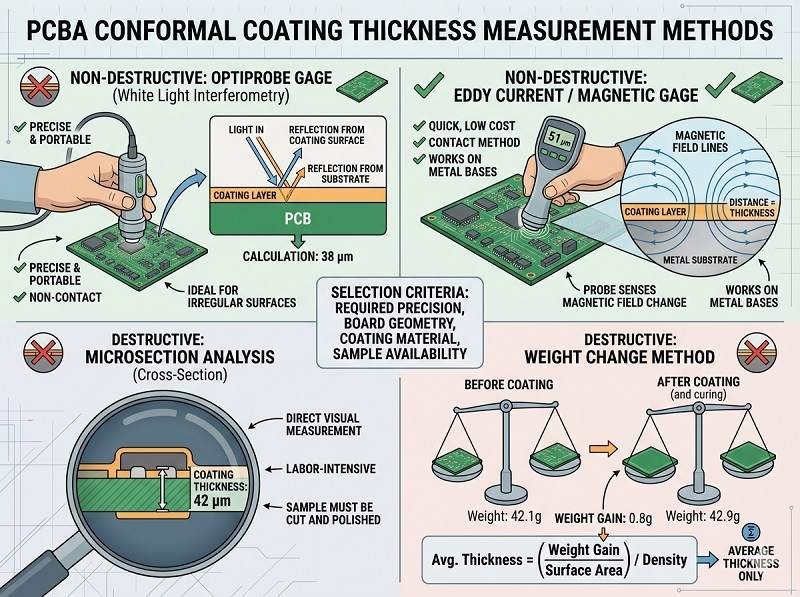
Waarom diktemeting belangrijk is
De dikte van Conforme coating heeft een directe invloed op de prestaties.
Als het te dun is:
- Onvoldoende bescherming tegen vocht en verontreinigingen
- Verminderde isolatieprestaties
Als het te dik is:
- Risico op scheuren of delaminatie
- Mogelijke interferentie met connectoren of bewegende delen
Nauwkeurige metingen zorgen voor optimale coatingkwaliteit in PCB-assemblage.
Gebruikelijke coatingdiktemetingsmethoden
Natte laagdiktemeting
Deze methode wordt gebruikt onmiddellijk na het aanbrengen van de coating voor het uitharden.
Hoe het werkt:
- Een natte-film-meter wordt op het gecoate oppervlak geplaatst
- De dikte wordt bepaald op basis van contactpunten
Voordelen:
- Snel en eenvoudig
- Helpt procesparameters in realtime aan te passen
Beperkingen:
- Alleen van toepassing vóór uitharding
- Minder nauwkeurig dan droge meting
Droge laagdiktemeting
Uitgevoerd nadat de coating is uitgehard, Dit is de meest gebruikte methode in SMT-assemblage.
De methoden omvatten:
Micrometermeting
- Meet de totale dikte voor en na de coating
- Berekent coatingdikte door verschil
Ultrasone diktemeting
- Gebruikt geluidsgolven om laagdikte te meten
- Niet-destructief en nauwkeurig
Wervelstroommethode
- Gebruikt voor geleidende substraten
- Meet dikte op basis van elektromagnetische respons
Doorsnedemeting
Hoe het werkt:
- PCB wordt gesneden om een dwarsdoorsnede bloot te leggen
- De dikte wordt gemeten onder een microscoop
Voordelen:
- Zeer nauwkeurig
- Nuttig voor procesvalidatie
Nadelen:
- Destructieve methode
- Niet geschikt voor routine-inspectie
Optische meetmethoden
Geavanceerd PCB-assemblage processen kunnen optische systemen gebruiken:
- Lasermeting
- Digitale microscopie
- Geautomatiseerde inspectiesystemen
Deze bieden een hoge precisie en zijn geschikt voor geautomatiseerde SMT-assemblage lijnen.
Typische laagdiktebereiken
Afhankelijk van het coatingtype:
- Acryl: 25-75 micron
- Silicone: 50-200 micron
- Polyurethaan: 25-100 micron
- Epoxy: 25-100 micron
Het handhaven van het juiste bereik zorgt voor betrouwbare Conforme coating prestaties.
Factoren die de dikte beïnvloeden
- Coatingmethode (spuiten, onderdompelen, borstelen, selectief)
- Viscositeit van coatingmateriaal
- Aanbrengsnelheid en druk
- Milieuomstandigheden
Deze moeten worden gecontroleerd in SMT-assemblage processen.
Eindconclusie
Het meten van de laagdikte is een essentiële stap voor kwaliteitscontrole in PCB-assemblage en SMT-assemblage. Door de juiste methoden te gebruiken, zoals natte filmmeters, ultrasoon testen en doorsnede-analyse, kunnen fabrikanten ervoor zorgen dat Conforme coating voldoet aan de prestatie- en betrouwbaarheidseisen.
Vraag een offerte aan voor conforme coating
Hebt u speciale coatingvereisten? Stuur ons uw PCB-bestanden ter evaluatie.
Stuur ons je vereisten en krijg snel antwoord van ons engineeringteam.
✔ 24-uurs respons ✔ Engineering-ondersteuning ✔ Kleine & massaproductie
Shenzhen Tengxinjie Electronics Co, Ltd.
 Nederlands
  English
  Deutsch
  Français
  Português do Brasil
  Español
  日本語
日本語  Italiano
  Русский
  한국어
한국어  العربية
  Svenska
  Polski
  Türkçe
  繁體中文
繁體中文