
Solder Paste in PCB Assembly
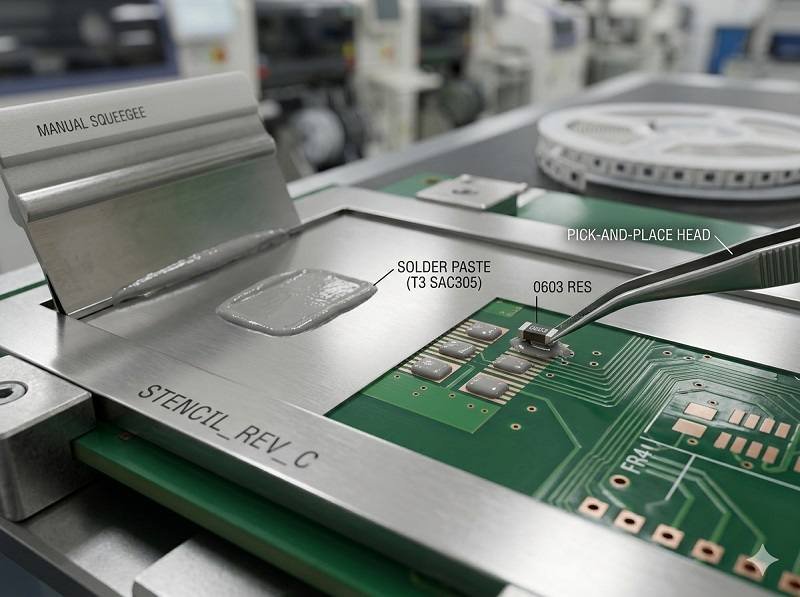
Solder paste is a crucial material used in PCBアセンブリ, especially in SMTアセンブリ, to attach electronic components to a printed circuit board. It is a mixture of tiny solder alloy particles and flux, forming a sticky, gray paste that is applied to PCB pads before component placement.
Solder paste acts as both a temporary adhesive to hold components in place and a conductive material that forms strong electrical and mechanical connections after the soldering process.
Composition of Solder Paste
Solder paste consists of two main components: solder powder and flux.
The solder powder is made of microscopic metal particles, typically composed of alloys such as tin, silver, and copper (SAC). These particles melt during the reflow process to create solid joints.
The flux is a chemical agent that cleans the metal surfaces, removes oxidation, and improves solder wetting. It ensures that the molten solder flows properly and forms reliable connections between the component leads and PCB pads.
The ratio of metal to flux usually ranges from 85% to 90% metal content, which affects the paste’s performance and printing characteristics.
How Solder Paste Works in SMT Assembly
の中で SMTアセンブリ process, solder paste is applied to the PCB using a stencil. The stencil ensures that the paste is deposited precisely on the solder pads.
After paste application, electronic components are placed onto the PCB. The sticky nature of the solder paste holds them in position temporarily.
The board is then passed through a reflow oven, where the paste is heated to a specific temperature profile. The solder particles melt, and the flux activates to clean the surfaces. Once cooled, the solder solidifies, creating strong and reliable joints.
This step is a key transition between PCB Manufacturing and final PCB Assembly.
Types of Solder Paste
There are different types of solder paste used depending on the application.
Leaded solder paste contains tin-lead alloys and is known for its lower melting point and good reliability. However, it is less commonly used today due to environmental regulations.
Lead-free solder paste, typically made from tin-silver-copper alloys, is widely used in modern electronics to comply with environmental standards such as RoHS.
No-clean solder paste leaves minimal residue and does not require post-cleaning, making it suitable for most applications.
Water-soluble solder paste requires cleaning after reflow but offers excellent flux activity and reliability for critical applications.
Importance of Solder Paste in PCB Assembly
Solder paste is essential for achieving high-quality PCB Assembly. It directly affects solder joint reliability, electrical performance, and product durability.
Accurate solder paste deposition ensures proper connections and prevents defects such as solder bridging, insufficient solder, or open circuits.
In high-density designs, especially those produced through SMT Assembly, solder paste quality and application precision become even more critical.
Solder Paste in Turnkey PCB Assembly
で ターンキーPCBアセンブリ, the manufacturer manages solder paste selection, storage, and application as part of the overall process. This ensures compatibility with PCB Manufacturing, stencil design, and SMT Assembly parameters.
Proper handling, including temperature control and shelf-life management, is essential to maintain paste quality and performance.
Common Issues with Solder Paste
Improper use of solder paste can lead to several defects.
Too much paste can cause bridging between pads, while too little can result in weak or open connections. Misalignment during stencil printing can also lead to placement issues.
Other challenges include paste drying, contamination, and incorrect reflow temperature profiles. These factors must be carefully controlled to ensure consistent results.
Best Practices for Using Solder Paste
最適な結果を得るためには、いくつかのベストプラクティスに従うべきである。.
Store solder paste under recommended temperature conditions and allow it to reach room temperature before use.
Use high-quality stencils for precise application and ensure regular cleaning to prevent clogging.
Optimize the reflow profile based on the solder paste type and PCB design.
Work with experienced PCB Assembly and SMT Assembly providers to ensure proper process control and quality assurance.
結論
Solder paste is a fundamental material in PCB Assembly, playing a key role in forming reliable electrical connections during SMT Assembly. Its composition, application, and processing directly impact the quality and performance of electronic products.
When properly managed within PCB製造 and Turnkey PCB Assembly processes, solder paste ensures consistent, high-quality results for both prototyping and mass production.
Fast, reliable, and cost-effective PCB assembly solutions. Request your quote now.
SMT、DIP、フルターンキーソリューションを含むプロフェッショナルなPCBアセンブリサービスを提供します。.
利用できる NDA ✔ 24 時間以内の速い引用語句 ✔ ISO によって証明される工場 ✔ ワンストップ PCB 及び PCBA サービス
 日本語
日本語  English
  Deutsch
  Français
  Português do Brasil
  Español
  Nederlands
  Italiano
  Русский
  한국어
한국어  العربية
  Svenska
  Polski
  Türkçe
  繁體中文
繁體中文