
Your defect rate
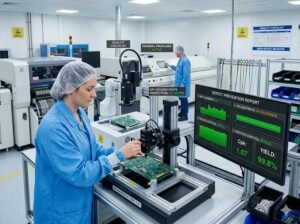
Defect rate is one of the most important indicators of quality in PCBアセンブリ, SMTアセンブリ, そして ターンキーPCBアセンブリ. It reflects how many boards or solder joints fail to meet quality standards during production.
A professional PCB製造 partner continuously works to minimize defect rates through strict process control, advanced equipment, and comprehensive inspection systems.

Typical defect rate in PCB assembly
In modern electronics manufacturing, defect rates are usually measured in DPPM (Defective Parts Per Million).
Typical industry benchmarks:
- Standard manufacturers: 500–2000 DPPM
- Advanced SMT Assembly lines: 100–500 DPPM
- High-reliability production (automotive/medical): <50–100 DPPM
For well-controlled ターンキーPCBアセンブリ, defect rates are typically maintained below 500 DPPM, with many projects achieving even lower levels depending on complexity.
How defect rate is calculated
Defect rate can be measured in different ways:
Per Board (Unit Defect Rate)
Percentage of defective PCBs out of total produced.
Per Solder Joint (DPPM)
More precise measurement, especially in SMTアセンブリ, where thousands of joints exist on a single board.
First Pass Yield (FPY)
Indicates how many boards pass all tests without rework.
These metrics together provide a complete view of PCB製造 品質だ。.
Factors that affect defect rate
Several factors influence defect rates in PCBアセンブリ:
Design Quality (DFM/DFT)
Poor PCB design can lead to soldering issues, misalignment, or test failures.
Component Quality
Low-quality or counterfeit components increase failure risk.
Process Control
Solder paste printing, placement accuracy, and reflow profiles directly impact SMTアセンブリ 品質だ。.
Equipment Precision
High-end machines reduce placement errors and improve consistency.
Operator Skill
Experienced engineers ensure proper setup, inspection, and troubleshooting.
How we minimize defect rates
信頼できる PCB製造 provider uses multiple strategies to maintain low defect rates:
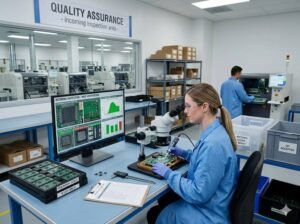
Strict Incoming Quality Control (IQC)
Ensures only qualified components enter production.
Advanced Equipment
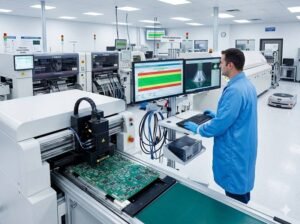
High-speed, high-precision SMT machines improve placement accuracy.
SPI + AOI Inspection
Early detection of solder paste and placement defects.
X線検査
Ensures hidden solder joints meet quality standards.
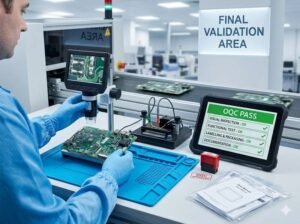
ICT and Functional Testing
Verifies electrical and functional performance after PCBアセンブリ.
Process Optimization
Continuous improvement of reflow profiles and assembly parameters.
Role of turnkey PCB assembly in quality control
で ターンキーPCBアセンブリ, defect rates are typically lower because:
- Component sourcing is controlled by the manufacturer
- Supply chain risks are minimized
- Processes are fully integrated and optimized
- Traceability is more complete
This end-to-end control helps achieve consistent quality in SMTアセンブリ and final products.
Continuous improvement and quality targets
Top manufacturers continuously monitor and improve defect rates through:
- 統計的工程管理(SPC)
- Root Cause Analysis (RCA)
- Corrective and Preventive Actions (CAPA)
- Regular equipment calibration and maintenance
The goal is not only to reduce defects but to approach zero-defect manufacturing.
What customers should expect
Customers should expect:
- Transparent reporting of defect rates
- Clear quality metrics (DPPM, FPY)
- Continuous improvement plans
- Consistent performance across batches
For critical applications, even stricter targets can be defined in advance.
結論
Defect rates in PCBアセンブリ, SMTアセンブリ, そして ターンキーPCBアセンブリ typically range from a few hundred to under 100 DPPM depending on quality level and application.
Through strict process control, advanced inspection, and integrated PCB製造 systems, a professional manufacturer can deliver consistently low defect rates and high product reliability.
コストと生産の最適化をお手伝いします。今すぐPCBアセンブリのお見積もりをご依頼ください。.
SMT、DIP、フルターンキーソリューションを含むプロフェッショナルなPCBアセンブリサービスを提供します。.
利用できる NDA ✔ 24 時間以内の速い引用語句 ✔ ISO によって証明される工場 ✔ ワンストップ PCB 及び PCBA サービス
 日本語
日本語  English
  Deutsch
  Français
  Português do Brasil
  Español
  Nederlands
  Italiano
  Русский
  한국어
한국어  العربية
  Svenska
  Polski
  Türkçe
  繁體中文
繁體中文