
BOM(部品表)
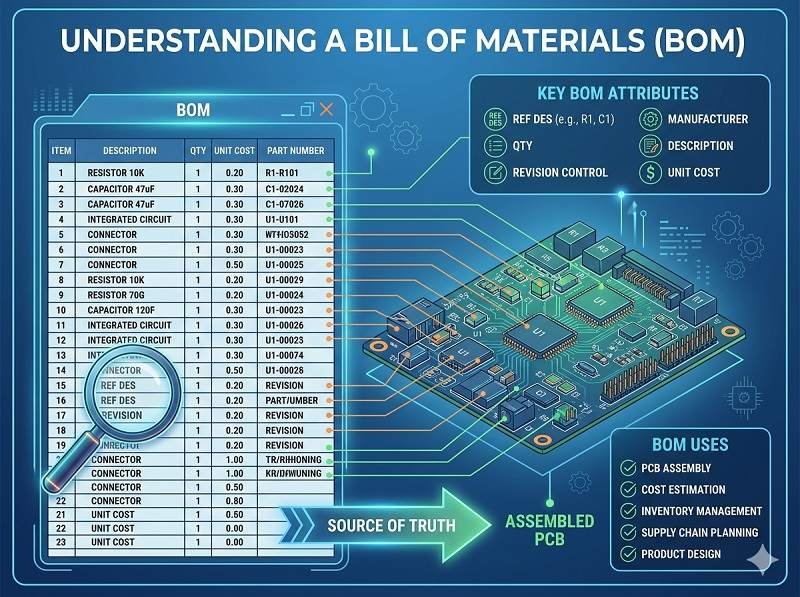
A BOM (Bill of Materials) is a detailed list of all components, materials, and parts required to manufacture and complete a product. In the context of PCBアセンブリ, a BOM serves as a critical document that defines every electronic component needed to build a printed circuit board assembly accurately.
It acts as a bridge between design and production, ensuring that engineers, procurement teams, and manufacturers all work with the same information.
Key Elements of a BOM
A standard BOM used in PCB製造 そして SMTアセンブリ typically includes several essential fields.
Each component is identified by a reference designator (such as R1, C1, U1), which corresponds to the PCB layout.
It also includes part numbers, component values (e.g., 10k resistor, 100nF capacitor), package types (such as 0603 or QFN), and quantities required.
Additional details may include manufacturer names, approved vendor lists, and alternative components to avoid supply chain disruptions.
Types of BOM in PCB Assembly
There are different types of BOMs depending on the stage of production.
An engineering BOM (EBOM) is created during the design phase and reflects the original circuit design.
A manufacturing BOM (MBOM) is optimized for production, including packaging, grouping, and sourcing information needed for ターンキーPCBアセンブリ.
Some companies also use a configurable BOM for products with multiple variants.
Role of BOM in PCB Assembly
The BOM plays a vital role throughout the PCBアセンブリ プロセスだ。.
It is used for component sourcing, cost estimation, inventory management, and production planning. In SMTアセンブリ, the BOM ensures that the correct components are placed in the right positions on the PCB.
で ターンキーPCBアセンブリ, the BOM is especially important because the manufacturer is responsible for purchasing all components. A clear and accurate BOM helps prevent delays, shortages, and incorrect substitutions.
BOM and Cost Control
A well-prepared BOM directly impacts the cost of PCB Assembly.
By selecting cost-effective components, specifying acceptable alternatives, and avoiding obsolete parts, companies can significantly reduce overall production costs.
The BOM also allows manufacturers to provide accurate quotations for PCB製造 and assembly services.
Common BOM Issues
Incomplete or inaccurate BOMs can cause serious problems in production.
Missing part numbers, unclear specifications, or incorrect quantities can lead to delays or assembly errors.
Using obsolete or hard-to-source components can increase lead times and costs.
Lack of approved alternatives may cause production to stop if a component becomes unavailable.
Best Practices for Creating a BOM
To ensure smooth PCB Assembly, it is important to follow best practices when creating a BOM.
Always include complete and accurate part numbers.
Specify manufacturer names and preferred suppliers.
Provide alternative components where possible.
Ensure consistency between the BOM, schematic, and layout files.
Use standardized formats to improve communication with manufacturers.
BOM in Turnkey PCB Assembly
で ターンキーPCBアセンブリ, the BOM becomes the foundation for the entire supply chain.
The manufacturer uses it to source components, verify availability, and ensure compliance with requirements such as RoHS.
A high-quality BOM helps streamline procurement and ensures that the entire process—from PCB製造 to final assembly—is efficient and error-free.
結論
A BOM (Bill of Materials) is one of the most important documents in PCB Assembly. It defines all the components required to build a circuit board and plays a key role in sourcing, cost control, and production efficiency.
By creating a clear and accurate BOM, companies can ensure smooth SMTアセンブリ, reduce risks, and achieve reliable results in both prototyping and mass production.
当社のエンジニアリングチームから迅速な回答を得る。今すぐPCBアセンブリのお見積もりをご依頼ください。.
SMT、DIP、フルターンキーソリューションを含むプロフェッショナルなPCBアセンブリサービスを提供します。.
利用できる NDA ✔ 24 時間以内の速い引用語句 ✔ ISO によって証明される工場 ✔ ワンストップ PCB 及び PCBA サービス

 日本語
日本語  English
  Deutsch
  Français
  Português do Brasil
  Español
  Nederlands
  Italiano
  Русский
  한국어
한국어  العربية
  Svenska
  Polski
  Türkçe
  繁體中文
繁體中文