
BGA solder inspection in modern PCB manufacturing
Ball Grid Array (BGA) components are widely used in modern electronics because they allow high-density connections and better electrical performance in compact designs. However, inspecting BGA solder joints is much more complex than traditional components because the solder joints are hidden underneath the package.
In modern PCB Assembly, especially in high-density products, BGA inspection has become a critical part of quality control. The same applies to Prototype PCB Assembly, where early-stage testing helps identify process or design issues before mass production. In large-scale PCB Manufacturing, consistent inspection ensures product stability and long-term reliability.
Why BGA solder joint inspection is critical
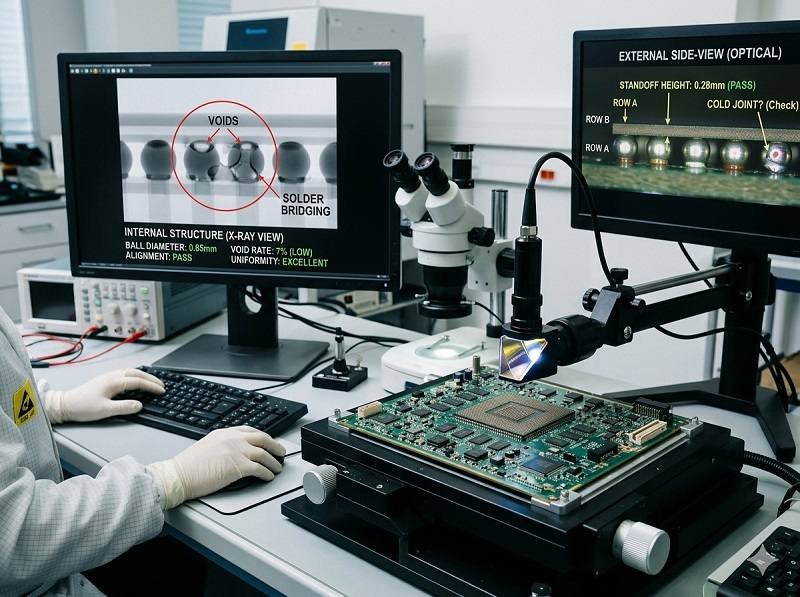
The biggest issue with BGA components is that defects are not visible from the outside. Unlike traditional solder joints, BGA connections cannot be checked with simple visual inspection after reflow.
Common problems include voids inside solder balls, cold solder joints, bridging, misalignment, and head-in-pillow defects. These issues may not appear immediately but can lead to serious failures during operation.
This is why in SMT Assembly, BGA inspection is considered a mandatory quality control step rather than an optional process.
Challenges in inspecting BGA solder joints
The main challenge is obvious: the solder joints are completely hidden under the component. This makes traditional optical inspection ineffective.
In modern PCB Manufacturing, additional challenges include miniaturization of components, high-density layouts, lead-free solder behavior, and multilayer PCB structures. All of these factors make BGA inspection more complex and require advanced detection methods instead of simple visual checks.
X-ray inspection for BGA solder joints
X-ray inspection is the most widely used and reliable method for BGA analysis in PCB Assembly.
2D X-ray inspection
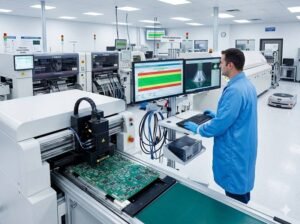
2D X-ray provides a flat image of the solder joints and is commonly used on production lines. It is effective for detecting voids, missing solder balls, bridging issues, and general alignment problems.
In SMT Assembly, this method is widely used because it is fast and suitable for high-volume inspection.
3D X-ray (CT inspection)
3D X-ray, also known as CT scanning, provides a more detailed internal view of the solder structure. It is widely used in high-reliability PCB Manufacturing environments.
This method can detect more advanced defects such as head-in-pillow, internal cracks, and uneven void distribution. In Prototype PCB Assembly, it is especially useful for validating new designs and improving process parameters.
AOI in SMT assembly and its limitations
Automated Optical Inspection (AOI) is a standard process in most SMT Assembly lines. It plays an important role in detecting placement and surface-level issues.
AOI can check component alignment, missing parts, polarity issues, and solder paste quality before reflow. However, it cannot inspect the actual BGA solder joints because they are hidden under the package.
Therefore, in PCB Assembly, AOI is always combined with X-ray inspection to achieve complete coverage.
Microsection analysis for failure investigation
When deeper analysis is required, microsectioning is used. This is a destructive method where the PCB is physically cut to examine solder joints under a microscope.
In PCB Manufacturing, this method is used for failure analysis, root cause investigation, and studying solder joint structure. It is especially valuable in Prototype PCB Assembly, where engineers need detailed feedback during development.
Electrical testing for BGA reliability
Inspection alone is not enough. Electrical testing is also required to ensure the board works correctly in real conditions.
In PCB Assembly, common testing methods include in-circuit testing (ICT), functional testing (FCT), burn-in testing, and thermal cycling tests. These methods help detect hidden electrical failures that cannot be seen through imaging alone.
Common BGA defects and how they are detected
Different inspection methods are used depending on the type of defect.
Voids are typically detected using X-ray inspection. Bridging issues can be identified through both X-ray and AOI. Head-in-pillow defects require 3D X-ray analysis. Cold solder joints are usually found through functional testing. Misalignment issues can be detected early by AOI before reflow.
By combining multiple methods, SMT Assembly processes can significantly improve product reliability.
Process control to prevent BGA defects
Good inspection is important, but preventing defects in the first place is even more critical.
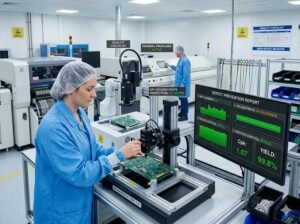
In PCB Manufacturing, manufacturers focus on process optimization such as solder paste printing accuracy, reflow temperature control, PCB pad design, component storage conditions, and clean production environments.
In Prototype PCB Assembly, these parameters are often adjusted repeatedly to achieve stable production results before scaling up.
Conclusion
BGA solder joint inspection is a key part of modern electronics manufacturing. Since defects are hidden, manufacturers must rely on a combination of X-ray inspection, AOI support, electrical testing, and process optimization.
In PCB Assembly, Prototype PCB Assembly, SMT Assembly, and PCB Manufacturing, a well-designed inspection strategy ensures higher product quality, lower failure rates, and improved long-term reliability.
Have a PCB project in mind? Request a quote and get expert support today.
We provide professional PCB assembly services including SMT, DIP, and full turnkey solutions.
✔ NDA Available ✔ Fast Quotation Within 24 Hours ✔ ISO Certified Factory ✔ One-stop PCB & PCBA Service
 English
  Deutsch
  Français
  Português do Brasil
  Español
  日本語
日本語  Nederlands
  Italiano
  Русский
  한국어
한국어  العربية
  Svenska
  Polski
  Türkçe
  繁體中文
繁體中文