
Is Incoming Inspection
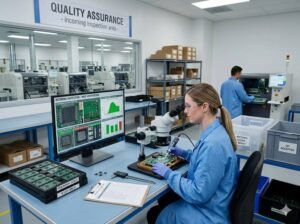
Incoming Inspection (also called Incoming Quality Control or IQC) is the process of checking raw materials, components, and parts before they enter the production line. It ensures that everything used in manufacturing meets required specifications before being used in Montaje de PCB, Montaje SMT, y Fabricación de PCB procesos.
The main goal of incoming inspection is simple: prevent defective or non-conforming materials from entering production.
In electronics manufacturing, even a single faulty component can lead to assembly failure, so this step is critical for both quality and reliability.

Why Incoming Inspection is Important
Incoming inspection acts as the first quality barrier in the production process. It helps manufacturers avoid costly problems later in the workflow.
En Montaje de PCB, components such as resistors, ICs, capacitors, and connectors must match exact specifications. If incorrect or counterfeit parts are used, the entire board may fail.
Key benefits include:
- Preventing defective materials from entering production
- Reducing rework and scrap rates
- Ensuring product consistency and reliability
- Protecting production equipment from damage caused by faulty parts
- Supporting traceability and quality compliance
Para Montaje de prototipos de PCB, incoming inspection is especially important because design validation depends on accurate and reliable components.
What is Checked During Incoming Inspection
Incoming inspection focuses on verifying both physical and technical characteristics of materials.
Typical checks include:
- Component part number and specification verification
- Quantity and packaging condition inspection
- Visual inspection for damage or defects
- Electrical parameter testing for selected components
- Moisture sensitivity level (MSL) verification for ICs
- Date code and authenticity checks
En Fabricación de PCB, raw PCB boards are also inspected for issues such as surface defects, warping, copper exposure, and drilling accuracy.
Incoming Inspection Process Flow
The incoming inspection process follows a structured workflow to ensure consistency.
First, materials arrive at the warehouse and are registered into the system. Each batch is assigned a tracking number for traceability.
Next, inspectors compare received materials against the approved BOM (Bill of Materials) and supplier documentation.
After that, sampling or full inspection is performed depending on risk level and material type. Critical components used in Montaje SMT often require stricter inspection standards.
Finally, materials are classified as:
- Approved (released for production)
- Quarantined (pending further evaluation)
- Rejected (returned to supplier)
Only approved materials are allowed into the production line.
Incoming Inspection in PCB Assembly
En Montaje de PCB, incoming inspection plays a key role in ensuring assembly quality and production stability.
Por ejemplo:
- ICs must match exact specifications and package types
- Passive components must meet tolerance requirements
- PCBs must pass visual and dimensional checks
- Solder materials must meet storage and performance standards
If any deviation is found, production is stopped or adjusted before assembly begins.
This prevents costly issues during Montaje SMT such as solder defects, misplacement, or functional failure.
Tools and Methods Used in Incoming Inspection
Modern manufacturing uses a combination of manual and automated methods to improve accuracy.
Common tools include:
- Digital calipers and microscopes
- Component testers and LCR meters
- X-ray inspection systems (for hidden defects)
- Barcode scanning systems for traceability
- ERP systems for material tracking
Advanced factories also use automated verification systems to detect counterfeit components and ensure supply chain reliability.
Common Issues Found in Incoming Inspection
Incoming inspection often identifies problems before production begins. Some common issues include:
- Incorrect component values or part numbers
- Damaged packaging or moisture exposure
- Counterfeit or substandard components
- PCB surface scratches or contamination
- Wrong revisions or mixed batches
Detecting these early helps avoid major production disruptions in Fabricación de PCB and assembly processes.
Conclusión
Incoming Inspection is a critical first step in electronics manufacturing quality control. It ensures that only verified and compliant materials enter production, reducing risks and improving final product reliability.
From Fabricación de PCB a Montaje SMT y Montaje de prototipos de PCB, incoming inspection protects both production efficiency and product performance by preventing issues at the source.
¿Necesita ayuda con el precio y el plazo de entrega del montaje de PCB? Solicite su presupuesto hoy mismo.
Ofrecemos servicios profesionales de ensamblaje de placas de circuito impreso, incluyendo SMT, DIP y soluciones completas llave en mano.
✔ NDA disponible ✔ Presupuesto rápido en 24 horas ✔ Fábrica certificada ISO ✔ Servicio integral de PCB y PCBA.
 Español
  English
  Deutsch
  Français
  Português do Brasil
  日本語
日本語  Nederlands
  Italiano
  Русский
  한국어
한국어  العربية
  Svenska
  Polski
  Türkçe
  繁體中文
繁體中文