
coating viscosity
Coating viscosity refers to the thickness or flow resistance of a liquid coating material—essentially, how easily a Conformal Coating flows during application. It is a critical parameter in PCB Assembly and SMT Assembly, as it directly affects coating quality, coverage, and process control.
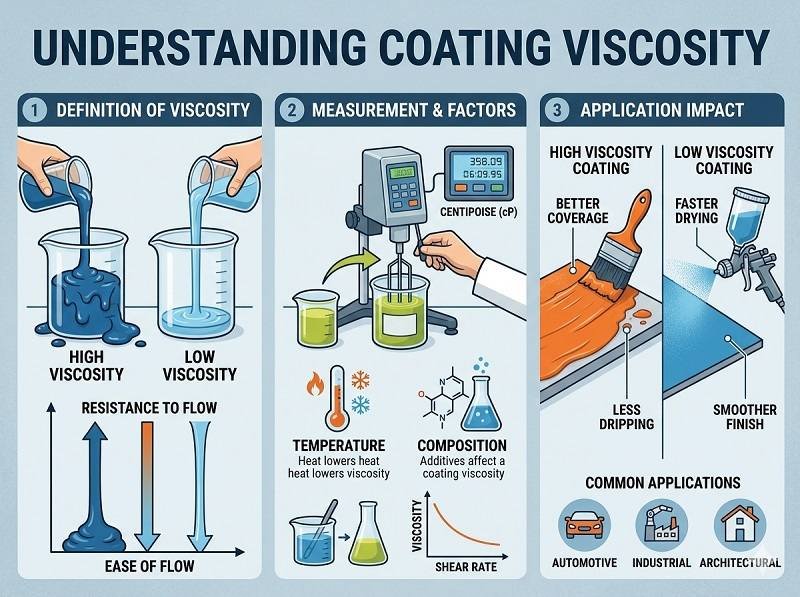
Understanding viscosity in simple terms
- Low viscosity = thin, flows easily (like water)
- High viscosity = thick, flows slowly (like syrup)
The right viscosity ensures that the Conformal Coating spreads evenly across the PCB without defects.
Why viscosity matters in PCB coating
In PCB Assembly, viscosity impacts several key factors:
- Coating uniformity: Proper viscosity ensures even thickness across components
- Coverage: Helps coating penetrate under components and around fine-pitch parts
- Defect prevention: Reduces risks of bubbles, streaks, or pooling
- Process compatibility: Different application methods require different viscosity ranges
In high-precision SMT Assembly, controlling viscosity is essential for consistent results, especially in automated coating systems.
Viscosity and application methods
Different coating methods require specific viscosity levels:
- Spray coating → Low viscosity for fine atomization
- Dip coating → Medium viscosity for full coverage
- Brush coating → Higher viscosity for manual control
- Selective coating → Carefully controlled viscosity for precision dispensing
In Turnkey PCB Assembly, manufacturers often adjust viscosity (by thinning or formulation selection) to match the coating process.
Factors that affect coating viscosity
Several variables influence viscosity:
- Temperature (higher temperature = lower viscosity)
- Coating formulation (acrylic, silicone, etc.)
- Solvent content
- Storage conditions and shelf life
Maintaining stable viscosity is important for repeatable results in production.
How viscosity is measured
Viscosity is typically measured in units such as:
- Centipoise (cP)
- Using tools like viscometers (e.g., Brookfield viscometer)
These measurements help ensure consistency in Conformal Coating processes.
Conclusion
Coating viscosity is a key property that determines how a Conformal Coating flows and performs during application. In PCB Assembly, SMT Assembly, and Turnkey PCB Assembly, controlling viscosity is essential for achieving uniform coverage, minimizing defects, and ensuring reliable protection of electronic components.
Get a Conformal Coating Quote
Need conformal coating for harsh environment applications? Submit your inquiry below.
Send us your requirements and get a fast response from our engineering team.
✔ 24-hour response ✔ Engineering support ✔ Small & Mass Production
Shenzhen Tengxinjie Electronics Co., Ltd.




 English
  Deutsch
  Français
  Português do Brasil
  Español
  日本語
日本語  Nederlands
  Italiano
  Русский
  한국어
한국어  العربية
  Svenska
  Polski
  Türkçe
  繁體中文
繁體中文