
Control coating thickness
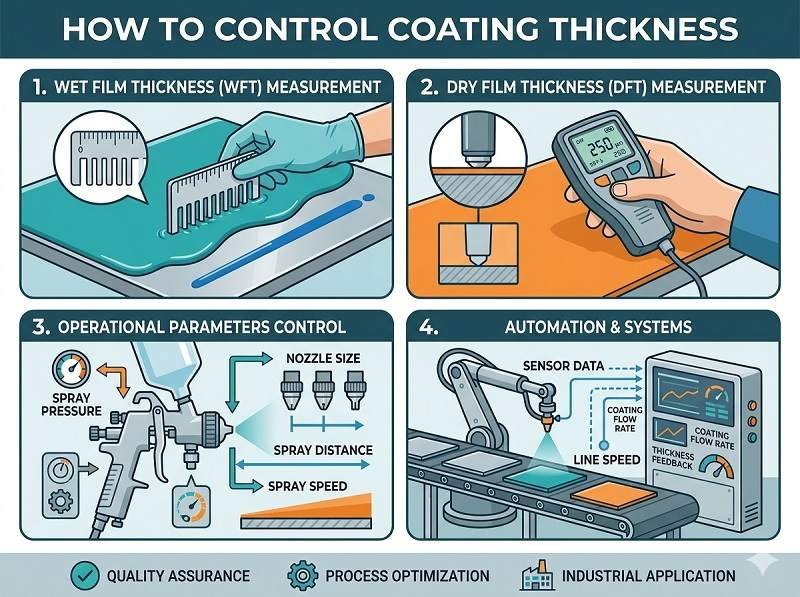
Controlling coating thickness is a critical step in achieving consistent protection and performance in PCB Assembly and SMT Assembly. Proper thickness ensures that Conformal Coating provides adequate insulation and environmental protection without causing defects such as pooling, cracking, or poor heat dissipation.
Why coating thickness matters
- Too thin → insufficient protection against moisture, dust, and corrosion
- Too thick → risk of bubbles, cracking, longer curing time, and heat retention
Maintaining the correct thickness is essential for reliability, especially in high-quality Turnkey PCB Assembly.
Choose the right coating method
Different application methods directly influence thickness control:
- Selective coating → most precise and repeatable thickness
- Spray coating → good control with proper parameter settings
- Dip coating → thicker layers, less precise control
- Brush coating → least consistent, depends on operator skill
Automated selective coating is commonly used in modern SMT Assembly for consistent results.
Control viscosity and material properties
The viscosity of Conformal Coating plays a major role:
- Lower viscosity → thinner coating
- Higher viscosity → thicker coating
Adjusting viscosity (via formulation or solvent dilution) helps achieve target thickness in PCB Assembly processes.
Optimize process parameters
Key process settings must be controlled:
- Spray pressure and nozzle size
- Flow rate and dispensing speed
- Distance between nozzle and PCB
- Number of coating passes
Fine-tuning these parameters ensures uniform thickness across the board in Turnkey PCB Assembly.
Use masking and design considerations
- Mask connectors, test points, and critical areas
- Design PCB layout to avoid excessive coating buildup
- Apply selective coating paths to control where thickness is applied
This improves both functionality and thickness consistency.
Measure and inspect thickness
Accurate measurement is essential:
- Wet film thickness gauges (during application)
- Dry film thickness measurement (after curing)
- UV light inspection (for UV-trace coatings)
Typical Conformal Coating thickness ranges from 25 to 250 microns, depending on application requirements.
Maintain process stability
- Keep consistent temperature and humidity
- Regularly calibrate coating equipment
- Standardize procedures in SMT Assembly lines
- Train operators for manual processes
Stable conditions ensure repeatable thickness control.
Conclusion
Controlling coating thickness requires a combination of the right application method, proper viscosity, optimized process parameters, and accurate measurement. In PCB Assembly, SMT Assembly, and Turnkey PCB Assembly, precise thickness control ensures reliable protection, minimizes defects, and maintains consistent product quality.
Get a Conformal Coating Quote
Need fast turnaround for conformal coating projects? Submit your request today.
Send us your requirements and get a fast response from our engineering team.
✔ 24-hour response ✔ Engineering support ✔ Small & Mass Production
Shenzhen Tengxinjie Electronics Co., Ltd.




 English
  Deutsch
  Français
  Português do Brasil
  Español
  日本語
日本語  Nederlands
  Italiano
  Русский
  한국어
한국어  العربية
  Svenska
  Polski
  Türkçe
  繁體中文
繁體中文