
Curing process in conformal coating
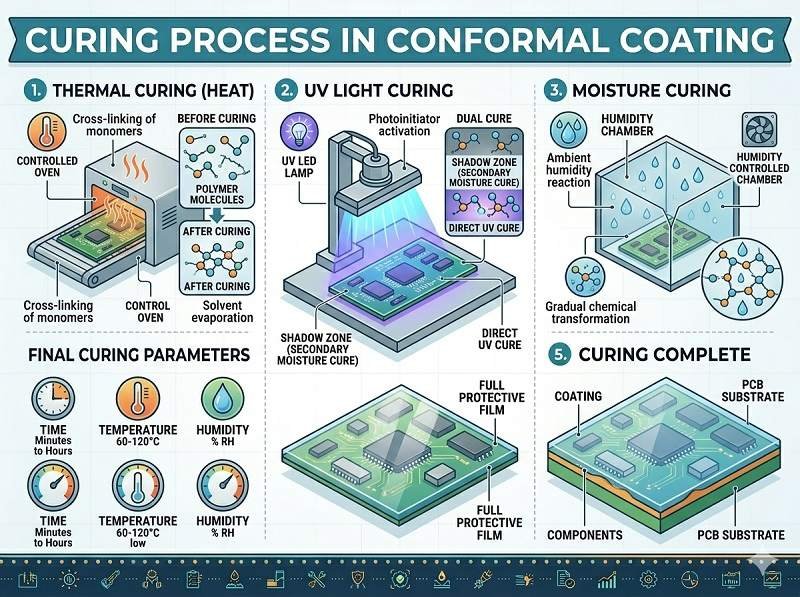
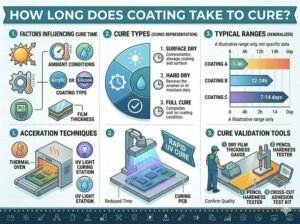
The curing process in Konform beläggning refers to the transformation of a liquid coating into a solid, durable protective film after application. This step is critical in Montering av kretskort, Montering av prototypkretskort, och SMT-montering, as it determines the coating’s final mechanical strength, adhesion, insulation performance, and environmental resistance.
Why curing is important
Without proper curing, the coating may remain soft, tacky, or partially bonded to the PCB surface. This can lead to poor protection, contamination, electrical leakage, or premature failure. A fully cured Konform beläggning ensures long-term reliability and stable performance in harsh environments.
Main curing methods
Air drying (solvent evaporation)
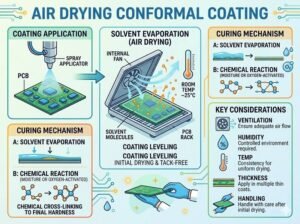
Some coatings, especially acrylic types, cure by allowing solvents to evaporate at room temperature. This method is simple and cost-effective for Montering av prototypkretskort, but it may take longer and depends on environmental conditions such as temperature and humidity.
Thermal curing (heat curing)
In this method, coated PCBs are placed in an oven to accelerate curing. Heat promotes chemical reactions or faster solvent evaporation, resulting in a stronger and more uniform coating. Thermal curing is widely used in mass SMT-montering for consistent results.
UV curing
UV-curable coatings harden rapidly when exposed to ultraviolet light. This method offers extremely fast processing speeds, making it ideal for high-volume Montering av kretskort. However, shadowed areas under components may require additional curing methods.
Dual curing (UV + moisture or heat)
To address shadowing issues, dual-cure coatings combine UV curing with a secondary mechanism such as moisture or heat curing. This ensures complete curing even in hard-to-reach areas of dense SMT-montering boards.
Moisture curing
Some coatings, such as certain polyurethane or silicone types, cure by reacting with moisture in the air. This process may take longer but provides excellent flexibility and environmental resistance.
Key curing parameters
Time and temperature
Each coating material has specific curing requirements. Insufficient time or incorrect temperature can result in incomplete curing, while excessive heat may damage components in Montering av kretskort.
Film thickness
Thicker coatings require longer curing times. Applying multiple thin layers can help ensure proper curing and avoid defects.
Ventilation and environment
Proper airflow helps remove solvents during curing, especially in air-drying processes. Controlled humidity is also important for moisture-curing systems.
Common curing defects
- Sticky or soft surface (under-curing)
- Cracking or brittleness (over-curing)
- Bubbles due to rapid solvent evaporation
- Uneven curing in shadowed areas
I Montering av prototypkretskort, curing profiles are often tested and optimized before scaling to full production.
Best practices for curing
- Follow manufacturer-recommended curing profiles
- Use calibrated ovens or UV systems
- Monitor temperature and exposure time
- Validate curing quality through inspection and testing
In conclusion, the curing process is a crucial step in Konform beläggning that directly affects the durability and performance of coated PCBs. Proper curing control in Montering av kretskort, SMT-montering, och Montering av prototypkretskort ensures a reliable protective layer that meets industry standards.
Få en offert på Conformal Coating
Har du frågor om konform beläggning för ditt mönsterkort? Våra ingenjörer är redo att hjälpa till.
Skicka oss dina krav och få ett snabbt svar från vårt ingenjörsteam.
✔ Svar 24 timmar om dygnet ✔ Teknisk support ✔ Små- och massproduktion
Shenzhen Tengxinjie Electronics Co, Ltd.
 Svenska
  English
  Deutsch
  Français
  Português do Brasil
  Español
  日本語
日本語  Nederlands
  Italiano
  Русский
  한국어
한국어  العربية
  Polski
  Türkçe
  繁體中文
繁體中文