
Chemicaliën verwijderen Conforme coating
In PCB-assemblage en SMT-assemblage, verwijderen Conforme coating is vaak nodig voor reparatie, herbewerking of inspectie. Het type chemische stof dat gebruikt wordt hangt af van het coatingmateriaal (acryl, siliconen, polyurethaan, epoxy of parylene), omdat elk materiaal verschillende weerstandseigenschappen heeft.
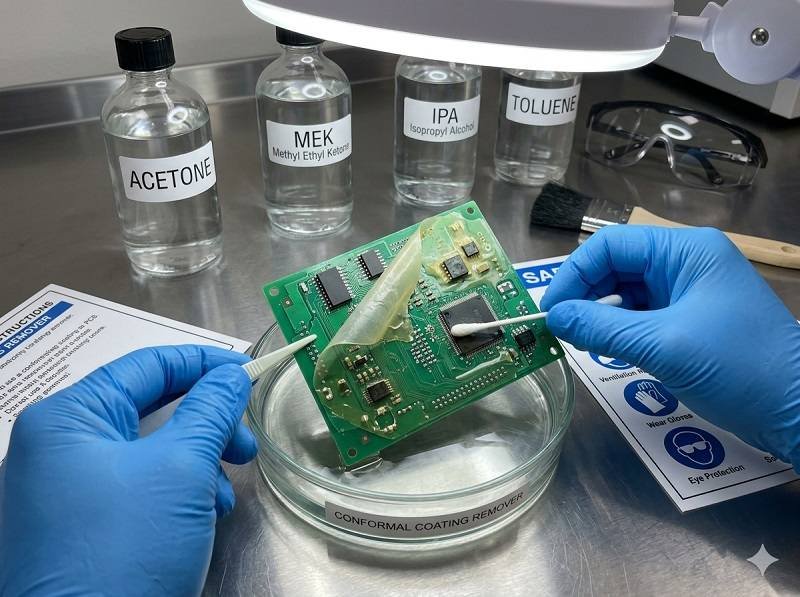
Gebruikelijke chemicaliën voor het verwijderen van Conforme coating
Oplosmiddelverwijderaars (voor acrylcoatings)
Acryl Conforme coating is het gemakkelijkst te verwijderen.
Gebruikelijke chemicaliën:
- Aceton
- Isopropylalcohol (IPA)
- Gespecialiseerde acrylverwijderaars
Kenmerken:
- Snel en effectief
- Minimale schade aan PCB bij correct gebruik
- Op grote schaal gebruikt in PCB-assemblage herwerken
Mengsels van oplosmiddelen (voor polyurethaancoatings)
Polyurethaan coatings vereisen sterkere chemicaliën.
Gebruikelijke chemicaliën:
- Speciale urethaanverwijderaars
- Mengsels van oplosmiddelen (bijv. glycolethers, esters)
Kenmerken:
- Goede effectiviteit bij gecontroleerde blootstelling
- Moet mogelijk worden geborsteld of gedrenkt
- Gebruikelijk in industriële SMT-assemblage reparatie
Siliconenverwijderaars
Silicone Conforme coating is resistenter en moeilijker te verwijderen.
Gebruikelijke chemicaliën:
- Silicone afbijtmiddelen
- Opzwellende oplosmiddelen (om de coating zachter te maken voor verwijdering)
Kenmerken:
- Meestal mechanische hulp nodig (schrapen)
- Langzamer proces in vergelijking met acryl
Epoxyverwijderaars
Epoxy coatings zijn zeer moeilijk chemisch te verwijderen.
Gebruikelijke chemicaliën:
- Sterke industriële epoxyafbijtmiddelen
- Vaak gecombineerd met warmte of mechanische verwijdering
Kenmerken:
- Tijdrovend en agressief
- Risico op beschadiging van componenten of printplaat
- Alleen gebruikt wanneer nodig in PCB-assemblage
Parylene verwijderchemicaliën
Parylene Conforme coating is zeer goed bestand tegen de meeste chemicaliën.
Verwijderingsmethoden:
- Gespecialiseerde chemische afbijtmiddelen
- Plasma-etsen (komt vaker voor dan chemisch etsen)
Kenmerken:
- Complex en duur proces
- Meestal gebruikt in high-end SMT-assemblage toepassingen
Belangrijke veiligheidsoverwegingen
Bij gebruik van chemicaliën om Conforme coating:
- Werk in goed geventileerde ruimten
- Gebruik de juiste persoonlijke beschermingsmiddelen (handschoenen, veiligheidsbril)
- Vermijd langdurige blootstelling aan oplosmiddelen
- Test eerst op een klein oppervlak om schade aan de printplaat te voorkomen
Alternatieve verwijderingsmethoden
Naast chemicaliën kunnen ook andere methoden worden gebruikt:
- Mechanische verwijdering (schrapen, microgereedschap)
- Thermische verwijdering (warmteontharding)
- Laser- of plasmaverwijdering (hoge precisie)
Deze worden vaak gecombineerd met chemische methoden in PCB-assemblage herwerken.
Eindconclusie
Verschillende Conforme coating materialen vereisen verschillende verwijderingschemicaliën. Acrylcoatings zijn het gemakkelijkst te verwijderen met gewone oplosmiddelen, terwijl siliconen, polyurethaan, epoxy en parylene sterkere of gespecialiseerde methoden vereisen. Op PCB-assemblage en SMT-assemblage, Het kiezen van de juiste verwijderingsmethode zorgt voor veilig en effectief herbewerken zonder de printplaat te beschadigen.
Vraag een offerte aan voor conforme coating
Zorg voor langdurige betrouwbaarheid van uw printplaten met onze coatingoplossingen. Begin hier.
Stuur ons je vereisten en krijg snel antwoord van ons engineeringteam.
✔ 24-uurs respons ✔ Engineering-ondersteuning ✔ Kleine & massaproductie
Shenzhen Tengxinjie Electronics Co, Ltd.
 Nederlands
  English
  Deutsch
  Français
  Português do Brasil
  Español
  日本語
日本語  Italiano
  Русский
  한국어
한국어  العربية
  Svenska
  Polski
  Türkçe
  繁體中文
繁體中文