
SMT Process Flow
De SMT process flow refers to the complete sequence of steps used in SMT-assemblage (Surface Mount Technology) to mount electronic components directly onto the surface of a printed circuit board. It is the most widely used method in modern PCB-assemblage, known for its speed, precision, and suitability for high-density electronic products.
Below is a detailed, real-world explanation of the SMT process flow used in professional PCB manufacturing.
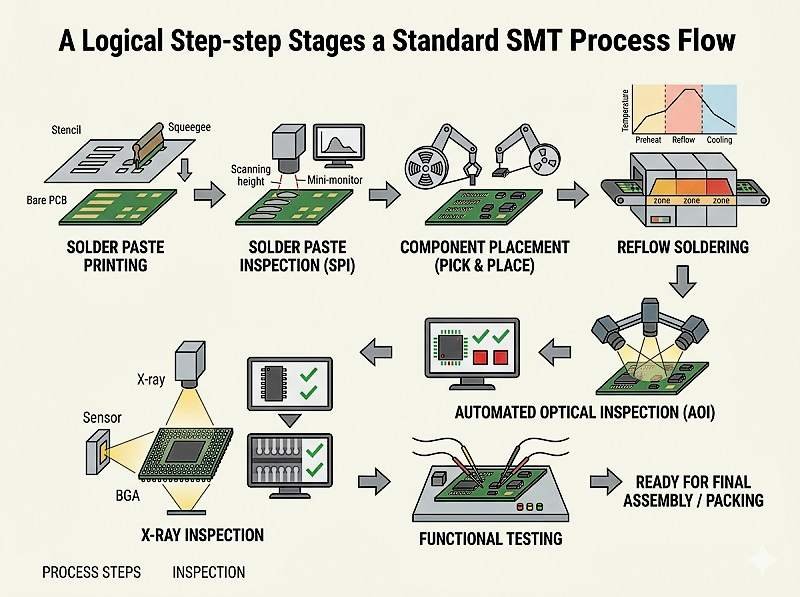
Overview of SMT Process Flow
A standard SMT Assembly process typically includes:
- Solder paste inspection (optional but recommended)
- Solder paste printing
- SPI (soldeerpasta-inspectie)
- Pick-and-place (component placement)
- Reflow solderen
- AOI (geautomatiseerde optische inspectie)
- X-ray inspection (if required)
- Cleaning and repair (if needed)
Each step plays a critical role in ensuring high-quality PCB Assembly.
Soldeerpasta afdrukken
This is the first and most critical step in SMT Assembly:
- A stencil is aligned over the PCB
- Solder paste is applied to component pads
- Paste consists of solder particles and flux
Key control points:
- Stencil thickness
- Printing pressure
- Alignment accuracy
Defects at this stage can affect the entire SMT process.
Soldeerpasta-inspectie (SPI)
After printing, SPI systems check the quality of the paste:
- Measures paste volume, height, and alignment
- Detects insufficient or excessive solder
- Prevents defects early in PCB Assembly
SPI significantly improves yield and reduces rework.
Pick-and-Place (Component Placement)
In this stage of SMT Assembly:
- Automated machines place components onto the PCB
- Components are picked from reels, trays, or tubes
- Vision systems ensure accurate alignment
Modern machines can place:
- Small passive components (0201, 01005)
- Complex ICs (QFP, BGA)
This step determines placement accuracy and production speed.
Reflow-solderen
After placement, boards go through a reflow oven:
- Controlled heating melts solder paste
- Components are permanently soldered
- Cooling solidifies the joints
Reflow stages include:
- Preheating
- Soaking
- Reflow peak
- Koeling
Proper temperature profiling is essential to avoid defects.
AOI (geautomatiseerde optische inspectie)
After soldering, AOI systems inspect the board:
- Detects missing or misaligned components
- Identifies soldering defects (bridges, insufficient solder)
- Ensures overall assembly quality
AOI is a standard step in high-quality PCB Assembly lines.
X-ray Inspection (For Complex Components)
For hidden solder joints (e.g., BGA):
- X-ray inspection is used
- Detects internal defects such as voids or bridging
This step is critical for advanced SMT Assembly projects.
Cleaning Process (Optional)
Depending on requirements:
- Flux residues may be removed
- Cleaning improves reliability, especially in sensitive applications
Not all PCB Assembly processes require cleaning.
Herwerken en repareren
If defects are found:
- Manual or automated rework is performed
- Components may be replaced or resoldered
Rework ensures final product quality meets standards.
Final Inspection and Quality Assurance
Before completion:
- Visuele inspectie
- Electrical testing (optional)
- Quality verification
This ensures the SMT Assembly meets all specifications.
Key Factors Affecting SMT Process Flow
- PCB design quality
- Component type and size
- Solder paste quality
- Machine precision
- Process control and environment
Proper optimization improves yield and reduces defects.
Advantages of SMT Assembly Process
- High automation and efficiency
- Suitable for high-density designs
- Lower labor cost
- Snellere productiesnelheid
- Better electrical performance
This is why SMT Assembly dominates modern PCB manufacturing.
Common SMT Defects
- Grafsteen
- Solder bridging
- Cold joints
- Misalignment
- Insufficient solder
Most defects originate from poor process control or design issues.
Conclusie
The SMT process flow is a highly automated and precise sequence that forms the backbone of modern PCB-assemblage. From solder paste printing to final inspection, each step in SMT-assemblage is critical to ensuring product quality and reliability.
Understanding this process helps engineers and buyers optimize design, reduce defects, and improve overall manufacturing efficiency.
Plant u uw volgende elektronicaproject? Begin met een PCB assemblage offerte.
We bieden professionele assemblagediensten voor printplaten, waaronder SMT, DIP en kant-en-klare oplossingen.
✔ NDA beschikbaar ✔ Snel offerte binnen 24 uur ✔ ISO-gecertificeerde fabriek ✔ One-stop PCB & PCBA Service
 Nederlands
  English
  Deutsch
  Français
  Português do Brasil
  Español
  日本語
日本語  Italiano
  Русский
  한국어
한국어  العربية
  Svenska
  Polski
  Türkçe
  繁體中文
繁體中文