
Kost PCB-assemblage
De kosten van printplaatassemblage zijn een van de belangrijkste overwegingen voor bedrijven die elektronische producten ontwikkelen. Of u nu werkt aan een prototype of opschaalt naar massaproductie, inzicht in de kostenstructuur van PCB-assemblage helpt u betere beslissingen te nemen, budgetten te beheersen en uw supply chain te optimaliseren.
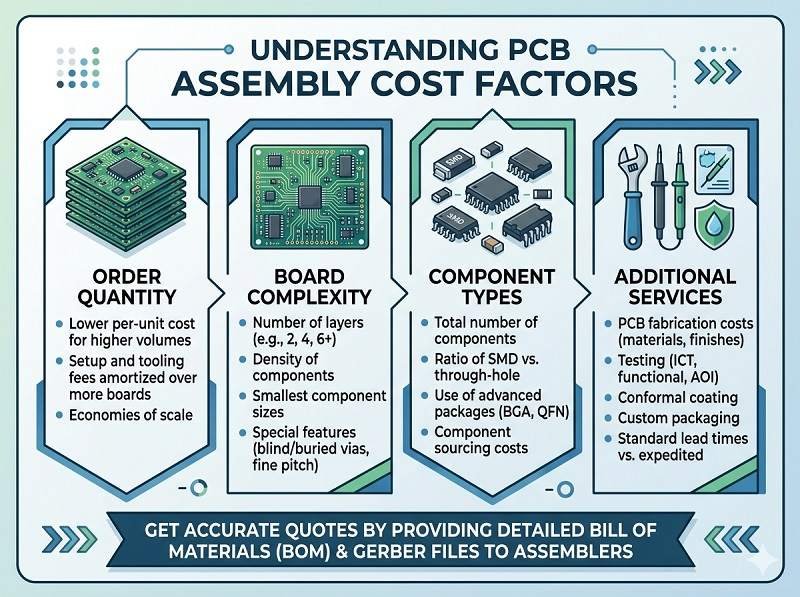
Welke factoren zijn van invloed op de kosten van PCB-assemblage
De kosten van PCB-assemblage liggen niet vast. Ze variëren afhankelijk van verschillende sleutelfactoren in ontwerp, materialen en productieprocessen.
Een van de grootste kostendrijvers is de complexiteit van het ontwerp. Printplaten met een hoge componentendichtheid, componenten met een fijne pitch of geavanceerde pakketten zoals BGA vereisen preciezere SMT-assemblageprocessen, wat de kosten verhoogt. Ook multilayer printplaten of HDI ontwerpen verhogen de PCB Fabricage kosten.
De inkoop van componenten is een andere belangrijke factor. De prijs van elektronische componenten kan aanzienlijk fluctueren afhankelijk van beschikbaarheid, merk en marktvraag. Tekorten of lange levertijden kunnen de inkoopkosten verhogen en de productie vertragen.
Het productievolume speelt ook een cruciale rol. Prototype PCB Assembly heeft meestal hogere kosten per eenheid omdat de setupkosten, het maken van stencils en programmeerkosten over een kleine hoeveelheid worden uitgesmeerd. Daarentegen profiteert de productie van grote volumes van schaalvoordelen, waardoor de kosten per eenheid dalen.
Arbeid en assemblagetechnologie hebben ook invloed op de prijs. Geautomatiseerd SMT-assemblage is efficiënter voor de productie van grote volumes, terwijl handmatige of gemengde assemblageprocessen nodig kunnen zijn voor bepaalde onderdelen, waardoor de arbeidskosten toenemen.
Testen en kwaliteitsborging voegen nog een extra kostenlaag toe. Functionele testen, AOI-inspectie, röntgeninspectie en ICT-testen zorgen allemaal voor betrouwbaarheid, maar dragen ook bij aan de totale prijs.
Kostenverdeling van PCB-assemblage
Om de totale kosten beter te begrijpen, helpt het om PCB Assembly in verschillende onderdelen op te splitsen.
De eerste is PCB Productie kosten. Dit omvat grondstoffen, het aantal lagen, de grootte van de printplaat, oppervlakteafwerking (zoals HASL of ENIG) en fabricageprocessen. Hoogwaardige materialen en nauwere toleranties verhogen de kosten, maar verbeteren de betrouwbaarheid.
Op de tweede plaats komen de kosten van onderdelen. Dit is vaak het grootste deel van de totale kosten, vooral voor complexe elektronische producten.
Ten derde zijn er de assemblagekosten. Dit omvat de kosten voor het plaatsen van SMT assemblages, het invoegen van doorlopende gaten, soldeerprocessen en eventueel herstelwerk.
Ten vierde zijn er de gereedschap- en setupkosten. Voor prototype PCB-assemblage omvat dit de vervaardiging van stencils en het programmeren van machines. Dit zijn meestal eenmalige kosten, maar ze hebben een grote invloed op de prijzen voor kleine partijen.
Tot slot moet er rekening worden gehouden met test-, verpakkings- en verzendkosten, vooral voor internationale klanten.
Typische kostenbereiken voor PCB-assemblage
Hoewel de kosten sterk uiteenlopen, kunnen enkele algemene marges helpen om een ruwe schatting te maken.
Voor Prototype PCB-assemblage, De kosten per bord kunnen variëren van $10 tot $100 of meer, afhankelijk van de complexiteit en het aantal componenten. Setupkosten kunnen nog eens $100 tot $500 toevoegen.
Voor de productie van kleine tot middelgrote batches dalen de kosten meestal tot $5 tot $30 per bord naarmate de setupkosten worden verdeeld.
Voor grootschalige SMT assemblage kunnen de kosten aanzienlijk dalen, soms tot onder $5 per eenheid, afhankelijk van het volume en de eenvoud van het ontwerp.
PCB Fabricagekosten zelf kunnen variëren van een paar dollar voor eenvoudige printplaten met twee lagen tot meer dan $50 voor complexe ontwerpen met meerdere lagen.
Hoe PCB-assemblagekosten verlagen
Het verlagen van de PCB assemblagekosten vereist een combinatie van slim ontwerp en strategische planning.
Ontwerp voor maakbaarheid (DFM) is essentieel. Het vereenvoudigen van lay-outs, het vermijden van onnodige complexiteit en het gebruik van standaardcomponentenpakketten kan de assemblageproblemen en -kosten verminderen.
Door componenten te kiezen die direct beschikbaar zijn, kunnen prijspieken en vertragingen in de toeleveringsketen worden voorkomen. Werken met een betrouwbare leverancier voor zowel PCB Fabricage als assemblage kan ook de coördinatiekosten verlagen.
Het optimaliseren van bestelhoeveelheden is een andere effectieve strategie. Zelfs een kleine verhoging van het bestelvolume kan de kosten per eenheid aanzienlijk verlagen dankzij schaalvoordelen.
De combinatie van PCB-productie en SMT-assemblage in een kant-en-klare service kan de kosten verder verlagen door de logistiek te stroomlijnen en fouten tot een minimum te beperken.
Waarom kostentransparantie belangrijk is
Inzicht in de verdeling van PCB assemblage kosten stelt bedrijven in staat om budgetten nauwkeuriger te plannen en onverwachte uitgaven te vermijden. Het helpt ook bij het vergelijken van leveranciers en het identificeren van gebieden waar kostenbesparingen mogelijk zijn zonder aan kwaliteit in te boeten.
Voor starters en ontwikkelaars biedt Prototype PCB Assembly flexibiliteit voor testen en iteratie, terwijl schaalbare SMT Assembly oplossingen een soepele overgang naar massaproductie mogelijk maken.
Conclusie
De kosten van PCB-assemblage zijn afhankelijk van meerdere factoren, waaronder de complexiteit van het ontwerp, de inkoop van componenten, het productievolume en de testvereisten. Door deze elementen te begrijpen en zowel het ontwerp als de productiestrategieën te optimaliseren, kunnen bedrijven de kosten effectief beheren en tegelijkertijd een hoge productkwaliteit behouden.
Of u nu werkt aan Prototype PCB Assembly of grootschalige SMT Assembly, het kiezen van de juiste PCB Manufacturing partner is cruciaal voor het bereiken van kostenefficiëntie en succes op de lange termijn.
Ontvang een professionele PCB assemblage offerte op maat van uw behoeften. Begin hier.
We bieden professionele assemblagediensten voor printplaten, waaronder SMT, DIP en kant-en-klare oplossingen.
✔ NDA beschikbaar ✔ Snel offerte binnen 24 uur ✔ ISO-gecertificeerde fabriek ✔ One-stop PCB & PCBA Service
 Nederlands
  English
  Deutsch
  Français
  Português do Brasil
  Español
  日本語
日本語  Italiano
  Русский
  한국어
한국어  العربية
  Svenska
  Polski
  Türkçe
  繁體中文
繁體中文