
PCB Rework Process
The PCB rework process refers to the method of correcting defects or replacing components on a printed circuit board after PCB 어셈블리 has been completed. It is an essential part of quality control in SMT 어셈블리 그리고 턴키 PCB 어셈블리, ensuring that defective boards can be repaired instead of scrapped.
Rework is commonly performed when inspection processes identify issues such as solder defects, misaligned components, or faulty parts.
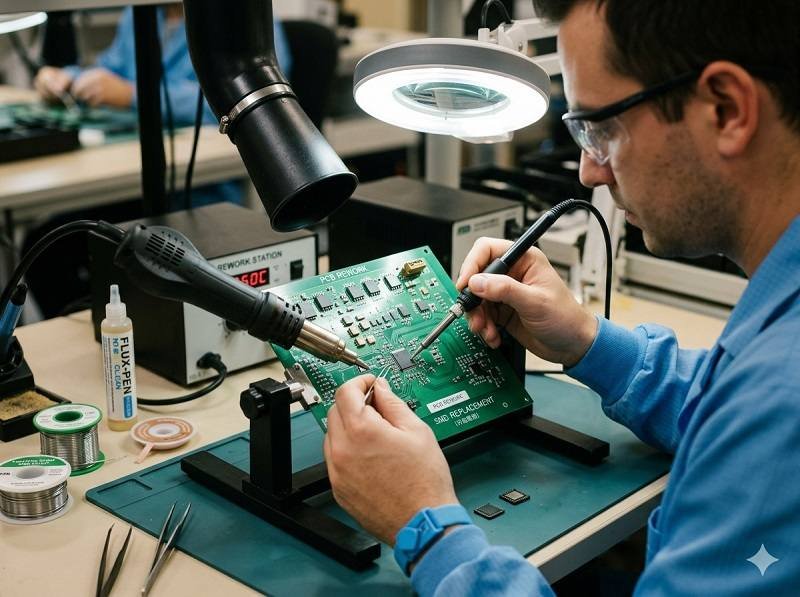
Why PCB Rework Is Necessary
Even with advanced PCB 제조 and automated assembly systems, defects can still occur.
Rework allows manufacturers to:
Fix assembly errors without discarding the entire PCB
Reduce production costs
Improve yield rates
Ensure products meet quality standards
It is especially important in high-value or complex SMT 어셈블리 프로젝트.
Common Reasons for PCB Rework
Several issues may require rework during or after PCB 어셈블리.
- Solder bridges or shorts
- Insufficient or excessive solder
- Misaligned or misplaced components
- Damaged components
- Incorrect component installation
- Cold solder joints
- BGA or hidden solder joint defects
These problems are often detected through AOI or X-ray inspection.
Steps in the PCB Rework Process
The rework process typically involves several controlled steps.
Inspection and Diagnosis
The defect is identified using inspection methods such as AOI, X-ray, or manual inspection.
Component Removal
The faulty component is carefully removed using specialized tools such as hot air rework stations or infrared heaters.
Pad Cleaning
Residual solder is removed from the PCB pads to prepare for reinstallation.
구성 요소 교체
A new component is placed on the PCB with proper alignment.
Resoldering
The component is soldered using controlled heating methods to ensure a reliable connection.
최종 검사
The repaired area is inspected again to verify quality and functionality.
Tools Used in PCB Rework
Rework requires specialized equipment to ensure precision and avoid damage.
Hot air rework stations
Infrared (IR) rework systems
Soldering irons with temperature control
Desoldering tools and solder wick
Microscopes for inspection
These tools are essential for handling fine-pitch components in SMT 어셈블리.
Challenges in PCB Rework
Rework can be complex and requires high skill levels.
Excessive heat may damage PCB pads or nearby components.
Repeated rework can weaken solder joints.
Fine-pitch and BGA components are difficult to rework accurately.
Process control is critical to maintain quality in 턴키 PCB 어셈블리.
Best Practices for PCB Rework
신뢰할 수 있는 결과를 얻으려면 제조업체는 모범 사례를 따라야 합니다.
Use controlled heating profiles to avoid thermal damage.
Train operators in proper rework techniques.
Minimize the number of rework cycles.
Use high-quality replacement components.
Follow industry standards such as IPC guidelines.
Role in SMT and Turnkey PCB Assembly
In SMT 어셈블리, rework is often used to correct defects identified after reflow soldering.
In 턴키 PCB 어셈블리, it plays a key role in ensuring final product quality before delivery.
Rework helps maintain high yield rates and reduces production waste.
Rework vs Repair
Rework and repair are sometimes confused but are different.
Rework restores a PCB to meet original specifications.
Repair involves fixing a board that may not fully meet original design standards.
Rework is more controlled and standardized in PCB 제조.
결론
The PCB rework process is a critical part of modern electronics manufacturing. It enables manufacturers to correct defects, improve yield, and ensure high-quality products without unnecessary waste.
In PCB 어셈블리, SMT 어셈블리, 및 턴키 PCB 어셈블리, effective rework processes help maintain reliability, reduce costs, and deliver consistent performance.
Fast, reliable, and cost-effective PCB assembly solutions. Request your quote now.
당사는 SMT, DIP 및 전체 턴키 솔루션을 포함한 전문 PCB 조립 서비스를 제공합니다.
NDA 가능 ✔ 24시간 이내 빠른 견적 ✔ ISO 인증 공장 ✔ 원스톱 PCB 및 PCBA 서비스
 한국어
한국어  English
  Deutsch
  Français
  Português do Brasil
  Español
  日本語
日本語  Nederlands
  Italiano
  Русский
  العربية
  Svenska
  Polski
  Türkçe
  繁體中文
繁體中文