
IPC-2581 file format
IPC-2581 is an open, intelligent data exchange format used in electronics manufacturing to transfer complete PCB design information in a single file. It is designed to replace traditional Gerber files by providing a more comprehensive and error-free solution for PCB 어셈블리, PCB 제조, 및 SMT 어셈블리 프로세스.
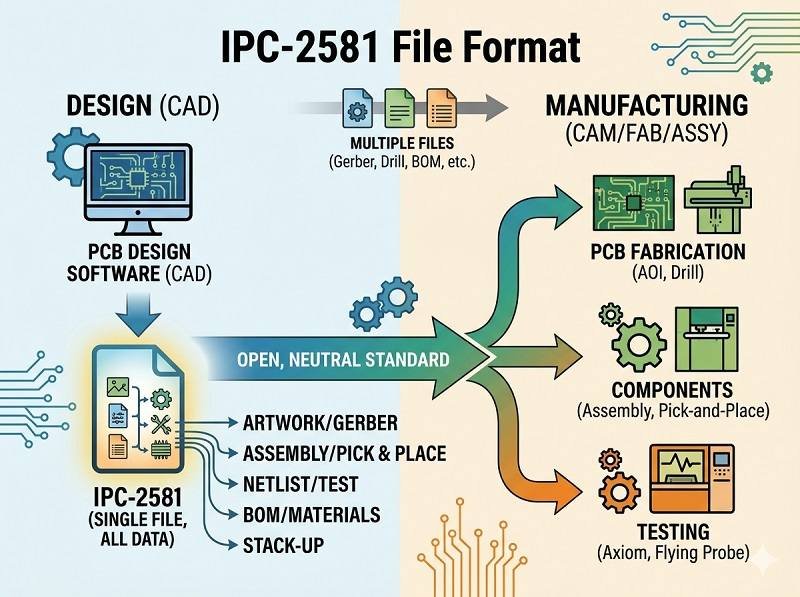
Overview of IPC-2581
The IPC-2581 format is developed and maintained by the IPC, a global association that sets standards for the electronics industry.
Unlike Gerber, which requires multiple files for different layers and processes, IPC-2581 consolidates all manufacturing data into one unified file. This includes PCB layout, layer stack-up, drill data, netlist, BOM, and assembly information.
This makes IPC-2581 especially valuable for modern PCB 어셈블리 workflows where accuracy and automation are critical.
What data does IPC-2581 include
One of the biggest advantages of IPC-2581 is that it contains all necessary data for both fabrication and assembly.
Typical information included:
- PCB layer data (copper, solder mask, silkscreen)
- Drill and via information
- Netlist (electrical connectivity)
- Stack-up details
- Component placement (X/Y coordinates)
- 자재 명세서(BOM)
- Assembly drawings and instructions
This eliminates the need to send separate Gerber files, pick-and-place files, and BOM documents for SMT 어셈블리.
IPC-2581 vs Gerber files
Traditional Gerber files are widely used in PCB 제조, but they have limitations.
Gerber is a graphical format that describes shapes and layers but does not include intelligent data such as netlist or component information. As a result, manufacturers must rely on additional files and manual interpretation, which increases the risk of errors.
IPC-2581, on the other hand, is a fully intelligent format. It provides machine-readable data for both fabrication and PCB 어셈블리, enabling higher automation and fewer misunderstandings.
Benefits of IPC-2581
Using IPC-2581 offers several advantages in PCB 어셈블리 및 프로덕션.
First, it reduces errors by eliminating manual data interpretation. Since all information is included in one file, there is less chance of mismatch between Gerber, BOM, and pick-and-place data.
Second, it improves efficiency. Manufacturers can directly import IPC-2581 data into their systems, speeding up CAM processing and SMT 어셈블리 setup.
Third, it enhances communication between designers and manufacturers. A single standardized file simplifies data exchange and reduces back-and-forth clarification.
Finally, it supports advanced manufacturing requirements such as high-density designs and complex multilayer boards.
Limitations and adoption
Despite its advantages, IPC-2581 adoption is still growing.
Some manufacturers continue to rely on Gerber because it is widely supported and familiar. Not all PCB design tools and factories fully support IPC-2581 yet, although this is rapidly changing.
For 프로토타입 PCB 어셈블리, many suppliers still request Gerber files due to compatibility reasons. However, more advanced manufacturers are beginning to accept IPC-2581 as a preferred format.
When to use IPC-2581
IPC-2581 is particularly useful for complex designs, high-reliability products, and automated production environments.
If your project involves advanced SMT 어셈블리, tight tolerances, or requires high accuracy, IPC-2581 can significantly improve data integrity and production efficiency.
It is also ideal when working with modern PCB 제조 partners that support digital workflows.
결론
IPC-2581 is a next-generation file format that simplifies and improves data exchange in electronics manufacturing. By combining all necessary information into a single intelligent file, it enhances efficiency, reduces errors, and supports advanced PCB 어셈블리 프로세스.
While Gerber remains widely used, IPC-2581 is becoming increasingly important for companies looking to optimize 프로토타입 PCB 어셈블리 대규모 SMT 어셈블리 프로덕션.
빠르고 정확한 PCB 어셈블리 견적이 필요하신가요? 몇 초 만에 요청을 제출하세요.
당사는 SMT, DIP 및 전체 턴키 솔루션을 포함한 전문 PCB 조립 서비스를 제공합니다.
NDA 가능 ✔ 24시간 이내 빠른 견적 ✔ ISO 인증 공장 ✔ 원스톱 PCB 및 PCBA 서비스

 한국어
한국어  English
  Deutsch
  Français
  Português do Brasil
  Español
  日本語
日本語  Nederlands
  Italiano
  Русский
  العربية
  Svenska
  Polski
  Türkçe
  繁體中文
繁體中文