
Processus de revêtement par immersion ou par pulvérisation
En Assemblage du circuit imprimé et Assemblage SMT, Le revêtement par immersion et le revêtement par pulvérisation sont des méthodes largement utilisées pour l'application d'un revêtement par immersion ou par pulvérisation. Revêtement conforme. Chaque procédé a ses propres avantages, ses propres limites et ses propres applications en fonction des exigences de production.
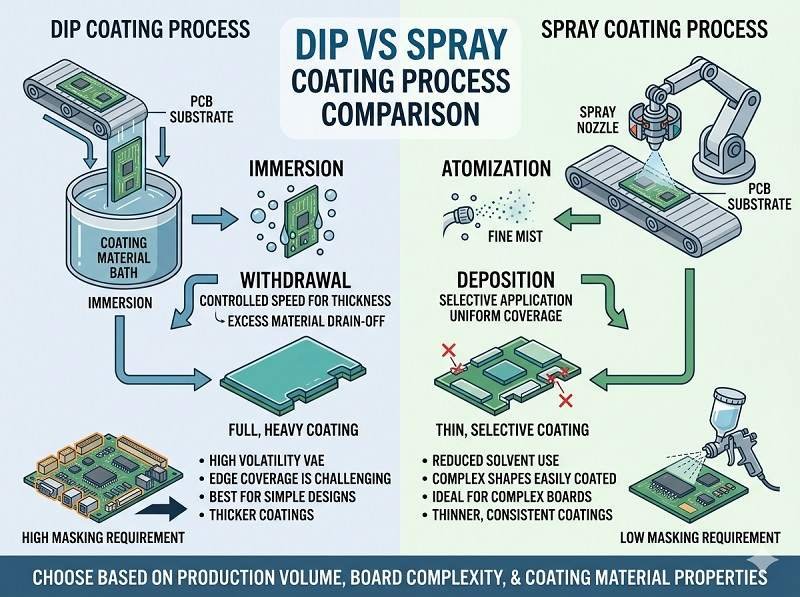
Qu'est-ce que le procédé de revêtement par immersion ?
Le revêtement par immersion consiste à plonger l'ensemble du circuit imprimé dans une cuve remplie de Revêtement conforme et de le retirer à une vitesse contrôlée.
Étapes du processus :
- Le circuit imprimé est nettoyé et masqué
- Le panneau est entièrement immergé dans le liquide de revêtement
- Le PCB est retiré lentement
- L'excédent de revêtement s'écoule
- Le revêtement est durci
Avantages :
- Excellente couverture, y compris pour les zones difficiles d'accès
- Processus simple avec un minimum d'équipement
- Convient pour les grands volumes Assemblage du circuit imprimé
Inconvénients :
- Revêtement appliqué sur l'ensemble du panneau (y compris les zones non désirées)
- Nécessite un masquage important
- Consommation de matériaux plus élevée
- Risque de formation d'une couche épaisse ou d'une flaque d'eau
Le revêtement par immersion est souvent utilisé lorsqu'une couverture complète est nécessaire et que la conception le permet.
Qu'est-ce que le procédé de revêtement par pulvérisation ?
Le revêtement par pulvérisation s'applique Revêtement conforme à l'aide d'une buse de pulvérisation, soit manuellement, soit par le biais de systèmes automatisés.
Étapes du processus :
- Le circuit imprimé est préparé et masqué
- Le revêtement est pulvérisé sur la surface de la carte
- Plusieurs passages peuvent être appliqués pour obtenir une épaisseur uniforme
- Le revêtement est durci
Avantages :
- Une épaisseur mieux contrôlée et plus uniforme
- Réduction des déchets de matériaux
- Peut être automatisé pour la mise en ligne Assemblage SMT
- Moins de masquage par rapport au revêtement par immersion
Inconvénients :
- Peut nécessiter plusieurs passages
- Les débordements doivent être contrôlés
- Un équipement légèrement plus complexe
Le revêtement par pulvérisation est couramment utilisé dans les Assemblage du circuit imprimé pour plus de précision et d'efficacité.
Principales différences entre le revêtement par immersion et le revêtement par pulvérisation
Couverture
- Revêtement par immersion : couverture complète, y compris les zones cachées
- Revêtement par pulvérisation : couverture contrôlée et ciblée
Utilisation des matériaux
- Revêtement par immersion : consommation plus élevée
- Revêtement par pulvérisation : plus efficace
Exigence de masquage
- Revêtement par immersion : nécessité d'un masquage important
- Revêtement par pulvérisation : moins de masquage nécessaire
Contrôle de l'épaisseur
- Revêtement par immersion : moins précis
- Revêtement par pulvérisation : meilleur contrôle de l'épaisseur
Automatisation
- Revêtement par immersion : semi-automatique ou manuel
- Revêtement par pulvérisation : facilement intégrable dans les systèmes automatisés Assemblage SMT lignes
Quelle est la meilleure solution ?
- Choisir revêtement par immersion pour les conceptions simples nécessitant une protection totale
- Choisir revêtement par pulvérisation pour les circuits imprimés complexes, la couverture sélective et le contrôle de haute qualité
Dans la plupart des Assemblage SMT les environnements, les revêtements par pulvérisation ou sélectifs sont préférés en raison de leur précision et de leur efficacité.
Conclusion finale
Le revêtement par immersion et le revêtement par pulvérisation sont tous deux des méthodes efficaces pour l'application de Revêtement conforme en Assemblage du circuit imprimé. Le revêtement par immersion offre une couverture complète et une grande simplicité, tandis que le revêtement par pulvérisation offre un meilleur contrôle, une plus grande efficacité et une meilleure adaptation à l'automatisation. Assemblage SMT. Le meilleur choix dépend de la conception du circuit imprimé, du volume de production et des exigences de qualité.
Obtenir un devis pour un revêtement conforme
Vous recherchez un partenaire de confiance pour les circuits imprimés avec une capacité de revêtement conforme ? Parlons-en.
Envoyez-nous vos exigences et obtenez une réponse rapide de notre équipe d'ingénieurs.
✔ Réponse dans les 24 heures ✔ Soutien technique ✔ Production en petite et grande série
Shenzhen Tengxinjie Electronics Co. Ltd.
 Français
  English
  Deutsch
  Português do Brasil
  Español
  日本語
日本語  Nederlands
  Italiano
  Русский
  한국어
한국어  العربية
  Svenska
  Polski
  Türkçe
  繁體中文
繁體中文