
Proceso de revestimiento DIP frente a pulverización
En Montaje de PCB y Montaje SMT, tanto el revestimiento por inmersión como el revestimiento por pulverización son métodos muy utilizados para aplicar Revestimiento conforme. Cada proceso tiene sus propias ventajas, limitaciones y aplicaciones adecuadas en función de los requisitos de producción.
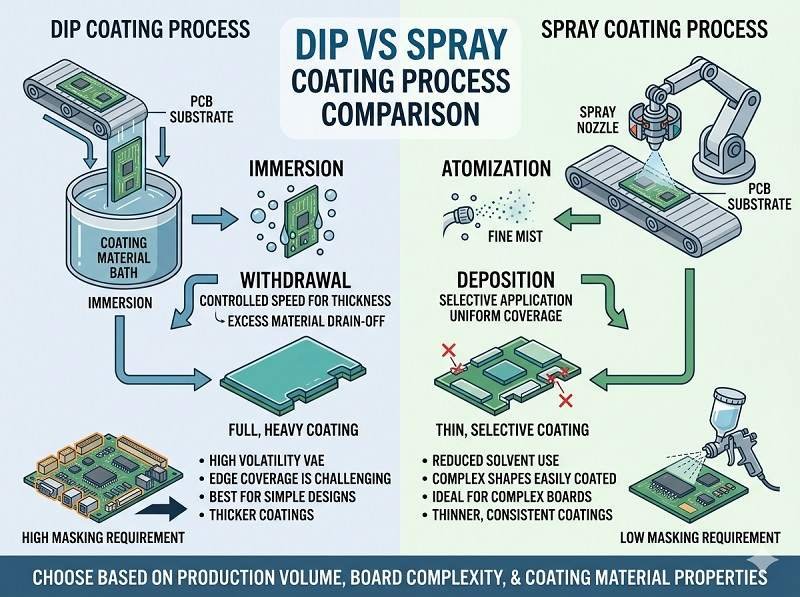
¿Qué es el proceso de revestimiento por inmersión?
El revestimiento por inmersión consiste en sumergir toda la placa de circuito impreso en un tanque lleno de Revestimiento conforme material y, a continuación, retirarlo a una velocidad controlada.
Etapas del proceso:
- Se limpia y enmascara la placa de circuito impreso
- El cartón se sumerge completamente en el líquido de recubrimiento
- El PCB se retira lentamente
- El exceso de revestimiento se escurre
- El revestimiento está curado
Ventajas:
- Excelente cobertura, incluidas las zonas de difícil acceso
- Proceso sencillo con un equipamiento mínimo
- Adecuado para grandes volúmenes Montaje de PCB
Desventajas:
- Revestimiento aplicado a todo el tablero (incluidas las zonas no deseadas)
- Requiere un extenso enmascaramiento
- Mayor consumo de material
- Riesgo de capa gruesa o encharcamiento
El revestimiento por inmersión suele utilizarse cuando se requiere una cobertura total y el diseño lo permite.
Qué es el proceso de recubrimiento por pulverización
El revestimiento por pulverización se aplica Revestimiento conforme mediante una boquilla pulverizadora, ya sea manualmente o a través de sistemas automatizados.
Etapas del proceso:
- Se prepara y enmascara la placa de circuito impreso
- El revestimiento se pulveriza sobre la superficie de la placa
- Pueden aplicarse varias pasadas para obtener un espesor uniforme
- El revestimiento está curado
Ventajas:
- Espesor más controlado y uniforme
- Reducción de los residuos de material
- Puede automatizarse para su uso en línea Montaje SMT
- Menos enmascaramiento en comparación con el revestimiento por inmersión
Desventajas:
- Puede requerir varias pasadas
- Es necesario controlar el exceso de pulverización
- Equipos algo más complejos
El revestimiento por pulverización se utiliza Montaje de PCB para una mayor precisión y eficacia.
Principales diferencias entre el recubrimiento por inmersión y el recubrimiento por pulverización
Cobertura
- Revestimiento por inmersión: cobertura total, incluidas las zonas ocultas
- Revestimiento por pulverización: cobertura controlada y específica
Uso del material
- Recubrimiento por inmersión: mayor consumo
- Revestimiento por pulverización: más eficaz
Requisito de enmascaramiento
- Revestimiento por inmersión: es necesario un enmascaramiento extenso
- Revestimiento por pulverización: requiere menos enmascaramiento
Control del espesor
- Recubrimiento por inmersión: menos preciso
- Revestimiento por pulverización: mejor control del espesor
Automatización
- Recubrimiento por inmersión: semiautomático o manual
- Recubrimiento por pulverización: se integra fácilmente en la automatización Montaje SMT líneas
¿Qué es mejor?
- Elija recubrimiento por inmersión para diseños sencillos que requieren una protección total
- Elija recubrimiento por pulverización para placas de circuito impreso complejas, cobertura selectiva y control de alta calidad
En la mayoría de los Montaje SMT se prefiere el revestimiento por pulverización o selectivo debido a su precisión y eficacia.
Conclusión final
Tanto el recubrimiento por inmersión como el recubrimiento por pulverización son métodos eficaces para aplicar Revestimiento conforme en Montaje de PCB. El recubrimiento por inmersión ofrece una cobertura completa y simplicidad, mientras que el recubrimiento por pulverización proporciona un mejor control, eficiencia y aptitud para la automatización. Montaje SMT. La mejor elección depende del diseño de la placa de circuito impreso, el volumen de producción y los requisitos de calidad.
Obtenga un presupuesto de revestimiento de conformación
¿Busca un socio de confianza para PCBA con capacidad de revestimiento de conformación? Hablemos.
Envíenos sus requisitos y obtenga una respuesta rápida de nuestro equipo de ingenieros.
✔ Respuesta en 24 horas ✔ Soporte de ingeniería ✔ Producción en serie y a pequeña escala
Shenzhen Tengxinjie Electronics Co.
 Español
  English
  Deutsch
  Français
  Português do Brasil
  日本語
日本語  Nederlands
  Italiano
  Русский
  한국어
한국어  العربية
  Svenska
  Polski
  Türkçe
  繁體中文
繁體中文