
Méthode de mesure de l'épaisseur du revêtement
La mesure de l'épaisseur du revêtement est le processus de détermination de l'épaisseur du revêtement. Revêtement conforme appliquée sur un PCB en Assemblage du circuit imprimé et Assemblage SMT. Une épaisseur appropriée est essentielle pour assurer une protection efficace sans interférer avec les performances électriques ou la fonctionnalité des composants.
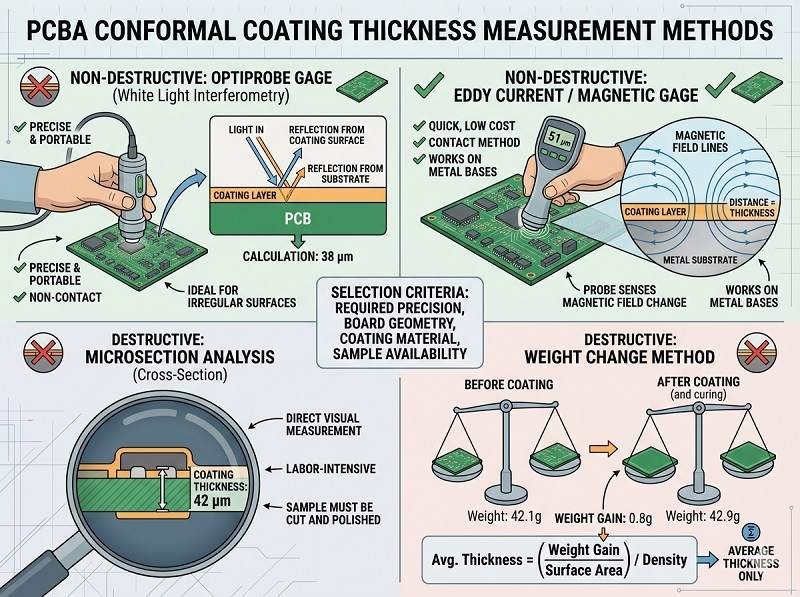
Pourquoi la mesure de l'épaisseur est-elle importante ?
L'épaisseur de Revêtement conforme a une incidence directe sur ses performances.
S'il est trop fin :
- Protection insuffisante contre l'humidité et les contaminants
- Réduction des performances d'isolation
Si elle est trop épaisse :
- Risque de fissuration ou de délamination
- Interférence potentielle avec des connecteurs ou des pièces mobiles
Des mesures précises garantissent une qualité optimale du revêtement dans les Assemblage du circuit imprimé.
Méthodes courantes de mesure de l'épaisseur des revêtements
Mesure de l'épaisseur du film humide
Cette méthode est utilisée immédiatement après l'application du revêtement avant le durcissement.
Comment cela fonctionne-t-il ?
- Une jauge de film humide est placée sur la surface revêtue.
- L'épaisseur est déterminée en fonction des points de contact
Avantages :
- Rapide et simple
- Permet d'ajuster les paramètres du processus en temps réel
Limites :
- Applicable uniquement avant le durcissement
- Moins précise que la mesure à sec
Mesure de l'épaisseur du film sec
Exécuté après le durcissement du revêtement, Il s'agit de la méthode la plus répandue dans les pays de l'Union européenne. Assemblage SMT.
Les méthodes utilisées sont les suivantes :
Mesure au micromètre
- Mesure l'épaisseur totale avant et après le revêtement
- Calcul de l'épaisseur du revêtement par différence
Mesure de l'épaisseur par ultrasons
- Utilise des ondes sonores pour mesurer l'épaisseur du revêtement
- Non-destructif et précis
Méthode des courants de Foucault
- Utilisé pour les substrats conducteurs
- Mesure de l'épaisseur sur la base de la réponse électromagnétique
Mesure de la section transversale
Comment cela fonctionne-t-il ?
- Le PCB est coupé pour exposer une section transversale
- L'épaisseur est mesurée au microscope
Avantages :
- Très précis
- Utile pour la validation des processus
Inconvénients :
- Méthode destructive
- Ne convient pas à l'inspection de routine
Méthodes de mesure optique
Avancé Assemblage du circuit imprimé peuvent utiliser des systèmes optiques :
- Mesure laser
- Microscopie numérique
- Systèmes d'inspection automatisés
Ils offrent une grande précision et conviennent aux systèmes automatisés. Assemblage SMT lignes.
Plages d'épaisseurs de revêtement typiques
En fonction du type de revêtement :
- Acrylique : 25-75 microns
- Silicone : 50-200 microns
- Polyuréthane : 25-100 microns
- Epoxy : 25-100 microns
Le maintien d'une gamme correcte garantit la fiabilité des Revêtement conforme performance.
Facteurs affectant l'épaisseur
- Méthode de revêtement (pulvérisation, immersion, brossage, sélective)
- Viscosité du matériau de revêtement
- Vitesse et pression d'application
- Conditions environnementales
Ceux-ci doivent être contrôlés en Assemblage SMT processus.
Conclusion finale
La mesure de l'épaisseur du revêtement est une étape vitale du contrôle de la qualité dans le cadre de l'application de la législation sur la protection de l'environnement. Assemblage du circuit imprimé et Assemblage SMT. En utilisant des méthodes appropriées telles que les jauges de film humide, les essais par ultrasons et l'analyse de la section transversale, les fabricants peuvent s'assurer que Revêtement conforme répond aux exigences de performance et de fiabilité.
Obtenir un devis pour un revêtement conforme
Vous avez des exigences particulières en matière de revêtement ? Envoyez-nous vos fichiers PCB pour évaluation.
Envoyez-nous vos exigences et obtenez une réponse rapide de notre équipe d'ingénieurs.
✔ Réponse dans les 24 heures ✔ Soutien technique ✔ Production en petite et grande série
Shenzhen Tengxinjie Electronics Co. Ltd.

 Français
  English
  Deutsch
  Português do Brasil
  Español
  日本語
日本語  Nederlands
  Italiano
  Русский
  한국어
한국어  العربية
  Svenska
  Polski
  Türkçe
  繁體中文
繁體中文