
Through-Hole Assembly Process
En through-hole assembly process is a traditional but still widely used method in Montaje de PCB, where electronic components are inserted into drilled holes on a printed circuit board and then soldered to form strong mechanical and electrical connections. While modern manufacturing relies heavily on Montaje SMT, through-hole technology (THT) remains essential for components that require durability, high power handling, or mechanical stability.
Below is a detailed explanation of the through-hole PCB Assembly process.
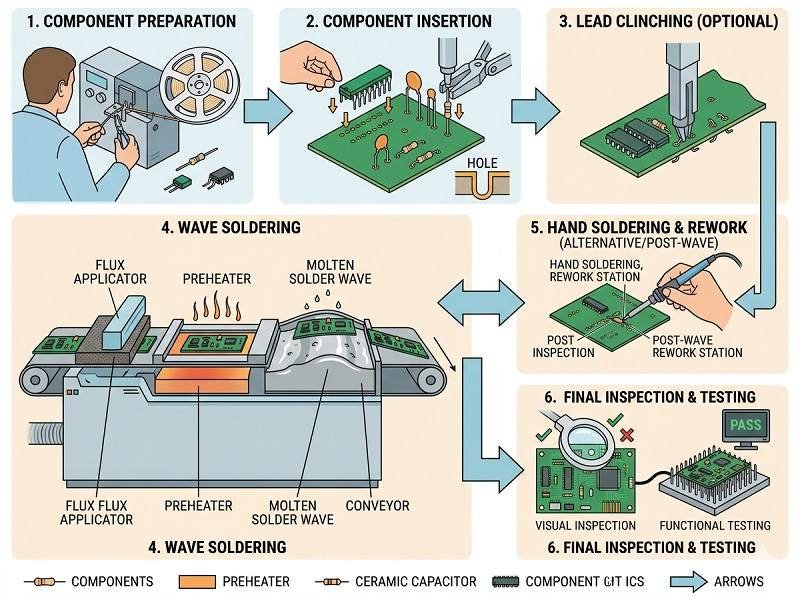
Overview of Through-Hole Assembly
In through-hole PCB Assembly:
- Component leads are inserted into pre-drilled holes
- Leads pass through the board and are soldered on the opposite side
- Connections are stronger compared to SMT-only designs
This method is commonly used in:
- Power electronics
- Equipamiento industrial
- Connectors and transformers
Through-Hole Assembly Process Flow
A standard through-hole PCB Assembly process includes:
- Component preparation
- Component insertion
- Lead trimming
- Soldering (wave or selective)
- Inspección y control de calidad
- Cleaning and finishing
Each step ensures reliability and structural strength.
Component Preparation
Before assembly begins:
- Components are checked for quality
- Leads may be pre-formed to fit hole spacing
- Parts are organized for efficient insertion
Proper preparation improves assembly efficiency and reduces errors.
Component Insertion
Components are inserted into the PCB:
- Manual insertion: used for low volume or complex boards
- Automated insertion: used in high-volume production
Operators or machines place components into designated holes based on assembly drawings.
Recorte de plomo
After insertion:
- Excess leads extending from the bottom of the PCB are trimmed
- Ensures proper soldering and prevents short circuits
This step prepares the board for the soldering process.
Soldering Methods
Soldadura por ola
The most common method in through-hole PCB Assembly:
- The PCB passes over a موجة من solder molten
- Solder attaches to exposed metal leads and pads
- Suitable for high-volume production
Soldadura selectiva
Used for mixed Montaje de PCB (SMT + through-hole):
- Solder is applied only to specific areas
- Prevents damage to nearby SMT components
Selective soldering offers higher precision.
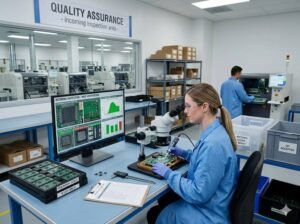
Inspección y control de calidad
After soldering, inspection ensures quality:
- Visual inspection for solder joints
- AOI (inspección óptica automatizada)
- X-ray inspection (if necessary)
Checks include:
- Proper wetting
- No cold joints
- No solder bridges
Cleaning Process
If required:
- Flux residues are removed
- Cleaning improves long-term reliability
This step is important for high-reliability applications.
Final Testing
Through-hole assembled boards may undergo:
- Pruebas eléctricas
- Pruebas funcionales
This verifies that the PCB Assembly performs as expected.
Advantages of Through-Hole Assembly
- Strong mechanical bonding
- High reliability in harsh environments
- Suitable for high-power and high-voltage applications
- Better resistance to vibration and thermal stress
Disadvantages Compared to SMT Assembly
- Higher labor cost
- Slower production speed
- Requires drilling holes (higher PCB cost)
- Lower component density
Because of these limitations, through-hole is often combined with Montaje SMT in modern designs.
Applications of Through-Hole PCB Assembly
- Sistemas de control industrial
- Electrónica del automóvil
- Aeroespacial y defensa
- Power supply units
- Large connectors and transformers
Through-Hole vs SMT Assembly
| Característica | Montaje pasante | Montaje SMT |
|---|---|---|
| Mounting method | Leads through holes | Surface mounting |
| Strength | Muy alta | Moderado |
| Automatización | Limitado | Highly automated |
| Coste | Más alto | Baja |
| Densidad | Baja | Más alto |
Conclusión
The through-hole assembly process remains a critical part of Montaje de PCB, especially for applications requiring strong mechanical connections and high reliability. Although Montaje SMT dominates modern electronics, through-hole technology continues to play an important role in mixed assembly designs.
Understanding both processes allows engineers and buyers to choose the right solution for performance, cost, and durability.
Permítanos ayudarle a optimizar costes y producción. Solicite hoy mismo un presupuesto de montaje de PCB.
Ofrecemos servicios profesionales de ensamblaje de placas de circuito impreso, incluyendo SMT, DIP y soluciones completas llave en mano.
✔ NDA disponible ✔ Presupuesto rápido en 24 horas ✔ Fábrica certificada ISO ✔ Servicio integral de PCB y PCBA.
 Español
  English
  Deutsch
  Français
  Português do Brasil
  日本語
日本語  Nederlands
  Italiano
  Русский
  한국어
한국어  العربية
  Svenska
  Polski
  Türkçe
  繁體中文
繁體中文