
Through-Hole Assembly Process
إن through-hole assembly process is a traditional but still widely used method in تجميع ثنائي الفينيل متعدد الكلور, where electronic components are inserted into drilled holes on a printed circuit board and then soldered to form strong mechanical and electrical connections. While modern manufacturing relies heavily on تجميع SMT, through-hole technology (THT) remains essential for components that require durability, high power handling, or mechanical stability.
Below is a detailed explanation of the through-hole PCB Assembly process.
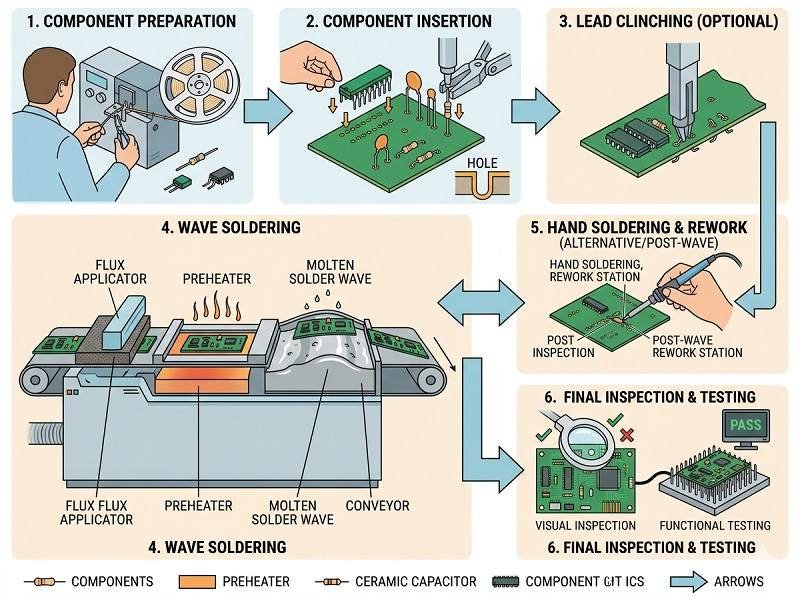
Overview of Through-Hole Assembly
In through-hole PCB Assembly:
- Component leads are inserted into pre-drilled holes
- Leads pass through the board and are soldered on the opposite side
- Connections are stronger compared to SMT-only designs
This method is commonly used in:
- Power electronics
- معدات صناعية
- Connectors and transformers
Through-Hole Assembly Process Flow
A standard through-hole PCB Assembly process includes:
- Component preparation
- Component insertion
- Lead trimming
- Soldering (wave or selective)
- الفحص ومراقبة الجودة
- Cleaning and finishing
Each step ensures reliability and structural strength.
Component Preparation
Before assembly begins:
- Components are checked for quality
- Leads may be pre-formed to fit hole spacing
- Parts are organized for efficient insertion
Proper preparation improves assembly efficiency and reduces errors.
Component Insertion
Components are inserted into the PCB:
- Manual insertion: used for low volume or complex boards
- Automated insertion: used in high-volume production
Operators or machines place components into designated holes based on assembly drawings.
تشذيب الرصاص
After insertion:
- Excess leads extending from the bottom of the PCB are trimmed
- Ensures proper soldering and prevents short circuits
This step prepares the board for the soldering process.
Soldering Methods
اللحام الموجي
The most common method in through-hole PCB Assembly:
- The PCB passes over a موجة من solder molten
- Solder attaches to exposed metal leads and pads
- Suitable for high-volume production
اللحام الانتقائي
Used for mixed تجميع ثنائي الفينيل متعدد الكلور (SMT + through-hole):
- Solder is applied only to specific areas
- Prevents damage to nearby SMT components
Selective soldering offers higher precision.
التفتيش ومراقبة الجودة
After soldering, inspection ensures quality:
- Visual inspection for solder joints
- الهيئة العربية للتصنيع (الفحص البصري الآلي)
- X-ray inspection (if necessary)
Checks include:
- Proper wetting
- No cold joints
- No solder bridges
Cleaning Process
If required:
- Flux residues are removed
- Cleaning improves long-term reliability
This step is important for high-reliability applications.
Final Testing
Through-hole assembled boards may undergo:
- الاختبار الكهربائي
- الاختبار الوظيفي
This verifies that the PCB Assembly performs as expected.
Advantages of Through-Hole Assembly
- Strong mechanical bonding
- High reliability in harsh environments
- Suitable for high-power and high-voltage applications
- Better resistance to vibration and thermal stress
Disadvantages Compared to SMT Assembly
- Higher labor cost
- Slower production speed
- Requires drilling holes (higher PCB cost)
- Lower component density
Because of these limitations, through-hole is often combined with تجميع SMT in modern designs.
Applications of Through-Hole PCB Assembly
- أنظمة التحكم الصناعي
- إلكترونيات السيارات
- الفضاء والدفاع
- Power supply units
- Large connectors and transformers
Through-Hole vs SMT Assembly
| الميزة | التجميع من خلال الفتحة العرضية | تجميع SMT |
|---|---|---|
| Mounting method | Leads through holes | Surface mounting |
| Strength | عالية جداً | معتدل |
| الأتمتة | محدودة | Highly automated |
| التكلفة | أعلى | أقل |
| الكثافة | أقل | أعلى |
الخاتمة
The through-hole assembly process remains a critical part of تجميع ثنائي الفينيل متعدد الكلور, especially for applications requiring strong mechanical connections and high reliability. Although تجميع SMT dominates modern electronics, through-hole technology continues to play an important role in mixed assembly designs.
Understanding both processes allows engineers and buyers to choose the right solution for performance, cost, and durability.
دعنا نساعدك على تحسين التكلفة والإنتاج. اطلب عرض أسعار تجميع ثنائي الفينيل متعدد الكلور اليوم.
نحن نوفر خدمات تجميع ثنائي الفينيل متعدد الكلور الاحترافية بما في ذلك SMT وDIP وحلول تسليم المفتاح الكاملة.
✔ إتاحة اتفاقية عدم الإفشاء ✔ عرض أسعار سريع في غضون 24 ساعة ✔ مصنع معتمد من ISO ✔ خدمة PCB و PCBA الشاملة
 العربية
  English
  Deutsch
  Français
  Português do Brasil
  Español
  日本語
日本語  Nederlands
  Italiano
  Русский
  한국어
한국어  Svenska
  Polski
  Türkçe
  繁體中文
繁體中文