
Método de medición del espesor del revestimiento
La medición del espesor del revestimiento es el proceso de determinar el espesor de Revestimiento conforme aplicado en una placa de circuito impreso en Montaje de PCB y Montaje SMT. Un grosor adecuado es fundamental para garantizar una protección eficaz sin interferir en el rendimiento eléctrico o la funcionalidad de los componentes.
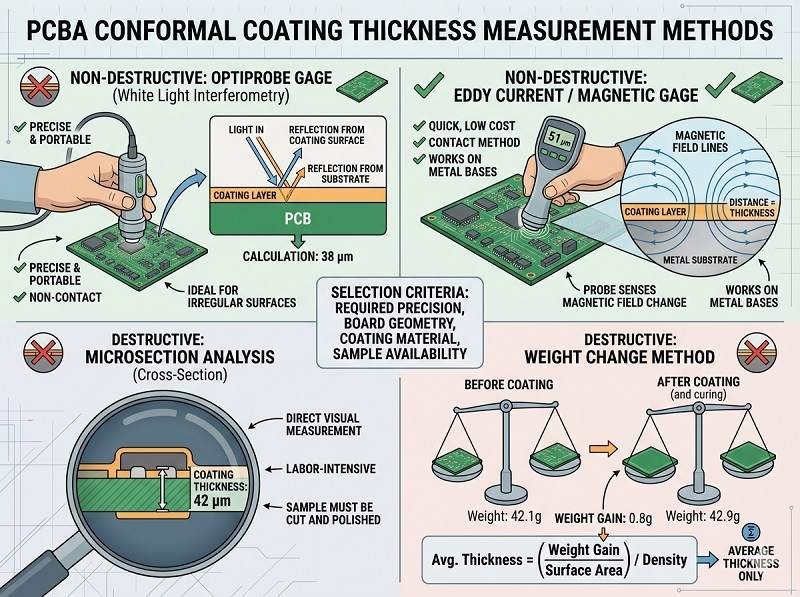
Por qué es importante medir el grosor
El grosor de Revestimiento conforme afecta directamente a su rendimiento.
Si es demasiado delgada:
- Protección insuficiente contra la humedad y los contaminantes
- Reducción del rendimiento del aislamiento
Si es demasiado espeso:
- Riesgo de agrietamiento o delaminación
- Posibles interferencias con conectores o piezas móviles
Una medición precisa garantiza una calidad óptima del revestimiento en Montaje de PCB.
Métodos habituales de medición del espesor de revestimientos
Medición del espesor de la película húmeda
Este método se utiliza inmediatamente después de la aplicación del revestimiento antes del curado.
Cómo funciona:
- Se coloca un medidor de película húmeda sobre la superficie recubierta
- El grosor se determina en función de los puntos de contacto
Ventajas:
- Rápido y sencillo
- Ayuda a ajustar los parámetros del proceso en tiempo real
Limitaciones:
- Sólo aplicable antes del curado
- Menos preciso que la medición en seco
Medición del espesor de la película seca
Realizado una vez curado el revestimiento, Este es el método más utilizado en Montaje SMT.
Los métodos incluyen:
Medición micrométrica
- Mide el grosor total antes y después del revestimiento
- Calcula el espesor del revestimiento por diferencia
Medición de espesor por ultrasonidos
- Utiliza ondas sonoras para medir el espesor del revestimiento
- No destructivo y preciso
Método de corrientes de Foucault
- Se utiliza para sustratos conductores
- Mide el espesor basándose en la respuesta electromagnética
Medición de la sección transversal
Cómo funciona:
- La placa de circuito impreso se corta para exponer una sección transversal
- El grosor se mide al microscopio
Ventajas:
- Muy preciso
- Útil para la validación de procesos
Desventajas:
- Método destructivo
- No apto para inspecciones rutinarias
Métodos de medición óptica
Avanzado Montaje de PCB Los procesos pueden utilizar sistemas ópticos:
- Medición láser
- Microscopía digital
- Sistemas automatizados de inspección
Proporcionan una gran precisión y son adecuados para Montaje SMT líneas.
Gamas típicas de grosor de revestimiento
Según el tipo de revestimiento:
- Acrílico: 25-75 micras
- Silicona: 50-200 micras
- Poliuretano: 25-100 micras
- Epoxi: 25-100 micras
Mantener el rango correcto garantiza la fiabilidad Revestimiento conforme rendimiento.
Factores que afectan al grosor
- Método de recubrimiento (pulverización, inmersión, cepillado, selectivo)
- Viscosidad del material de revestimiento
- Velocidad y presión de aplicación
- Condiciones medioambientales
Deben controlarse en Montaje SMT procesos.
Conclusión final
La medición del grosor del revestimiento es un paso fundamental del control de calidad. Montaje de PCB y Montaje SMT. Mediante el uso de métodos apropiados, como calibres de película húmeda, pruebas ultrasónicas y análisis de secciones transversales, los fabricantes pueden garantizar que Revestimiento conforme cumple los requisitos de rendimiento y fiabilidad.
Obtenga un presupuesto de revestimiento de conformación
¿Necesita un revestimiento especial? Envíenos sus archivos de PCB para su evaluación.
Envíenos sus requisitos y obtenga una respuesta rápida de nuestro equipo de ingenieros.
✔ Respuesta en 24 horas ✔ Soporte de ingeniería ✔ Producción en serie y a pequeña escala
Shenzhen Tengxinjie Electronics Co.



 Español
  English
  Deutsch
  Français
  Português do Brasil
  日本語
日本語  Nederlands
  Italiano
  Русский
  한국어
한국어  العربية
  Svenska
  Polski
  Türkçe
  繁體中文
繁體中文