
Verfahren zur Messung der Beschichtungsdicke
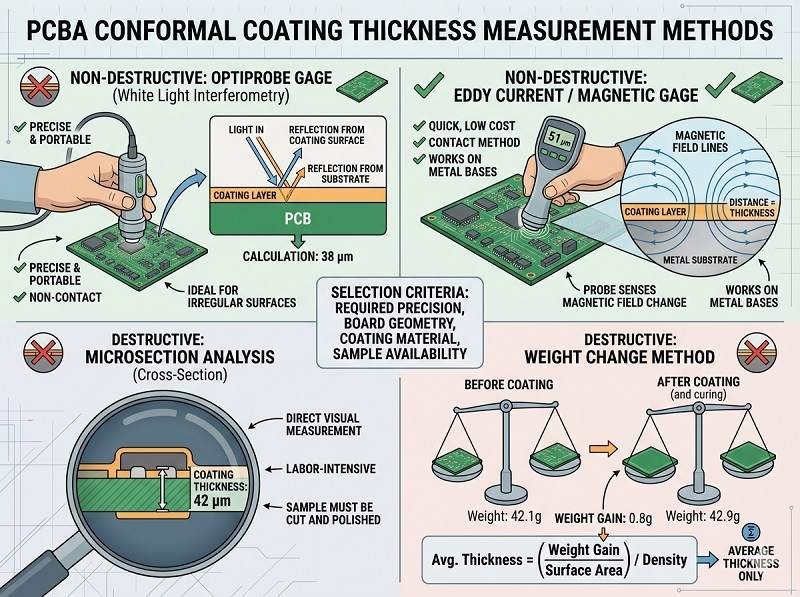
Die Messung der Schichtdicke ist der Prozess der Bestimmung der Dicke von Konforme Beschichtung aufgebracht auf eine Leiterplatte in PCB-Montage und SMT-Bestückung. Die richtige Dicke ist entscheidend, um einen wirksamen Schutz zu gewährleisten, ohne die elektrische Leistung oder die Funktionalität der Komponenten zu beeinträchtigen.
Warum Dickenmessung wichtig ist
Die Dicke der Konforme Beschichtung wirkt sich direkt auf seine Leistung aus.
Wenn zu dünn:
- Unzureichender Schutz vor Feuchtigkeit und Verunreinigungen
- Geringere Isolierleistung
Wenn zu dick:
- Risiko der Rissbildung oder Delaminierung
- Mögliche Interferenzen mit Steckern oder beweglichen Teilen
Genaue Messung gewährleistet optimale Beschichtungsqualität in PCB-Montage.
Gängige Methoden zur Messung der Schichtdicke
Messung der Nassschichtdicke
Diese Methode wird verwendet unmittelbar nach dem Auftragen der Beschichtung vor dem Aushärten.
Wie es funktioniert:
- Ein Nassfilmmessgerät wird auf der beschichteten Oberfläche angebracht
- Die Dicke wird anhand der Kontaktpunkte bestimmt
Vorteile:
- Schnell und einfach
- Hilft bei der Anpassung der Prozessparameter in Echtzeit
Beschränkungen:
- Nur vor der Aushärtung anwendbar
- Weniger genau als die Trockenmessung
Messung der Trockenschichtdicke
Durchgeführt nachdem die Beschichtung ausgehärtet ist, ist dies die am weitesten verbreitete Methode in SMT-Bestückung.
Die Methoden umfassen:
Mikrometer-Messung
- Misst die Gesamtdicke vor und nach der Beschichtung
- Berechnet die Schichtdicke anhand der Differenz
Dickenmessung mit Ultraschall
- Verwendet Schallwellen zur Messung der Schichtdicke
- Zerstörungsfrei und genau
Wirbelstromverfahren
- Verwendet für leitende Substrate
- Misst die Dicke auf der Grundlage der elektromagnetischen Reaktion
Querschnittsmessung
Wie es funktioniert:
- PCB wird geschnitten, um einen Querschnitt freizulegen
- Die Dicke wird unter einem Mikroskop gemessen
Vorteile:
- Sehr genau
- Nützlich für die Prozessvalidierung
Benachteiligungen:
- Zerstörende Methode
- Nicht für die Routinekontrolle geeignet
Optische Messmethoden
Fortgeschrittene PCB-Montage Verfahren können optische Systeme verwenden:
- Laser-Messung
- Digitale Mikroskopie
- Automatisierte Inspektionssysteme
Diese bieten eine hohe Präzision und eignen sich für automatisierte SMT-Bestückung Zeilen.
Typische Schichtdickenbereiche
Abhängig von der Art der Beschichtung:
- Acryl: 25-75 Mikrometer
- Silikon: 50-200 Mikrometer
- Polyurethan: 25-100 Mikrometer
- Epoxid: 25-100 Mikrometer
Die Beibehaltung des richtigen Bereichs gewährleistet eine zuverlässige Konforme Beschichtung Leistung.
Faktoren, die die Dicke beeinflussen
- Beschichtungsverfahren (Spritzen, Tauchen, Pinsel, selektiv)
- Viskosität des Beschichtungsmaterials
- Anwendungsgeschwindigkeit und Druck
- Umweltbedingungen
Diese müssen kontrolliert werden in SMT-Bestückung Prozesse.
Endgültige Schlussfolgerung
Die Messung der Schichtdicke ist ein wichtiger Schritt in der Qualitätskontrolle PCB-Montage und SMT-Bestückung. Durch den Einsatz geeigneter Methoden wie Nassfilmmessungen, Ultraschallprüfungen und Querschnittsanalysen können die Hersteller sicherstellen, dass Konforme Beschichtung die Anforderungen an Leistung und Zuverlässigkeit erfüllt.
Angebot für Conformal Coating einholen
Haben Sie spezielle Beschichtungsanforderungen? Senden Sie uns Ihre PCB-Dateien zur Bewertung.
Senden Sie uns Ihre Anforderungen und erhalten Sie eine schnelle Antwort von unserem technischen Team.
✔ 24-Stunden-Reaktion ✔ Technische Unterstützung ✔ Klein- und Massenproduktion
Shenzhen Tengxinjie Electronics Co, Ltd.

 Deutsch
  English
  Français
  Português do Brasil
  Español
  日本語
日本語  Nederlands
  Italiano
  Русский
  한국어
한국어  العربية
  Svenska
  Polski
  Türkçe
  繁體中文
繁體中文