
Cost Difference Between Prototype and Mass Production
In electronics manufacturing, understanding the cost difference between prototype and mass production is essential for budgeting, pricing, and product planning. Whether you are working with تجميع ثنائي الفينيل متعدد الكلور the cost structure changes significantly depending on production volume, process efficiency, and supply chain optimization.
Prototype production focuses on small quantities and flexibility, while mass production emphasizes efficiency, scale, and cost reduction. Below is a detailed breakdown of how and why their costs differ.
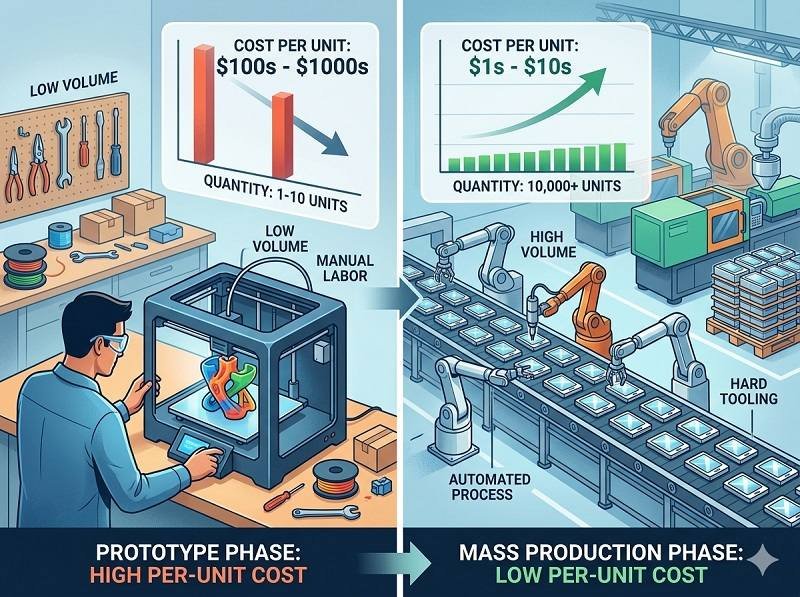
What is Prototype Production?
Prototype production refers to the manufacturing of a small number of units—often between 1 and a few hundred boards—for testing, validation, and design verification. In this stage, تجميع ثنائي الفينيل متعدد الكلور و تجميع SMT processes are optimized for flexibility rather than efficiency.
Prototypes are used to:
- Validate circuit design and functionality
- Identify potential design flaws
- Test performance before scaling production
- Support product development and iteration
Because of these goals, prototype PCB Assembly tends to have higher costs per unit.
What is Mass Production?
Mass production refers to manufacturing large quantities of PCBAs, often ranging from thousands to millions of units. At this stage, تجميع ثنائي الفينيل متعدد الكلور و تجميع SMT are fully optimized for speed, consistency, and cost efficiency.
Mass production focuses on:
- Reducing unit cost
- Increasing production efficiency
- Maintaining consistent quality
- Meeting large market demand
Due to economies of scale, the cost per unit drops significantly compared to prototype production.
Key Cost Differences Between Prototype and Mass Production
Unit Cost
The most obvious difference is the cost per unit:
- Prototype PCB Assembly: High cost per unit
- Mass PCB Assembly: Low cost per unit
In prototype runs, setup costs are spread over a small number of boards, making each unit more expensive. In mass production, these costs are distributed across thousands of units, reducing the per-unit price.
Setup and NRE (Non-Recurring Engineering) Costs
Both prototype and mass production involve setup costs, such as stencil creation, programming pick-and-place machines, and process calibration.
- In prototypes, NRE costs are significant relative to volume
- In mass production, NRE costs are diluted across large quantities
For example, stencil fabrication and SMT Assembly programming may cost the same whether you produce 10 boards or 10,000 boards, but the impact per unit is much lower in mass production.
Component Cost
Component pricing varies greatly based on order volume:
- Prototype: Components are purchased in small quantities, often at higher prices
- Mass production: Bulk purchasing reduces component cost significantly
Additionally, in mass production, EMS providers can negotiate better pricing with suppliers.
Labor and Assembly Efficiency
Prototype PCB Assembly often involves more manual work, adjustments, and engineering support:
- More manual soldering and inspection
- Frequent line changes and setup adjustments
- Lower automation efficiency
In contrast, mass production uses fully optimized تجميع SMT lines:
- High-speed automated placement
- Minimal manual intervention
- Continuous production runs
This dramatically reduces labor cost per unit.
Yield and Process Optimization
During prototype production, the process is still being refined:
- Higher risk of defects or rework
- Engineering time required for troubleshooting
In mass production:
- Processes are stabilized and optimized
- Higher yield and lower defect rates
- Reduced rework and waste
Improved yield directly lowers overall manufacturing cost.
Lead Time and Logistics
Prototype production often prioritizes speed over cost:
- Expedited component sourcing
- Faster turnaround times
- Higher logistics costs
Mass production allows for better planning:
- Optimized supply chain
- Lower shipping costs
- Scheduled production cycles
Example Cost Comparison
While actual costs vary depending on design complexity and region, a general comparison looks like this:
- Prototype PCB Assembly: High per-unit cost, low total volume
- Mass PCB Assembly: Low per-unit cost, high total volume but better overall value
For example, a PCB that costs $20–$50 per unit in prototype stage may drop to $2–$10 per unit in mass production, depending on volume and design.
Hidden Costs to Consider
Beyond direct manufacturing costs, there are additional factors:
Design Iteration Costs
Multiple prototype revisions can increase total development cost.
Inventory Risk
Mass production requires larger inventory investment, which carries risk if demand changes.
Quality Costs
Poor prototype validation can lead to costly issues during mass production.
How to Reduce Costs in Both Stages
To optimize costs for both prototype and mass production:
- Use Design for Manufacturability (DFM) principles
- Standardize components where possible
- Choose experienced PCB Assembly and SMT Assembly providers
- Plan for scalability from the beginning
- Optimize BOM for cost and availability
الخاتمة
The cost difference between prototype and mass production mainly comes down to scale, efficiency, and optimization. تجميع النموذج الأولي لثنائي الفينيل متعدد الكلور has a higher cost per unit due to low volume, higher setup impact, and less efficient processes. In contrast, mass production benefits from economies of scale, automated SMT Assembly, and optimized supply chains, resulting in significantly lower unit costs.
Understanding these differences helps businesses make informed decisions, control budgets, and successfully transition from prototype to full-scale production in electronics manufacturing.
Fast, reliable, and cost-effective PCB assembly solutions. Request your quote now.
نحن نوفر خدمات تجميع ثنائي الفينيل متعدد الكلور الاحترافية بما في ذلك SMT وDIP وحلول تسليم المفتاح الكاملة.
✔ إتاحة اتفاقية عدم الإفشاء ✔ عرض أسعار سريع في غضون 24 ساعة ✔ مصنع معتمد من ISO ✔ خدمة PCB و PCBA الشاملة
 العربية
  English
  Deutsch
  Français
  Português do Brasil
  Español
  日本語
日本語  Nederlands
  Italiano
  Русский
  한국어
한국어  Svenska
  Polski
  Türkçe
  繁體中文
繁體中文