
Detect coating defects
Detecting defects in Conformal Coating is essential to ensure reliability and performance in PCB Assembly and SMT Assembly. Even small coating issues can lead to moisture ingress, corrosion, or electrical failure. A combination of inspection methods is typically used in Turnkey PCB Assembly to identify and control defects effectively.
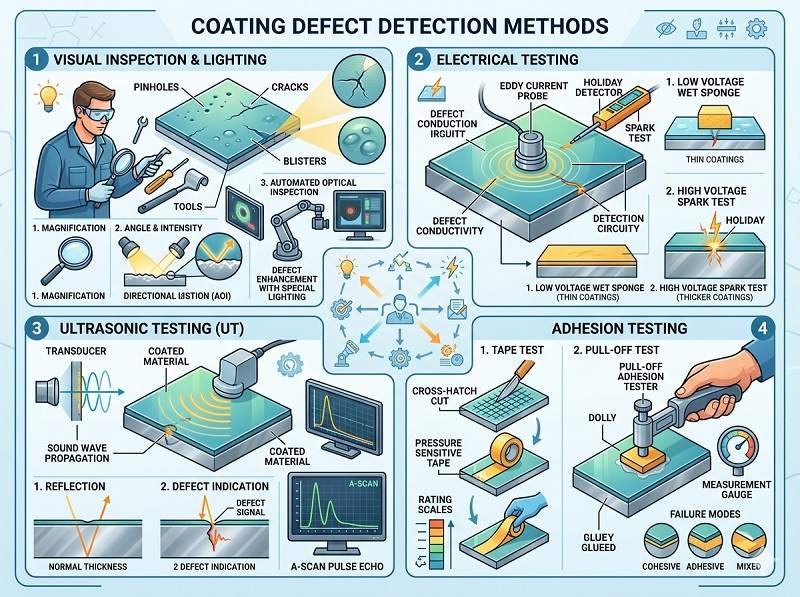
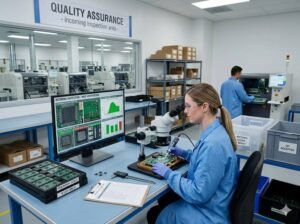
Visual inspection (basic method)
The simplest way to detect coating defects is through visual inspection:
- Use proper lighting and magnification
- Check for uneven coating, bubbles, or missed areas
- Identify overcoating on connectors or test points
Although basic, this method is still widely used as a first step in PCB Assembly quality control.
UV light inspection (most common method)
Many Conformal Coating materials include UV tracers:
- Coating glows under UV light
- Missing or thin areas appear dark
- Easy detection of coverage issues and contamination
This is one of the most efficient techniques in SMT Assembly lines for fast defect identification.
AOI (Automated Optical Inspection)
AOI systems provide automated and highly accurate detection:
- Detects insufficient or excessive coating
- Identifies bubbles, voids, and inconsistencies
- Compares results with programmed standards
AOI is commonly used in high-volume Turnkey PCB Assembly for consistent inspection results.
Thickness measurement
Defects are not always visible—thickness control is also important:
- Use wet film gauges during application
- Use dry film measurement tools after curing
- Ensure coating falls within typical range (25–250 µm)
Incorrect thickness can lead to performance issues even if coverage looks acceptable.
Functional and electrical testing
Some coating defects only appear during operation:
- Insulation resistance testing
- High-voltage testing (for leakage or breakdown)
- Environmental stress testing (humidity, temperature)
These tests verify whether Conformal Coating is performing correctly in real conditions.
Common coating defects to look for
- Bubbles and voids
- Cracking or peeling
- Delamination
- Shadowing (uncoated areas)
- Overcoating on critical parts
- Contamination under coating
Early detection helps reduce rework and improve yield in PCB Assembly.
Best practices for defect detection
- Combine multiple inspection methods (UV + AOI + visual)
- Standardize inspection criteria and procedures
- Train operators and maintain equipment
- Integrate inline inspection in SMT Assembly processes
Conclusion
Detecting coating defects requires a combination of visual, UV, automated, and functional inspection methods. In PCB Assembly, SMT Assembly, and Turnkey PCB Assembly, a robust inspection process ensures that Conformal Coating is applied correctly, preventing failures and improving overall product reliability.
Get a Conformal Coating Quote
Ready to start your conformal coating project? Fill out the form below to get started.
Send us your requirements and get a fast response from our engineering team.
✔ 24-hour response ✔ Engineering support ✔ Small & Mass Production
Shenzhen Tengxinjie Electronics Co., Ltd.
 English
  Deutsch
  Français
  Português do Brasil
  Español
  日本語
日本語  Nederlands
  Italiano
  Русский
  한국어
한국어  العربية
  Svenska
  Polski
  Türkçe
  繁體中文
繁體中文