
UV inspection for coating
UV inspection for coating is a quality control method used to verify the presence, coverage, and uniformity of Conformal Coating on a PCB using ultraviolet (UV) light. It is widely applied in PCB Assembly and SMT Assembly because it provides a fast, reliable, and non-destructive way to detect coating defects.
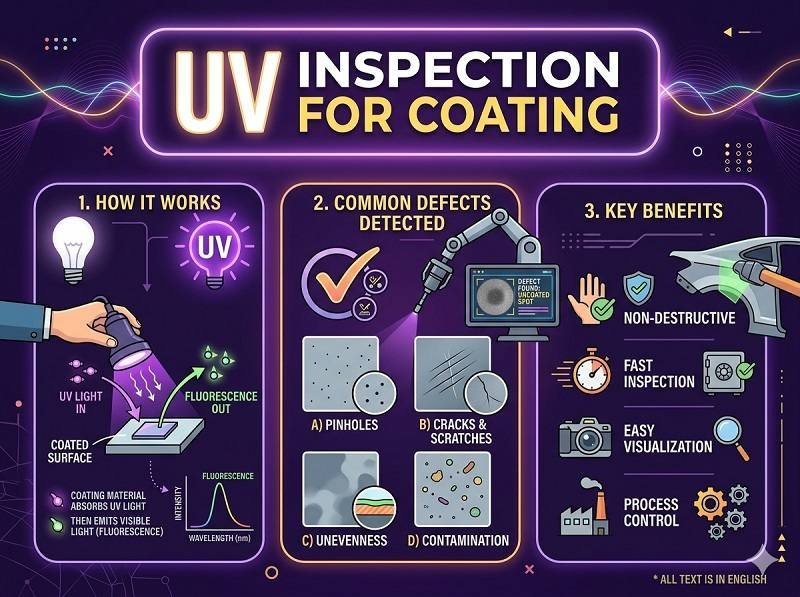
How UV inspection works
Most Conformal Coating materials used in manufacturing contain a UV fluorescent tracer. Under normal lighting, the coating may be transparent and difficult to see. However, when exposed to UV light:
- Coated areas glow or fluoresce
- Uncoated or thin areas appear dark
- Excess coating becomes highly visible
This makes it easy for operators or automated systems to quickly assess coating quality during Turnkey PCB Assembly.
What UV inspection checks
UV inspection helps identify several key issues:
- Incomplete coverage (missed areas)
- Uneven coating thickness
- Overcoating on connectors or test points
- Shadowing effects under components
- Bubbles, voids, or contaminants
In high-density SMT Assembly, this method is especially useful for detecting hidden defects that are difficult to see with the naked eye.
Advantages of UV inspection
- Fast and efficient → suitable for high-volume production
- Non-destructive → does not damage the PCB or coating
- High visibility → clearly highlights coating boundaries
- Easy integration → works with both manual and automated inspection systems
Because of these benefits, UV inspection is a standard step in many PCB Assembly lines.
Limitations to consider
- Requires coatings with UV tracer additives
- Cannot precisely measure coating thickness (often combined with other methods)
- May not fully reveal defects under very dense components
To overcome these limitations, UV inspection is often combined with AOI or thickness measurement in Turnkey PCB Assembly processes.
Applications of UV inspection
UV inspection is commonly used in:
- Consumer electronics
- Automotive electronics
- Industrial control systems
- Medical devices
- Aerospace electronics
In all these fields, ensuring correct Conformal Coating application is essential for long-term reliability.
Conclusion
UV inspection is a simple yet powerful method for verifying Conformal Coating quality. By making the coating visible under UV light, it allows manufacturers to quickly detect defects and ensure proper coverage. In PCB Assembly, SMT Assembly, and Turnkey PCB Assembly, UV inspection plays a key role in maintaining consistent quality and improving product reliability.
Get a Conformal Coating Quote
Not sure which conformal coating is right for your product? Contact our experts today.
Send us your requirements and get a fast response from our engineering team.
✔ 24-hour response ✔ Engineering support ✔ Small & Mass Production
Shenzhen Tengxinjie Electronics Co., Ltd.
 English
  Deutsch
  Français
  Português do Brasil
  Español
  日本語
日本語  Nederlands
  Italiano
  Русский
  한국어
한국어  العربية
  Svenska
  Polski
  Türkçe
  繁體中文
繁體中文