
Coating is used in aerospace PCBs
Aerospace electronics operate in some of the harshest environments—extreme temperatures, rapid pressure changes, vibration, and exposure to moisture or contaminants. Because of these conditions, Conformal Coating is essential in aerospace PCB Assembly and SMT Assembly to ensure long-term reliability and safety.
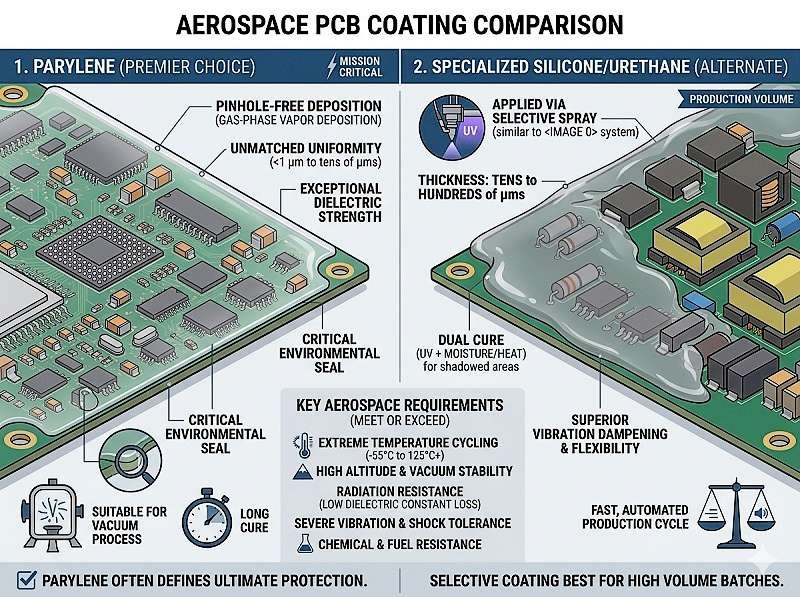
Most commonly used coatings in aerospace
There is no single universal coating, but the following types are most widely used in aerospace Turnkey PCB Assembly:
Parylene coating (top choice for critical systems)
Parylene is often considered the gold standard for aerospace applications.
- Ultra-thin, uniform, and pinhole-free coating (via vapor deposition)
- Excellent dielectric strength for high-reliability circuits
- Superior moisture and chemical resistance
- Performs well in extreme temperatures and vacuum conditions
Because of its reliability, parylene is commonly used in satellites, avionics, and mission-critical systems. The main drawback is its high cost and complex processing.
Silicone conformal coating (widely used)
Silicone Conformal Coating is another popular choice in aerospace PCB Assembly.
- Excellent thermal stability (wide temperature range)
- Flexible → withstands vibration and thermal cycling
- Good moisture resistance
- Strong performance in high-altitude environments
Silicone is often used in avionics, control systems, and power electronics where flexibility and temperature resistance are important.
Polyurethane coating (for chemical resistance)
Polyurethane coatings are used when chemical exposure is a concern.
- Good dielectric strength
- Strong resistance to fuels, solvents, and chemicals
- Durable in harsh industrial-like aerospace environments
However, they are less flexible than silicone and harder to rework.
Epoxy coating (for mechanical durability)
Epoxy Conformal Coating is sometimes used for:
- High mechanical strength
- Excellent adhesion and environmental resistance
But it is rigid, which makes it less suitable for applications with high vibration or thermal cycling.
Why aerospace requires advanced coatings
In aerospace SMT Assembly, coatings must address:
- Extreme temperature fluctuations (from very low to very high)
- Low pressure and vacuum conditions
- High vibration and mechanical stress
- Moisture and condensation during ground operations
- Long service life with minimal maintenance
Conformal Coating helps prevent corrosion, electrical leakage, and failure under these demanding conditions.
Standards and quality requirements
Aerospace coatings typically need to meet strict industry standards, such as:
- IPC-CC-830 (qualification and performance of coatings)
- MIL-I-46058 (military specification, now largely replaced but still referenced)
These standards are often required in certified Turnkey PCB Assembly processes for aerospace customers.
Conclusion
The most commonly used coatings in aerospace PCBs are parylene and silicone conformal coatings, with polyurethane and epoxy used in specific cases. In high-reliability PCB Assembly, SMT Assembly, and Turnkey PCB Assembly, coating selection depends on environmental conditions, mechanical stress, and performance requirements. For mission-critical aerospace systems, reliability always outweighs cost.
Get a Conformal Coating Quote
Have questions about conformal coating for your PCB? Our engineers are ready to help.
Send us your requirements and get a fast response from our engineering team.
✔ 24-hour response ✔ Engineering support ✔ Small & Mass Production
Shenzhen Tengxinjie Electronics Co., Ltd.
 English
  Deutsch
  Français
  Português do Brasil
  Español
  日本語
日本語  Nederlands
  Italiano
  Русский
  한국어
한국어  العربية
  Svenska
  Polski
  Türkçe
  繁體中文
繁體中文