
Is BGA Assembly
BGA assembly refers to the process of mounting and soldering Ball Grid Array (BGA) components onto a printed circuit board as part of PCB Assembly. BGA is a type of surface-mount packaging where the electrical connections are made through an array of tiny solder balls located on the underside of the component, rather than traditional pins or leads.
BGA assembly is widely used in modern electronics due to its ability to support high-density designs, improved electrical performance, and better thermal management. It is a critical part of advanced SMT Assembly processes.
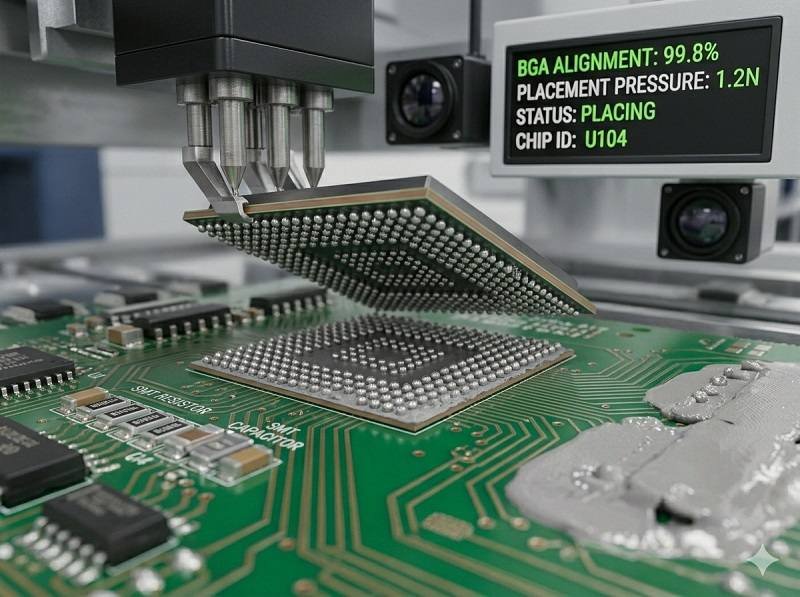
What is a BGA Component
A Ball Grid Array (BGA) component is an integrated circuit package that uses a grid of solder balls to connect to the PCB. These solder balls serve as both electrical connections and mechanical support.
Compared to traditional packages, BGAs offer more connection points in a smaller area, making them ideal for complex and compact devices such as smartphones, computers, and networking equipment.
BGA Assembly Process
The BGA assembly process involves several precise steps.
First, solder paste is applied to the PCB pads using a stencil. Accurate paste deposition is essential for proper solder joint formation.
Next, the BGA component is placed onto the PCB using high-precision pick-and-place machines. Proper alignment is critical because the solder joints are hidden underneath the component.
The board is then passed through a reflow oven. During this stage, the solder balls melt and fuse with the solder paste on the PCB pads, creating strong electrical connections.
Finally, the board is cooled, and the solder solidifies to form reliable joints.
Challenges in BGA Assembly
BGA assembly presents unique challenges compared to standard SMT Assembly.
One of the main challenges is that the solder joints are not visible after assembly, making inspection difficult. Specialized methods such as X-ray inspection are required to verify solder joint quality.
Alignment accuracy is also critical. Even slight misalignment can lead to defective connections.
Thermal management is another important factor. Proper reflow profiles must be used to ensure uniform heating and avoid defects such as voids or cold joints.
Inspection and Testing in BGA Assembly
Due to the hidden nature of BGA solder joints, advanced inspection techniques are used.
X-ray inspection is the most common method, allowing manufacturers to view solder joints beneath the component.
Automated optical inspection (AOI) may also be used for surrounding components, while functional testing ensures the overall performance of the assembled board.
These inspection methods are essential for maintaining quality in PCB Assembly involving BGAs.
Role of SMT Assembly in BGA Assembly
BGA assembly is a specialized part of SMT Assembly. It relies heavily on precise equipment, including advanced pick-and-place machines and controlled reflow soldering processes.
SMT Assembly enables the accurate placement and soldering required for BGA components, supporting high-density and high-performance designs.
BGA Assembly in Turnkey PCB Assembly
In Turnkey PCB Assembly, BGA assembly is managed as part of a complete manufacturing solution. The provider handles PCB Manufacturing, component sourcing, stencil design, SMT Assembly, and inspection.
This integrated approach ensures that all aspects of the process are optimized for BGA components, reducing defects and improving reliability.
Advantages of BGA Assembly
BGA assembly offers several advantages.
It supports higher pin density, allowing more connections in a smaller footprint.
It improves electrical performance by reducing inductance and resistance.
It enhances thermal performance, as heat can dissipate through the solder balls and PCB.
It also provides better mechanical stability compared to traditional leaded packages.
Applications of BGA Assembly
BGA assembly is widely used in advanced electronic products.
Applications include consumer electronics such as smartphones and laptops, as well as networking equipment, automotive electronics, and industrial systems.
It is especially important in high-performance devices that require compact design and reliable connections.
Best Practices for BGA Assembly
To achieve successful BGA assembly, manufacturers should follow best practices.
Ensure accurate stencil design and solder paste application.
Use high-precision placement equipment for proper alignment.
Optimize reflow temperature profiles to avoid defects.
Implement X-ray inspection for quality assurance.
Work with experienced PCB Assembly providers who specialize in SMT Assembly and BGA technology.
Conclusion
BGA assembly is a critical process in modern PCB Assembly, enabling high-density, high-performance electronic designs. As part of advanced SMT Assembly, it requires precision, specialized equipment, and rigorous inspection.
When integrated into Turnkey PCB Assembly and PCB Manufacturing processes, BGA assembly ensures reliable performance and supports the production of complex electronic products at scale.
Your PCB assembly solution starts here. Click below to request a quote.
We provide professional PCB assembly services including SMT, DIP, and full turnkey solutions.
✔ NDA Available ✔ Fast Quotation Within 24 Hours ✔ ISO Certified Factory ✔ One-stop PCB & PCBA Service

 English
  Deutsch
  Français
  Português do Brasil
  Español
  日本語
日本語  Nederlands
  Italiano
  Русский
  한국어
한국어  العربية
  Svenska
  Polski
  Türkçe
  繁體中文
繁體中文