
Akrilik ve silikon HumiSeal kaplamalar arasındaki fark
Akrilik ve silikon HumiSeal kaplamalar en yaygın kullanılan iki yöntemdir Konformal Kaplama içinde türleri PCB Montajı, Prototip PCB Montajı, ve SMT Montajı. Her ikisi de neme, toza ve kirletici maddelere karşı koruma sağlarken, önemli ölçüde farklılık gösterirler performans, esneklik, maliyet ve uygulama senaryoları.
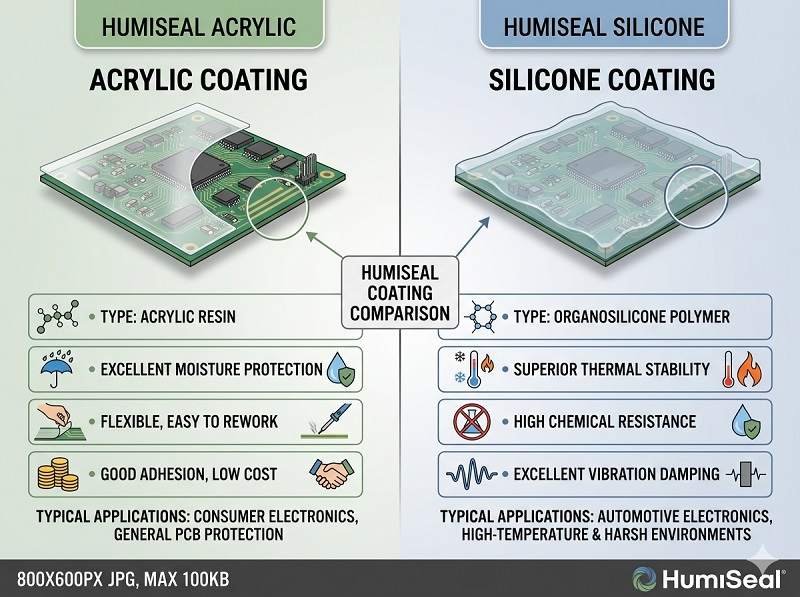
Temel fark: malzeme özellikleri
Temel ayrım kimyasal yapılarında yatmaktadır:
- Akrilik kaplamalar (AR) → sert, şeffaf, hızlı kuruyan polimerler
- Silikon kaplamalar (SR) → yumuşak, kauçuk benzeri, oldukça esnek malzemeler
Akrilik kaplamalar kürlenerek sert koruyucu tabaka, silikon kaplamalar kalırken elasti̇k ve esnek.
Kurutma hızı ve proses verimliliği
Akrilik kaplamalar şu özellikleriyle bilinir hızlı kuruma ve kolay işleme, Bu da onları yüksek hız için ideal hale getirir SMT Montajı üretim hatları. Dakikalar içinde kuruyabilir ve uygulaması kolaydır.
Silikon kaplamalar tipik olarak şunları gerektirir daha uzun kürlenme süresi, Özellikle nemle kürleme söz konusuysa, bu durum üretim verimini yavaşlatabilir.
Esneklik ve titreşim direnci
Bu en önemli farklardan biridir:
- Akrilik → nispeten sert, titreşim veya termal döngü altında çatlayabilir
- Silikon → son derece esnektir, gerilimi emer ve çatlamaya karşı dirençlidir
Silikon kaplamalar aşağıdakilerin bulunduğu ortamlar için daha uygundur mekanik stres, titreşim veya termal genleşme.
Sıcaklık direnci
Akrilik kaplamalar şu alanlarda iyi performans gösterir orta sıcaklık aralıkları (tipik olarak ~120°C'ye kadar).
Silikon kaplamalar şunları sunar mükemmel yüksek ve düşük sıcaklık direnci, ve genellikle -55°C ila 200°C veya daha yüksek, Bu da onları zorlu ortamlar için ideal hale getirir.
Kimyasal ve çevresel direnç
- Akrilik → iyi nem koruması, ancak sert kimyasallara karşı sınırlı direnç
- Silikon → kimyasallara, neme ve zorlu ortamlara karşı güçlü direnç
Silikon kaplamalar aşağıdakiler için tercih edilir otomotiv, havacılık ve dış mekan elektroniği uzun süreli dayanıklılığın kritik olduğu yerlerde.
Yeniden işleme ve onarım
İçinde PCB Montajı, yeniden işleme kabiliyeti çok önemlidir:
- Akrilik → çıkarması ve onarması kolay yaygın çözücüler kullanarak
- Silikon → çıkarılması daha zor, özel süreçler gerektirir
Bu, akrilik kaplamaları aşağıdakiler için son derece uygun hale getirir Prototip PCB Montajı, sık sık değişiklik yapılması gereken yerlerde.
Maliyet ve üretimle ilgili hususlar
- Akrilik → daha düşük maliyet + daha hızlı işlem
- Silikon → daha yüksek maliyet + daha iyi performans
Yüksek hacim için SMT Montajı, akrilik genellikle maliyet verimliliği için seçilirken, performans gereksinimleri daha yüksek maliyeti haklı çıkardığında silikon kullanılır.
Tipik uygulamalar
Akrilik HumiSeal kaplamalar (örn. 1B31):
- Tüketici elektroniği
- LED sürücüler ve güç kaynakları
- Genel amaçlı PCB Montajı
- Prototip PCB Montajı (kolay yeniden çalışma)
Silikon HumiSeal kaplamalar:
- Otomotiv elektroniği
- Havacılık ve uzay sistemleri
- Dış mekan ve yüksek nemli ortamlar
- Yüksek sıcaklık uygulamaları
Özet karşılaştırma
| Özellik | Akrilik Kaplama | Silikon Kaplama |
|---|---|---|
| Kurutma hızı | Çok hızlı | Daha yavaş |
| Esneklik | Düşük ila orta | Çok yüksek |
| Sıcaklık direnci | Orta düzeyde | Mükemmel |
| Kimyasal direnç | Orta düzeyde | Yüksek |
| İşlenebilirlik | Kolay | Zor |
| Maliyet | Daha düşük | Daha yüksek |
| En iyi kullanım | Standart elektronik | Zorlu ortamlar |
Son bilgiler
Akrilik ve silikon HumiSeal kaplamalar arasında “herkese uyan tek bir seçenek” yoktur.
- Seçin akri̇li̇k kaplamalar için uygun maliyetli, hızlı ve yeniden işleme dostu içinde çözümler PCB Montajı ve SMT Montajı
- Seçin si̇li̇kon kaplamalar için zorlu ortamlar, yüksek güvenilirlik ve uzun süreli dayanıklılık
Uygulamada, birçok üretici her iki seçeneği de Prototip PCB Montajı Seri üretim için en uygun kaplamayı seçmeden önce.
Konformal Kaplama Teklifi Alın
Ürününüz için hangi konformal kaplamanın doğru olduğundan emin değil misiniz? Uzmanlarımızla bugün iletişime geçin.
İhtiyaçlarınızı bize gönderin ve mühendislik ekibimizden hızlı bir yanıt alın.
✔ 24 saat yanıt ✔ Mühendislik desteği ✔ Küçük ve Seri Üretim
Shenzhen Tengxinjie Electronics Co, Ltd.
 Türkçe
  English
  Deutsch
  Français
  Português do Brasil
  Español
  日本語
日本語  Nederlands
  Italiano
  Русский
  한국어
한국어  العربية
  Svenska
  Polski
  繁體中文
繁體中文